Why Do Many Small DC Motors Specifically Have Three Commutator Segments?
Table of Contents
1. Three segments: the first design that behaves like a real product
A two-segment commutator works in a classroom drawing. It does not behave nicely in a cheap consumer product.
With two segments and two coils, the brushes see 180° spacing between gaps. When both brushes hit gaps at the same time, you get either:
- almost no torque (coil effectively disconnected), or
- a nasty short across the supply and both coils, depending on geometry and timing.
That gives you:
- Dead spots where the rotor simply refuses to start.
- Hot brushes and commutator edges.
- Brutal EMI when the inductive path is snapped open.
Practical references on commutators explicitly note that real motors need at least three commutator segments to avoid a “dead” position where both brushes bridge just two segments and no useful torque appears.
Engineers answering the same question in technical forums make the same point in fewer words:
“Practical motors need at least 3 segments (and coils) to ensure startup from any position.”
So three segments is simply the smallest configuration that:
- starts from any rotor angle with decent probability, and
- doesn’t destroy itself via repeated short circuits and arcing.
From “demo toy on a bench” to “small motor that must always start in a razor or a pump”, that’s a hard requirement.
2. How three segments fix the two-segment pain points
Now picture a three-pole armature with three commutator segments and the usual two brushes:
- Segments are 120° apart mechanically.
- Brushes are still 180° apart.
When one brush is passing over a gap, the other brush is sitting fully on the third segment. Result:
- You don’t get both brushes shorting the entire commutator at once.
- You don’t fully interrupt current through all coils at the same instant.
- Sparking and radiated noise drop noticeably compared with the minimal two-segment lab motor.
From the commutation perspective, three segments are the first point where:
- At least one active coil almost always has a usable torque angle.
- The commutation “window” is wide enough that production tolerances, brush wear, and slight magnet asymmetry do not completely break start-up behavior.
That’s why you see three-coil, three-segment permanent-magnet micromotors called out explicitly in motor design texts as the default cylinder-type toy motor structure.

3. Why so many stay at three segments instead of adding more
For large industrial DC machines, nobody stops at three segments. Segment count scales with voltage, speed, and torque ripple requirements. It’s normal for big machines to use dozens of segments, with the segment count equal or related to coil count in the armature winding.
Small motors play a different game. A few things dominate:
3.1 Winding and assembly cost
Every added commutator segment implies:
- extra connection points between coils and copper bars
- more chance of a bad weld / solder joint
- slightly trickier tooling and alignment of the commutator stack
For a high-volume toy-grade motor, you might be shipping tens of millions of units. The industry has a very optimized tooling ecosystem around three-slot armatures with three coils and a three-segment commutator. Changing that raises:
- Capex for new winding machines and jigs
- Scrap rates during ramp-up
- QA complexity (more points to check, more resistance-matching between segments, etc.)
From a buyer’s point of view, those costs land right in your BOM and yield-loss discussions.
3.2 Torque ripple vs. “good enough”
Yes, more commutator segments can flatten torque ripple. Classic comparison plots show cleaner torque for 32 segments than for 4, and so on.
But look at how these motors are actually used:
- Toy car running at thousands of rpm on alkaline cells
- Small fan inside an appliance
- Motorized valve that moves briefly and stops
At those use cases, the jump from 2 → 3 segments is huge (no more dead spots, less arcing). The jump from 3 → 5 or 7 segments is much smaller and often invisible at the system level once gearbox, inertia, and plastic backlash are in the path.
So the industry tends to accept:
- slightly higher torque ripple
- in exchange for
- lower part count, simpler winding, and mature supply chains at three segments.
3.3 Space and geometry inside tiny cans
On very small diameters, cram too many segments onto the shaft and you run into:
- Minimum copper bar width before the segment becomes fragile
- Minimum mica / insulation thickness between segments
- Limits on brush width vs. gap size (you still need each brush wider than the gap for reliable contact)
In other words: more segments do not scale down forever. At some point the geometry defeats you, and three segments sit near a sweet spot for many common frame sizes.
4. Three segments as a de-facto standard module
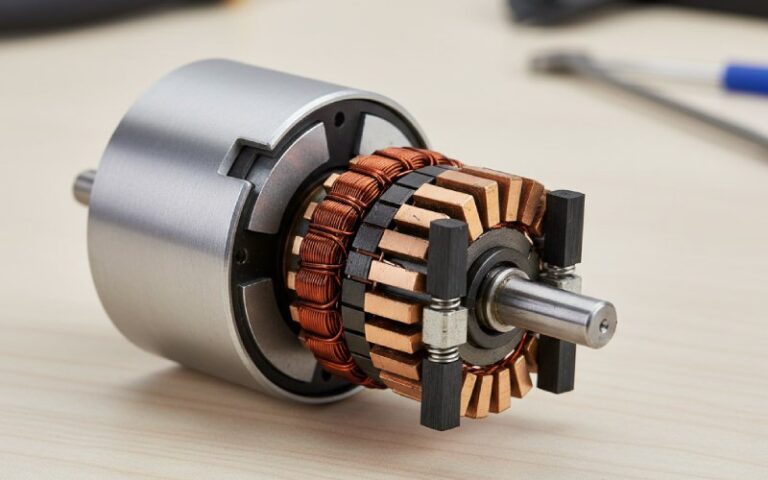
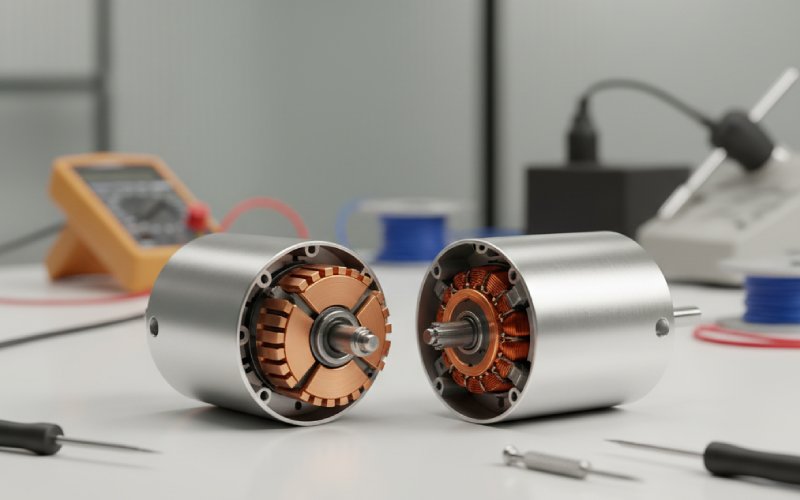
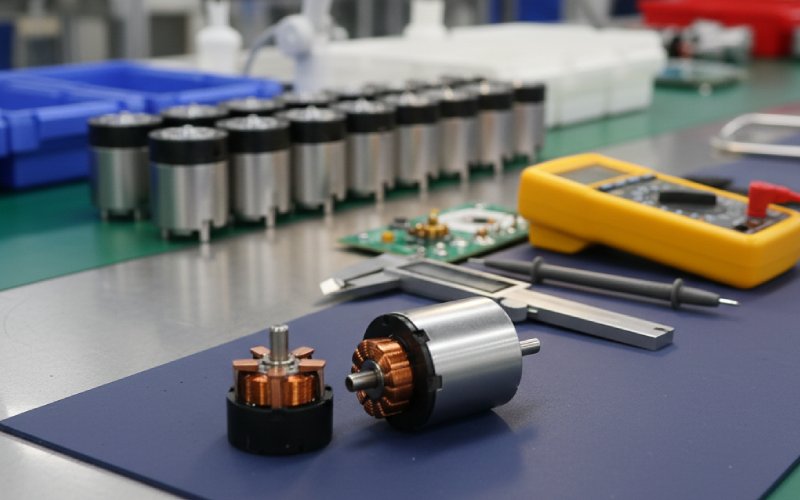
Open a random cheap gadget with a brushed motor. Inside you will often find a cylindrical permanent-magnet micromotor whose:
- armature is a three-coil lap winding
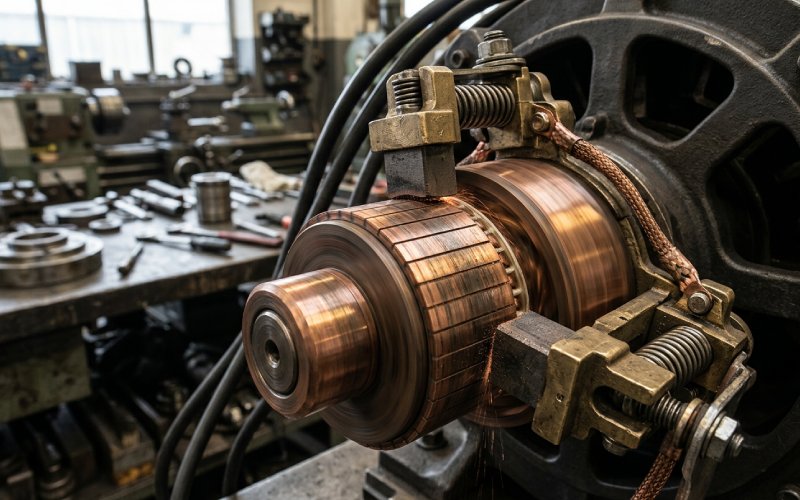
- connected to a three-segment commutator
- working against a two-pole ferrite stator magnet.
Once that pattern spread across toys, small pumps, blowers, and low-end automotive accessories, it became its own ecosystem:
- Tooling and know-how for 3-slot armatures are everywhere.
- Many factories can swap in alternative wire gauges, shaft shapes, or magnet grades without touching the underlying three-segment architecture.
- Testing jigs, balancing fixtures, and commutator trimming tools are all standardized around this format.
So even if an application could benefit from, say, five segments, the global availability and unit cost of three-segment motors often win the argument, especially for B2B buyers focused on cost and lead time.
5. Quick comparison: 2 vs 3 vs “many” segments
From a sourcing or design decision point of view, it’s handy to see the coarse trade-offs:
| Commutator segment count | Start-up from any position | Torque ripple | EMI & brush stress | Cost / complexity (small motors) | Typical usage |
|---|---|---|---|---|---|
| 2 segments | Poor – real dead spots; needs “kick” or bias | Very high | High arcing risk, brush shorting possible | Low copper count but not manufacturable at scale for serious products | Demonstration motors, kits, teaching models |
| 3 segments | Good – starts from almost any angle in practice | Moderate; acceptable for most toy / appliance loads | Much lower spark energy vs 2-segment; EMI manageable with simple capacitors | Very cost-optimized for high volume; mature tooling | Toys, fans, pumps, small PM DC motors, low-cost automotive accessories |
| 5+ segments | Very good – many active coils at any time | Lower torque ripple; smoother speed control | Better commutation, less brush heating at same power | More expensive commutator, more coils, more QA steps | Larger DC machines, higher-end brushed motors, applications sensitive to speed ripple |
For a lot of “commodity” use cases, that middle column is exactly where you want to be.
6. What engineers and buyers should actually ask about
When the motor spec sheet simply says “3-pole DC motor, 3-segment commutator”, what do you still need to probe?
For engineers
You already accept the three-segment structure. The questions drift elsewhere:
- Commutation quality
- Brush material and spring force
- Commutator bar run-out and surface finish
- Any built-in suppression (capacitors, chokes) for EMI control
- Winding data
- Turns per coil, wire gauge, and thermal class
- Resistance matching between segments (imbalance shows up as torque ripple and noise)
- Thermal and mechanical limits
- Maximum continuous current before commutator softening
- Maximum safe speed before mechanical stress on segments becomes an issue
The commutator segment count is just the starting point. The execution details decide whether your motor quietly runs a tiny pump or chews through brushes in a few weeks.
For purchasing
Different angle, same hardware:
- Is this a standard 3-segment platform in the factory? If they already produce similar 3-segment motors for other customers, you get better lead time and lower NRE.
- What’s the commutator material and plating? Copper alloy, plating type, and bar hardness all influence life and cost.
- Failure pattern data Ask how many field returns are related to commutator wear, burning, or segment cracking. That tells you whether the 3-segment design is mature or just cheap.
- Test coverage Do they test resistance between adjacent segments, run-out, and basic spark level on every batch? Or only at development?
The nice thing about the three-segment choice is that it’s well understood. You’re not paying for experimental geometry.
7. FAQ: three-segment commutator questions that keep coming back
Q1. Why not just specify “more segments for smoother torque” on small motors?
Because every added segment raises cost, process complexity, and failure points, while the torque benefit gets washed out by gearbox play, load inertia, and low-precision mechanics in typical small-motor systems. In many cheap devices the torque ripple of a 3-segment design is already hidden by the rest of the mechanics.
Q2. Are all small brushed DC motors three-segment?
No. There are plenty of small motors with more segments, especially where speed stability or low acoustic noise matters (instrumentation, high-end fans, some automotive modules). But in toys and low-cost appliances, the three-coil / three-segment permanent-magnet motor is by far the most common pattern.
Q3. Does three segments guarantee start-up from any position?
Not mathematically, but in practice it’s close enough when combined with reasonable brush width and magnet strength. The key is that with three segments and three coils, there’s almost always at least one coil producing torque in a usable direction, and no complete loss of current when both brushes cross gaps.
Q4. What breaks first when a 3-segment motor is abused?
Very often:
Brushes wear or chip
Commutator edges burn and erode
Welds between coil ends and commutator bars fatigue or crack
Those are all stress points tied to commutation. Segment count affects them indirectly, but for small motors the implementation details (brush grade, cooling, connection quality) matter more than switching from 3 to 5 segments.
Q5. When should I actively avoid a three-segment commutator?
A few cases:
You need tight speed regulation at low speed with low inertia and no gearbox (precision tape drives, some metering applications).
Your application has strict EMI limits and will run near sensitive RF circuitry; more segments plus better suppression can make life easier.
You expect long life at high current density; the extra contact events of more segments can actually reduce per-event stress.
In those situations, it’s worth stepping up to motors with more commutator segments or skipping mechanical commutation altogether and moving to brushless.
8. Short summary
- Two-segment commutators are fine for blackboard drawings, but they have dead spots and punishing arcing in real hardware.
- Three segments are the smallest structure that gives reliable start-up from almost any rotor angle and keeps EMI under control with simple suppression parts.
- For small DC motors, three segments hit a manufacturing and performance sweet spot: easy winding, mature tooling, acceptable torque ripple, and global availability.
So when you keep seeing the phrase “three-segment commutator” in small-motor specs, it isn’t just tradition. It’s the minimum structure that behaves like a real product, not a lab toy, while still keeping your BOM and process headaches under control.