Why Do Some Motors Have Multiple Brushes per Polarity?
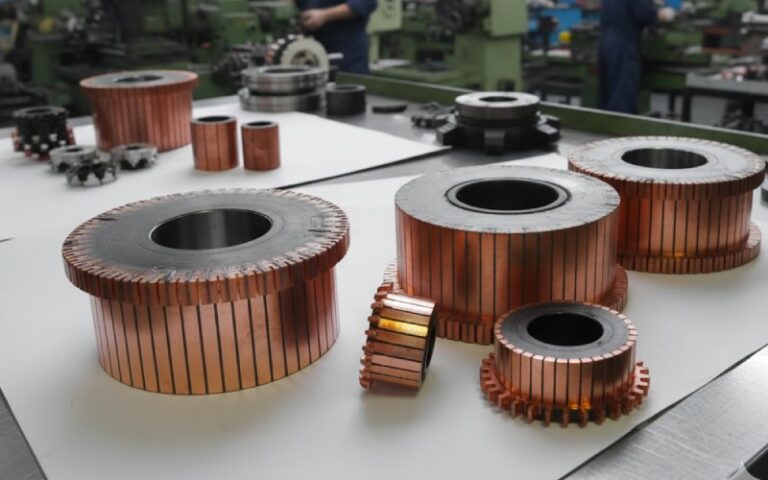
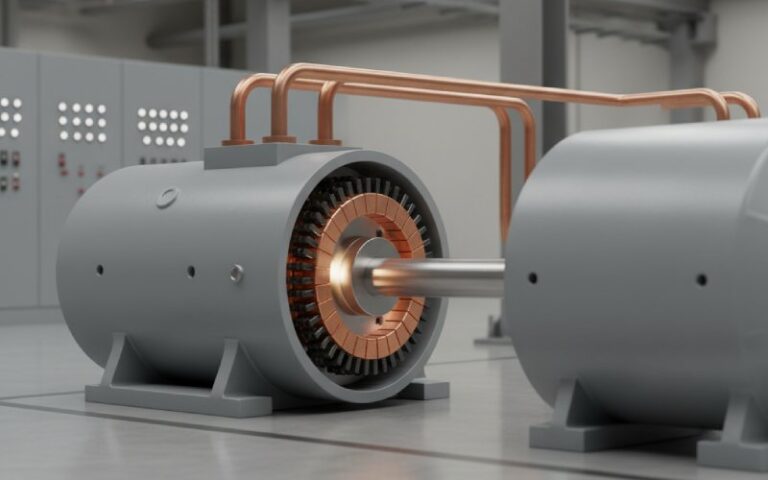
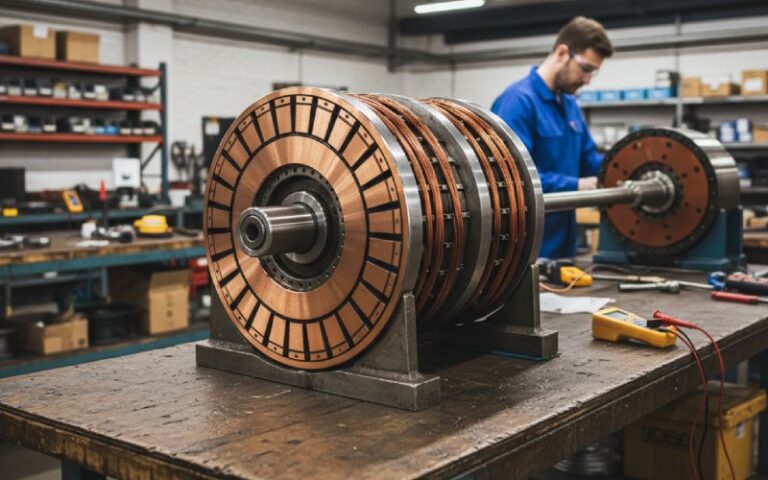
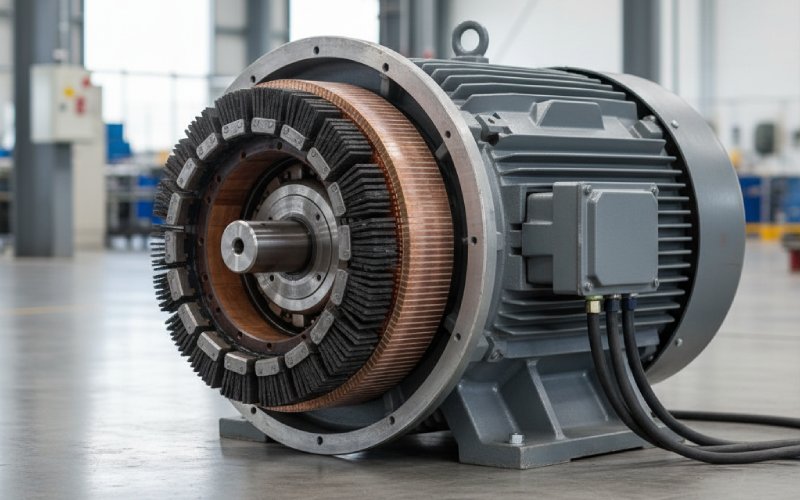
Walk up to a big DC motor or an older universal motor and you’ll sometimes see it: not one positive brush and one negative, but whole clusters of brush blocks. Several “+” brushes. Several “–” brushes. Same polarity, repeated.
This isn’t cosmetic. It’s the result of a bunch of design constraints colliding: current density, commutation physics, mechanical layout, and maintenance reality.
Table of Contents
The one-line answer
Short version:
Motors get multiple brushes per polarity because a single brush cannot safely carry the required current, share it evenly across armature parallel paths, keep commutation clean, and survive mechanically at the required speed and duty.
So designers slice the job into smaller pieces: more brush faces, more holders, same polarity bus.
What “multiple brushes per polarity” actually looks like
Different cases show up in the field:
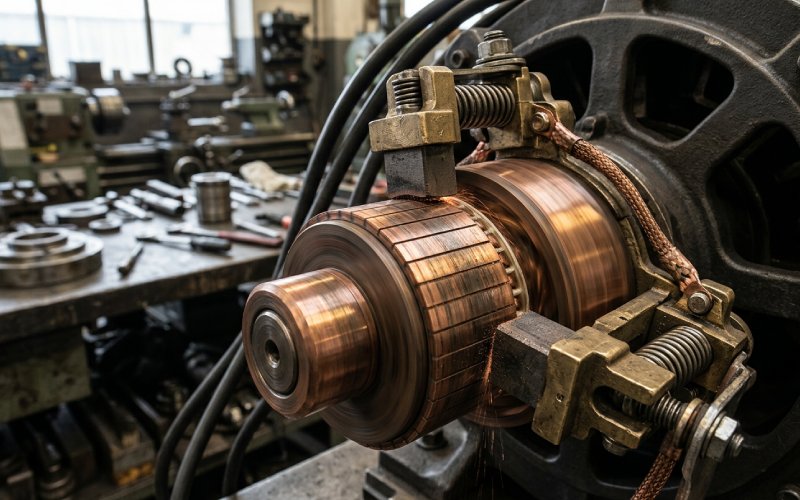
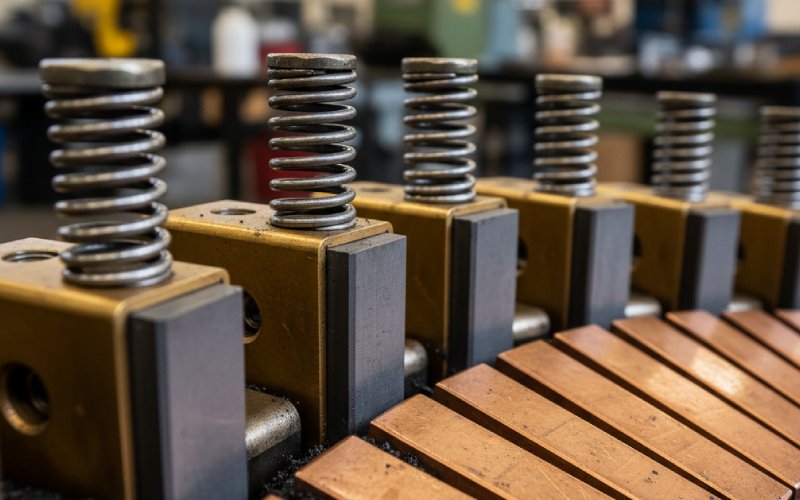
- Multi-brush per pole on a large DC machine Several carbon blocks sit side-by-side in one holder arm, all tied to the same positive or negative terminal. Often 2–4 brushes per arm, several arms around the commutator.
- Lap-wound armatures with many poles Lap windings have as many parallel paths (and thus brushes) as poles, so a 6-pole motor will naturally want 6 brush positions. Half are positive, half negative, sometimes doubled up mechanically.
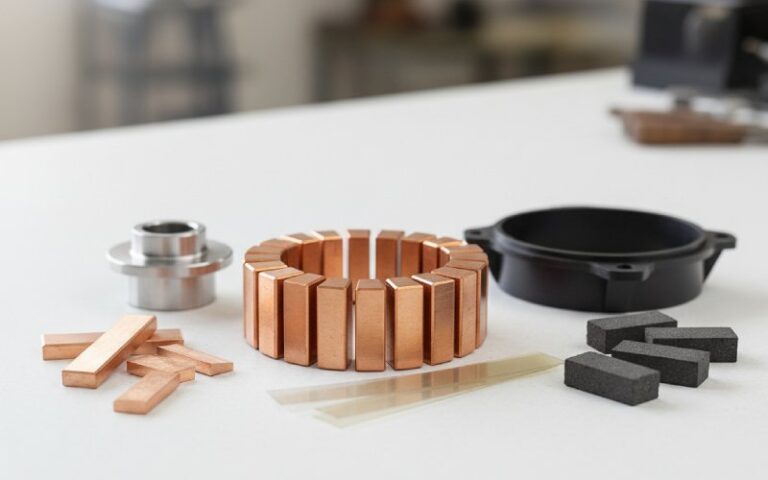
- Multi-wafer or split brushes One “brush” body is actually several narrow wafers electrically in parallel. This gives several micro-contacts instead of one big chunk and helps with film control and commutation.
All of these fall under the same question: why not just one big brush for each polarity and be done?
Let’s unpack that.
1. Current density limits: the real driver
Carbon and metal-graphite brushes are great sliding contacts, but they have clear current-density limits. Typical data sheets give you numbers like:
- Carbon / carbographitic: ~8–16 A/cm² continuous, modest speeds.
- Electrographite: ~8–12 A/cm² continuous, up to 20–25 A/cm² short peaks, and high peripheral speed.
- Copper / metal-graphite: roughly 10–30 A/cm² continuous, with peaks up to ~100 A/cm² for some grades.
Brush guides also point out that current density strongly influences brush wear, friction and temperature.
So for a quick mental check:
- Say your motor armature needs 400 A at rated load.
- You pick a carbon brush with a contact face of 3 cm².
- You decide to stay around 10 A/cm² continuous.
One brush then safely carries about 3 cm² × 10 A/cm² = 30 A.
To carry 400 A, you’d need around 400 A / 30 A ≈ 13.3 → 14 brushes sharing the current.
Split across polarities, that’s seven positive and seven negative (ignoring exact winding layout). That’s why you walk around a big machine and see a whole ring of brushes instead of two giant ones.
Designers could make brushes physically larger, of course. But that runs into the next constraint.
2. Why not just one huge brush bar?
A wide single brush looks simple, but it performs badly in real hardware:
- Contact pressure control gets ugly Spring systems like a nice, compact footprint. Make the brush very wide and it’s hard to keep uniform pressure across the entire commutator arc, so you get uneven wear and hot spots. Brush-holder standards talk about clearances and spring forces for a reason.
- Surface conformity Commutators are never perfectly round. Multiple smaller brushes can “float” over small runout and misalignment. One big bar tends to rock, losing contact in parts of the face and arcing elsewhere.
- Serviceability Global commutator references explicitly mention that, when more than one brush is required, assemblies with multiple brushes are mounted in parallel to distribute current evenly and allow replacing a brush without stopping the equipment. One huge brush would force a shutdown and re-bedding for every change.
- Redundancy With multi-brush arrangements, losing a single brush isn’t instantly fatal. Current redistributes (not perfectly, but enough to limp home or reach the next maintenance window).
So: one gigantic brush solves a drawing, not a real motor.
3. Armature winding dictates brush count
Especially in lap-wound DC machines, the winding itself demands more brushes.
From standard machine notes:
- In a lap winding, the number of parallel paths a equals the number of poles p and also the number of brushes.
- Lap windings therefore have many parallel paths and are suited to high-current, low-voltage machines.
Combine that with the current-density point:
- Big industrial DC motors → lap winding.
- Lap winding → many parallel paths.
- Parallel paths → multiple brush positions.
- Each position often uses multiple physical brush blocks to carry its share of current.
So when you hear “multiple brushes per polarity” on a large mill drive or crane motor, you’re often looking at a lap-wound armature doing exactly what theory says it should.
4. Commutation quality and torque smoothness
Multiple brushes around the commutator edge also help the “quietness” of the electromagnetic side:
- More simultaneous commutation zones With several brush sets around the circumference, more coils are in commutation at any instant. That reduces current step size per coil and tames voltage spikes and visible sparking.
- Torque ripple reduction Finer segmentation in both poles and brushes makes torque variation per revolution smaller. Some engineering answers point out that more brushes and more stator/rotor slots make torque more constant, which matters where starting torque is high and vibration needs to stay low.
- Film control Multi-wafer and staggered brushes are suggested by brush manufacturers specifically as tools to improve commutation and film behaviour on large machines.
You don’t get free torque from more brushes, but you get better behaviour under the same torque.
5. Mechanical and maintenance realities
Big commutator machines live or die on maintenance overhead. Multi-brush layouts are partly about making life easier for the people maintaining them.
Some practical reasons:
- Standard brush sizes Using several standard-size blocks instead of a special “mega-brush” keeps spare parts cheaper and more available.
- Easier troubleshooting You can compare tracks, lift individual brushes to diagnose problem segments, and swap one block at a time without dismantling the entire assembly.
- Managing light-load issues OEM manuals for DC motors even discuss light loading: under very low currents, brushes may not film properly and commutator wear can accelerate. They sometimes mention temporarily removing some brushes on motors that already have multiple brushes per pole, but also warn that changing brush grades or the number of brushes per pole without guidance can void the warranty and create unsafe conditions.
Net: multi-brush per polarity isn’t only about performance. It’s also about a survivable maintenance model over decades.
6. Quick comparison table
Here’s a compact view of why designers choose multiple brushes instead of one per polarity.
| Design driver | What the physics says | How multiple brushes per polarity help |
|---|---|---|
| Brush current density | Typical carbon grades ~8–16 A/cm², electrographite ~8–12 A/cm² steady, metal-graphite up to 30 A/cm² steady, 100 A/cm² peaks. | Several smaller brushes in parallel share hundreds of amps without exceeding grade limits. |
| Armature winding (lap) | Lap winding: parallel paths = poles = brushes; suited for high-current, low-voltage machines. | Many brush positions appear by design; each positive/negative polarity is naturally implemented with multiple physical brushes. |
| Commutation quality | Brush and film data show commutation is sensitive to current distribution, contact drop and brush position. | Distributed contacts and multi-wafer brushes smooth current transfer, reduce arcing and improve film stability. |
| Mechanical behaviour | Brush-holder and spring systems need controlled pressure and clearance; wide single brushes are hard to load evenly. | Multiple narrow brushes conform better to runout, are easier to spring-load, and ride more stably on the commutator. |
| Maintenance & uptime | Commutator guides note multi-brush holders allow brush replacement without stopping equipment. | You can change one brush at a time, carry standard spares, and get some redundancy if one brush fails. |

7. What this means when you’re specifying a motor or commutator
For a B2B buyer or designer, the “why” translates into a couple of practical checks.
a) Do the brush counts and grades line up with the armature current?
For any candidate motor:
- Look at rated armature current at your operating point.
- Look up brush grade, recommended A/cm², and brush face area.
- Multiply area × current density × number of brushes per polarity.
If the result is close to or above your actual current, you’re in trouble. You either need more brushes, a different grade, or a different motor.
b) Don’t casually remove brushes for “safety margin”
It’s tempting to say “we only ever run at 30% load, let’s pull half the brushes and forget about them.”
The problems:
- Magnetic symmetry gets upset; some pole pairs run “harder” than others.
- Current will concentrate in whichever paths and brushes have the lowest resistance.
- OEM documentation repeatedly warns that changing the number of brushes per pole can make the motor unsafe and void support.
If you genuinely need a different arrangement, that’s a brush-and-winding redesign job, not a screwdriver job.
c) When multi-brush per polarity is a red flag
It’s not always a bonus. Watch for:
- Very large brush count on a compact frame Sometimes means the original design is being pushed hard on current density.
- Frequent film or sparking issues Could indicate poor current sharing between parallel brushes, wrong grade, or uneven spring pressures. Brush guides emphasise that both current density and spring pressure are tightly linked to performance.
In those situations, knowing why the brushes are multiplied helps you have a better conversation with the motor or brush vendor.
FAQ: Multiple Brushes per Polarity
1. Does more brushes per polarity always mean more torque?
Not directly. Maximum torque depends mainly on armature current and flux. Multiple brushes are just how you deliver that current without cooking the brushes or destroying commutation. If anything, they are a sign that the torque level is already high, not a cause of higher torque.
2. Why do some small motors only have two brushes?
Because their current is low enough that:
Two brushes at acceptable A/cm² handle the load.
The armature may be wave-wound, so there are only two parallel paths regardless of pole count. Wave windings have just two parallel paths and usually only need two brush positions, which suits low-current, higher-voltage machines.
No need for extra brushes there; they would only add cost and complexity.
3. Can I replace a multi-brush holder with a single wider brush holder?
In practice, no:
You’d need to redesign the spring system, brush grade, and commutation geometry.
You’d upset the original current-sharing and contact-drop assumptions.
Industrial commutator references describe multiple brushes in parallel as the intended way to carry heavy current and allow live replacement.
So swapping to a single bar is a redesign, not a maintenance action.
4. Why are some “single brushes” split into several wafers?
Those are multi-wafer or split brushes:
Several narrow wafers in one body, electrically in parallel.
Used to control cross-currents, reduce sparking, and improve film behaviour on large slow machines.
Electrically they still act as one polarity contact, but mechanically they behave like several smaller brushes riding together.
5. Do brushless motors eliminate all of this?
Yes and no:
Brushless DC and AC machines move commutation into electronics, so there’s no commutator or brush current density limit to worry about.
You trade sliding-contact problems for semiconductor, cooling, and control problems instead.
For high-power retrofits where brush maintenance is killing uptime, moving to a brushless system is often attractive. But in many heavy-duty or legacy systems, a multi-brush commutator motor is still the most practical way to deliver big torque on DC rails.