Why Do Some DC Motors Have an Odd Number of Commutator Segments?
If you read brushed DC motor datasheets all day, you start to notice patterns.
One of the quiet ones: “Number of commutator segments: 3”, “5 segments”, “7 segments”. Sometimes even. Quite often odd.
For a buyer or design engineer, that little line is not just trivia. It says a lot about torque ripple, noise, cost, test strategy, and even which supplier you should trust for a precision job.
This article assumes you already know what a commutator does. Let’s go straight to why the segment count — especially an odd segment count — keeps showing up on serious DC motor designs.
Table of Contents
1. What segment count actually controls
A few basic relationships, just as a reminder:
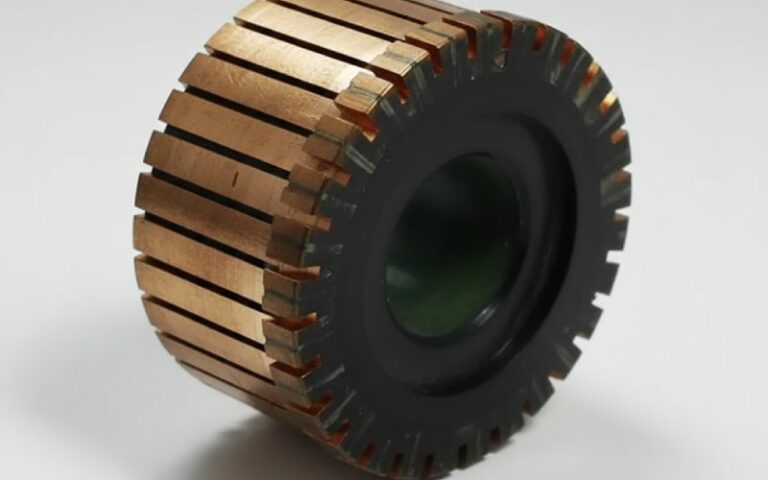
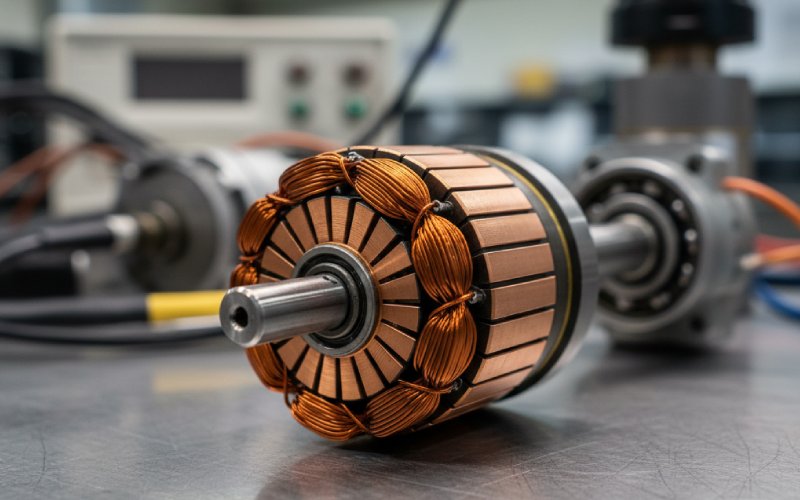
- The number of commutator segments is normally equal to the number of armature coils in a classic DC machine.
- More segments → more, smaller coils → more frequent commutation events and smoother torque, up to the point where manufacturing cost and tolerances dominate.
- For small 2-pole brushed motors, a 3-pole armature (3 segments) is the most common minimal design; it avoids dead spots and lets brushes bridge two segments without a hard short.
Once those are fixed, odd vs even segment counts change the geometry of when commutation happens relative to the magnetic poles.
That geometry is where the interesting behavior starts.
2. Odd segments: more commutation points per revolution
Take a simple 2-pole permanent-magnet DC motor with two brushes 180° apart.
- With an even number of commutator segments, the pattern of which coils are commutating repeats every half turn in a very regular way.
- With an odd number of segments, the “commutation instants” are offset. Over one mechanical revolution you effectively get twice as many distinct commutation positions compared with a similar even-segment layout.
Coreless motor specialists at maxon motor actually call this out directly: an odd number of commutator segments doubles the number of commutation points, and they state that 5 commutator segments are much better than 6 for their small brushed motors.
Why does that matter?
- Each commutation event is a small disturbance in torque and current.
- Spread those events more densely over the revolution → each disturbance is smaller in angular terms.
- Result: lower torque ripple and smoother motion at low speed for the same basic motor size.
So when you see “5 segments – 1 pole pair” or similar in a coreless motor datasheet, that’s usually a deliberate choice to push down torque ripple without changing the magnetic circuit.
Not magic. Just geometry and statistics.
3. Odd segments, slots, and torque ripple
Segment count never lives alone. It sits on top of:
- Number of slots
- Number of poles
- Winding type (lap, wave, re-entrant, etc.)
Odd slot and segment counts show up again and again in torque ripple papers and design notes:
- For permanent-magnet machines, designers often choose odd stator slot counts (or fractional slot per pole) to break up regular cogging torque patterns and cut torque ripple.
- In brushed DC wave windings, having an odd armature slot or segment count can help maintain the desired commutator pitch and avoid awkward coil spans.
Your brushed DC motor is not a BLDC, of course, but the idea is similar:
Avoid simple common factors between slots, poles and segments if you want torque ripple to be small.
Odd segment counts are one of the tools for that. Not the only one, but a cheap and robust one.
For high-volume commodity motors (toys, fans, pumps), you’ll still see 3-slot, 3-segment designs because they are easy to make and “good enough”.
Once you move into instrumentation, medical pumps, robotics joints, or anything that needs clean speed regulation, 5-segment and other “non-trivial” combinations (often with odd slots) start to appear much more often.
4. Why not just keep adding segments?
If more (and odd) segments give smoother torque, why not 11, 13, 21…?
Two reasons you’ll care about as a buyer:
- Manufacturing complexity
- Increasing segment count makes each segment narrower.
- Hooks or weld pads become small; adjacent wire ends sit closer together and are easier to short or damage.
- Inspection and rework get slower. Yield drops.
- Tolerance stack-up and cost
- Maxon’s own training material notes that after a certain point, extra segments bring no meaningful technical gain, but they do push up production cost and introduce torque variations from winding tolerances.
So in practice, for small brushed motors you often see a simple ladder:
- Entry level: 3 segments
- Better smoothness: 5 segments
- Specialty / larger machines: higher counts only where absolutely justified
Odd, but not excessive.
5. What an odd segment count usually signals (for purchasing)
From a sourcing perspective, segment count is a quick hint about how the motor was targeted.
| Design aspect | Lower / even segment count (e.g., 3, 4, 6) | Higher / odd segment count (e.g., 5, 7) | What it usually means for you |
|---|---|---|---|
| Typical segment pitch | Larger pitch, fewer segments | Smaller pitch, more segments | Tighter machining, more attention per unit |
| Torque ripple at low speed | Higher, especially with simple 3-slot designs | Lower; more commutation events per turn | Better for slow, load-sensitive motion |
| Current & voltage spikes at brushes | Larger steps during each commutation | Smaller steps, higher effective commutation frequency | Easier EMI filtering, less brush erosion (all else equal) |
| Sensitivity to winding tolerances | Lower segment count hides some variation | More sensitive to minor imbalance between coils | Supplier process control starts to matter more |
| Manufacturing cost | Lower part count, simpler tooling | Higher part count, narrower hooks, more detailed inspection | Expect a price jump, especially in precision motors |
| Typical applications | Toys, blowers, simple pumps, low-cost gearmotors | Servo drives, medical devices, robotics, instruments | Segment count aligns with your market segment |
The table is not a hard rule. But if you see a “precision” motor still using a 3-segment commutator with no clear justification, that’s a red flag worth questioning.
6. How this ties back to engineers and buyers on the same team
When your mechanical, electrical and purchasing teams look at a DC motor, they usually focus on:
- Rated voltage, speed, torque
- Efficiency, continuous current
- Bearings, brush material, gearhead options
Commutator segment count is easy to overlook. It shouldn’t be.
Some practical patterns:
- Low-speed positioning or very light loads
- Think: syringe pumps, small actuators with gear reduction, optical mechanisms.
- Here, torque ripple shows up directly as speed ripple or tiny position steps.
- Asking for a 5-segment coreless motor instead of a 3-segment slotted design often gives a visible quality jump without changing the rest of the system much.
- High-speed tools and fans
- At high RPM, the dominant issues are balance, brush life, and EMI.
- More segments shift commutation noise to a higher frequency and reduce the energy per spike, which tends to be easier to filter.
- But cost pressure is usually high, so you’ll see minimal segment counts unless noise limits are strict.
- Custom motors or semi-customs
- When a supplier offers “custom winding and commutator options”, segment count is often negotiable within a family.
- That’s your chance to trade a small cost increase for smoother torque or better EMC.
7. Questions to ask your motor supplier about segment count
When you’re evaluating quotes, adding a few targeted questions can reveal how seriously a supplier treats their commutator design:
- “Why did you choose this specific number of segments for this frame size?” A good answer links it to slot count, pole count, target torque ripple and cost, not just “that’s our standard”.
- “Do you offer the same motor with a different segment count?” Useful if you’re trying to tune for low noise or smoother motion without changing the footprint.
- “How do you control hook spacing and insulation when segment count goes up?” You’re probing their process control and short-circuit risk at higher counts.
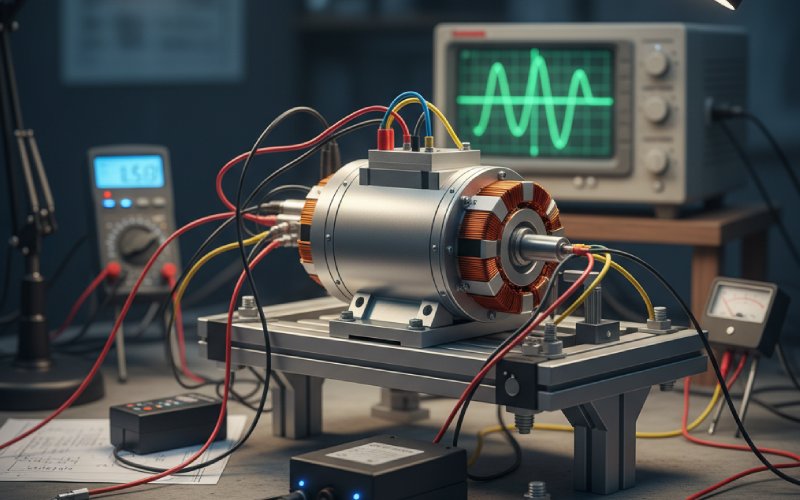
- “What torque ripple data or commutation waveform can you share?” Even a simple oscilloscope trace of commutation spikes tells you whether the segment design is under control.
You don’t need a full motor design discussion in every sourcing round. But on long-life projects, this level of questioning usually pays for itself.
FAQ: Odd commutator segments in DC motors
Q1. Do all DC motors benefit from an odd number of commutator segments?
No. For many low-cost applications, a 3-segment or 4-segment design is entirely adequate. Odd segment counts are most useful where torque ripple, low-speed smoothness, or EM noise are actually constraints rather than “nice to have”.
Q2. Is the number of commutator segments always equal to the number of slots?
Not necessarily. The number of commutator segments usually matches the number of armature coils, while slot count is how many physical slots the coils sit in. Lap and wave windings can use odd or fractional relationships between slots, poles, and segments to optimize performance and reduce cogging torque.
Q3. Why do many small DC motors use exactly 3 segments?
Because 3 is the simplest arrangement that avoids a dead spot, lets the brushes bridge two segments without a damaging short, and keeps manufacturing very cheap. This is why it dominates in toys and other mass-produced low-cost drives.
Q4. If 5 segments are “better than 6”, should I avoid even segment counts completely?
Not automatically. The “5 is better than 6” statement is for a specific family of small coreless motors, where an odd segment count doubles commutation points without making hooks too small. In larger industrial machines, the optimal segment count depends on many other geometric and thermal constraints.
Q5. Should segment count appear in my motor specification?
If your product is sensitive to torque ripple, audible noise, or very low-speed smoothness, segment count is worth specifying or at least discussing. For rugged, bulk-power drives where gearbox and load inertia dominate, it can stay as a “nice-to-know” parameter.
Q6. How does segment count affect testing and QA?
Higher segment counts mean more measurement points when you check inter-segment resistance, hipot, and insulation. Automated rigs can handle this, but fixture design needs to keep up as segment pitch shrinks.