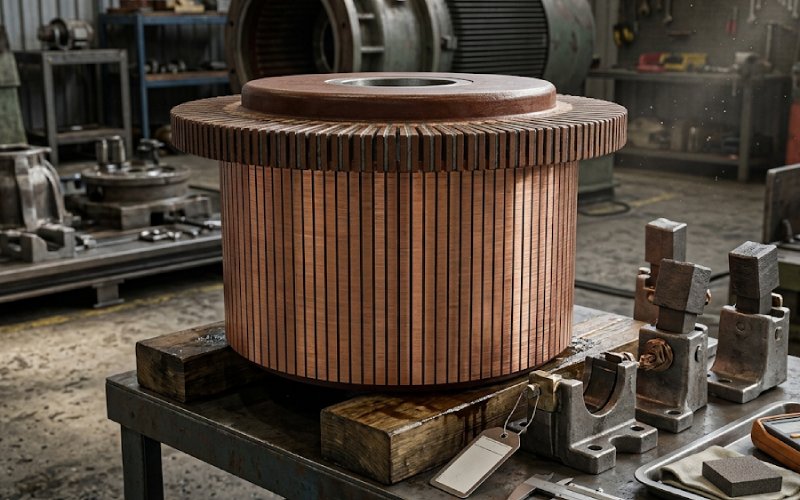
Storing Spare Commutators to Prevent Corrosion and Damage
TL;DR
- Store spare commutators in a sealed, clean, dry package at 30-50% RH, with minimal temperature swing.
- Keep them away from sulfur, chlorides, acids, oil mist, cardboard dust, rubber goods, and bare-hand contact.
- Inspect by condition, not by habit. A spare that gets opened too often stops being a protected spare.
Table of Contents
A spare commutator can lose value while doing nothing.
It sits on a shelf. Looks fine. Copper still bright enough. The package is still there, technically. Then installation day comes and the surface is stained, the slots hold debris, the edges have pressure marks, or the part has picked up enough contamination to turn a simple replacement into cleanup, resurfacing, questions, delay.
That is the real storage problem. Not appearance. Readiness.
Good commutator storage is not about making the part look polished six months later. It is about keeping the copper stable, the mica undisturbed, the segment edges protected, and the working surface free of films you did not intend to put there.
What causes spare commutator damage in storage
Humidity is the obvious one. Still the most common. Once the surrounding air stays too damp, copper stops being passive enough for shelf life to feel safe. Add a little contamination and the surface changes faster than people expect.
Then the less obvious things start doing their share:
- sulfur-bearing air
- chloride contamination
- acidic vapors
- oily airborne residue
- fingerprints
- reactive packaging
- temperature cycling that creates condensation
A warehouse can look clean and still be wrong for copper contact surfaces.
That catches people. They assume “indoors” means controlled. Usually not. A shelf near an outside wall, a mezzanine under a hot roof, a cabinet beside rubber stock, a repacked carton from general stores inventory — that is often where the trouble starts.
And storage damage is rarely dramatic at first. It tends to arrive as small surface change, uneven darkening, faint residue, edge wear from bad support, then more work than anyone planned for.
Best practices for commutator storage
The target is simple enough: stable, clean, enclosed, dry.
Not showroom dry. Not lab-grade overkill. Just controlled.
Recommended storage targets
| Storage factor | Recommended target | Why it matters | Practical action |
|---|---|---|---|
| Relative humidity | 30-50% RH | Limits surface moisture film formation and slows corrosion | Use sealed packaging with desiccant and humidity indicator |
| Temperature | 15-25°C, stable | Swing matters more than the number; cycling drives condensation risk | Avoid roof heat, cold walls, loading bays, and daily thermal swings |
| Air exposure | Low sulfur, low chloride, low acid vapor | Copper surfaces react fast in contaminated air | Keep away from chemicals, batteries, curing zones, exhaust, rubber stock |
| Packaging | Sealed inert packaging | Prevents air exchange, dust, and reactive contact materials | Use clean plastic barrier bags or sealed rigid containers |
| Internal support | Non-abrasive, non-reactive support | Prevents dents, slot damage, and contact marking | Support by hub/body, not by working surface |
| Handling | No bare-hand contact | Finger oils and salts create uneven corrosion and stain patterns | Use clean gloves and handle only where needed |
| Inspection interval | Condition-based | Frequent opening defeats the package | Inspect packaging first; open only on trigger |
These numbers are not magic. They are just sensible working limits. Once humidity climbs and stays there, or the part starts breathing contaminated air, the margin goes away quickly.
Packaging matters more than people think
A spare commutator should not be left in a general-purpose box and called protected.
Cardboard sheds. Some papers hold moisture. Some packing materials release compounds that copper does not forgive. Rubber nearby can be a problem. Wood can be a problem. Felt can be a problem. Even clean-looking foam can become the wrong choice if it compresses the wrong area or leaves residue.
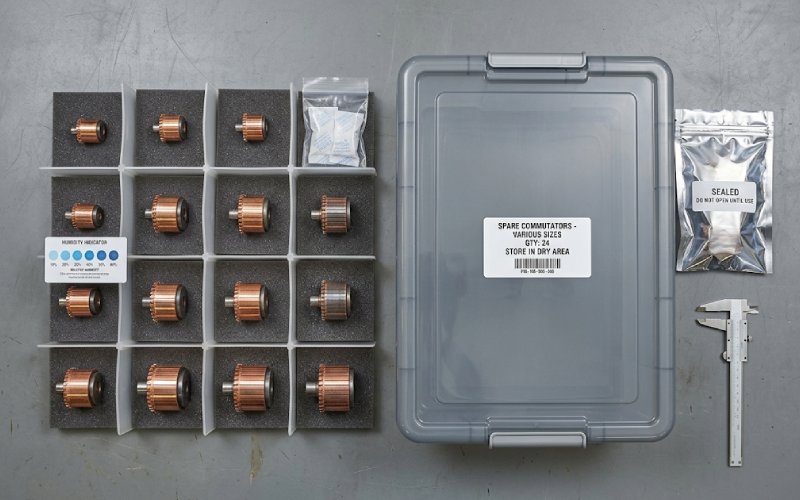
A better storage stack looks like this:
- Clean commutator
- Dry condition confirmed
- Non-reactive inner wrap or support
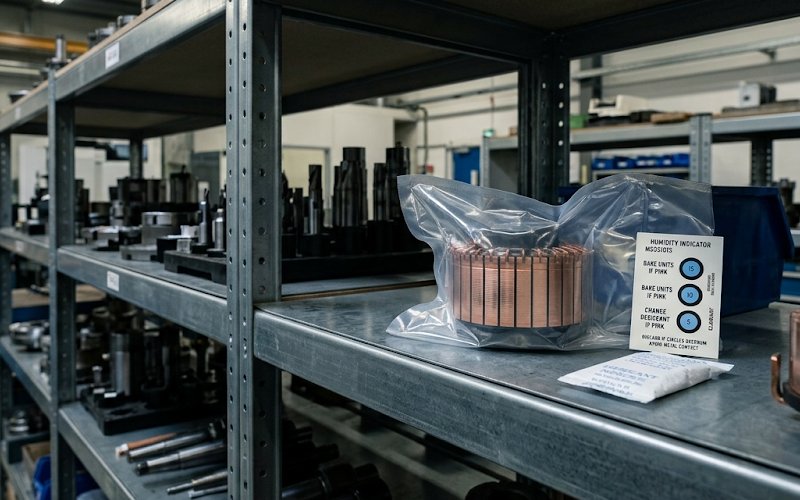
- Sealed moisture-resistant outer package
- Desiccant
- Humidity indicator
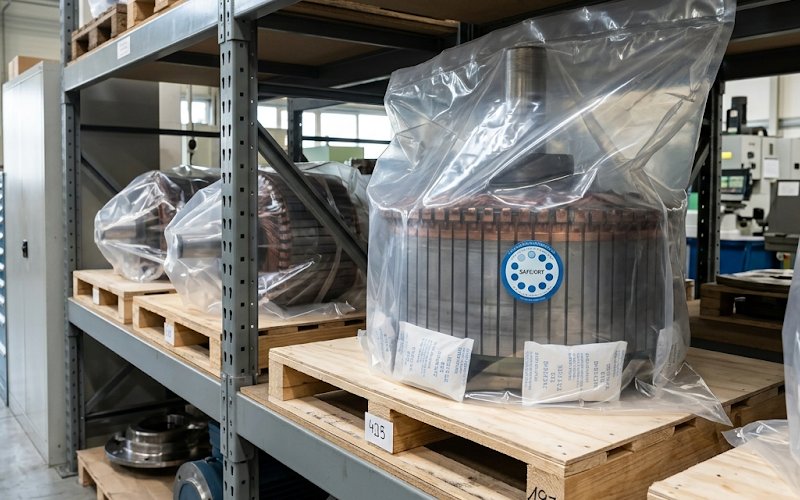
- Rigid outer support if transport or stacking is involved
That is enough for most sites. Not elegant. Effective.
For longer storage or harsher plant conditions, use a fully enclosed corrosion-control package rather than relying on dry air alone. Moisture control helps. Clean air helps. Together they work better.
How to handle a spare commutator before it ever reaches the shelf
This part gets skipped. Then later people blame storage.
Do not store a commutator that was handled casually during receipt, inspection, or repacking. If someone touched the copper track with bare hands, set it down on dirty paper, dragged it across a bench, or blew dust at it with oily compressed air, the damage chain may already be active before the spare goes into stock.
A few rules make a difference:
- Wear clean gloves
- Handle by hub or non-working surfaces
- Keep the commutator off dirty benches
- Do not stack unprotected units face-to-face
- Do not clamp across finished contact areas
- Do not assume “we will clean it later” is harmless
Later usually means more aggressive cleaning. More aggressive cleaning usually means avoidable surface change.
The common storage mistakes
These are the ones that keep showing up.
1. Storing the part in an opened carton
Once the package is open, the spare starts tracking room conditions. Dust, humidity, handling, all of it.
2. Using whatever packaging is nearby
General warehouse materials are not neutral just because they are convenient.
3. Storing near rubber, chemicals, or process exhaust
Copper does not need direct liquid exposure to degrade. The air can do enough.
4. Opening the package for routine visual checks
People want reassurance. Fair enough. But repeated opening adds moisture cycles and handling risk. A sealed spare should stay sealed unless there is a reason.
5. Cleaning for appearance
If the goal becomes “make it shiny,” someone eventually reaches for the wrong abrasive. Then the spare is no longer preserved. It is being reworked before service.
6. Ignoring temperature transition
A cold packaged part opened in warm humid air can sweat immediately. It was safe until it was inspected.
That last one is especially avoidable. Leave the sealed package closed until the part reaches room condition.
A storage method that works in an actual shop
You do not need a complicated program. You need a repeatable one.
Step 1: Clean only as much as needed
Remove loose dust with a clean, dry, lint-free cloth. Do not polish for appearance. Do not use oily wipes on the working surface. Do not introduce abrasive residue unless there is a real defect that requires controlled rework.
Step 2: Protect the geometry
Make sure the commutator is supported so the copper track, segment edges, and insulation are not carrying load during storage. Pressure marks from bad support count as storage damage.
Step 3: Seal the part
Use a clean sealed barrier bag or rigid enclosed container. Add desiccant sized for the package volume, not whatever packet happened to be lying around. Include a humidity indicator where practical.
Step 4: Store above floor level in a stable zone
Avoid windows, outside walls, hot mezzanines, shipping doors, washdown areas, and shared storage beside reactive materials.
Step 5: Label for condition, not just part number
Mark the package with:
- date packed
- packed by
- humidity target
- open only if required
- acclimatize before opening if cold
That last note prevents a lot of self-inflicted condensation.
How to inspect stored commutators without ruining storage life
Inspection should start with the package, not the copper.
Check:
- seal integrity
- punctures
- collapsed support
- desiccant status if visible
- humidity indicator if present
- signs of internal condensation
- storage location drift
If all of that looks right, there may be no reason to open the package.
If you do open it, inspect for:
- uneven darkening
- fingerprint outlines
- green or blue-green corrosion products
- sticky films
- debris in mica slots
- nicked edges
- pressure marks
- rubbing damage from internal movement
And then close the loop. If one spare shows early corrosion, inspect the storage method, not just the part. Usually the package or location is at fault.
What to do before installation
Do not pull a spare from cold storage and open it immediately in warmer humid air. Let the sealed package equalize first.
Once opened, assess the actual condition. A lightly darkened but clean surface is not the same thing as active corrosive deposit. Not every color change requires intervention. But contamination, residue, or corrosion product should not be ignored.
The wrong response here is aggressive cleanup by habit.
The better response is simple:
- confirm the surface condition
- confirm slots are clean
- confirm no insulation edge damage
- confirm no foreign film
- perform only the minimum corrective work needed
A spare is valuable when it installs cleanly. Not when it photographs well under bright light.
Why this matters to maintenance cost
Poor commutator storage rarely shows up as a line item called “bad storage.”
It shows up as:
- extra prep before installation
- unplanned cleaning
- re-machining or resurfacing
- doubts during commissioning
- shortened service confidence
- argument over whether the spare arrived bad or was stored badly
That is why storage discipline matters even when failure has not happened yet. It reduces friction before the motor is even back together.
Small controls. Less noise later.
FAQ
How should spare commutators be stored to prevent corrosion?
Store them sealed, clean, dry, and away from reactive air. A practical target is 30-50% relative humidity, moderate stable temperature, inert packaging, desiccant, and no bare-hand contact on the copper surface.
What humidity is safe for commutator storage?
A good working range is 30-50% RH. Above that, especially with contaminated air or repeated temperature cycling, the risk of corrosion and surface film formation increases.
Can spare commutators be stored in cardboard boxes?
Not as the main protective method for long-term storage. Cardboard is fine as outer logistics packaging if the commutator itself is already sealed inside a proper inner barrier package. By itself, it is not enough.
Should a commutator be polished before storage?
No, not as a routine step. Clean it if needed. Do not polish for appearance. Unnecessary surface work can introduce scratches, residue, or a more reactive fresh surface.
What is the first sign of poor commutator storage?
Usually uneven tarnish, stain patterns from handling, residue, or debris collecting where it should not be. More advanced cases show visible corrosion products or contamination in the slots.
Is desiccant alone enough?
Sometimes, in clean indoor storage. Not always. If the surrounding air is chemically aggressive or the storage period is long, sealed packaging and broader corrosion-control measures work better than desiccant alone.
How often should stored commutators be inspected?
Inspect the package regularly. Open the package only when there is a reason: damaged seal, humidity indicator drift, visible internal condensation, relocation to a bad environment, or planned installation.
Can I touch the copper surface during inspection?
Better not. Use clean gloves and avoid contact with the working surface. Finger oils and salts can leave marks that develop into uneven corrosion later.
Final note
A spare commutator should come off the shelf ready for use, not ready for rescue.
That standard is not difficult to reach. But it does require one thing many stores systems do not naturally provide: control. Not a lot. Enough.