
Starter Motor Commutator Bad Spot: What It Really Means For Your Business
When people complain about a “starter motor commutator bad spot”, they rarely mean one single defect. Sometimes it’s a burnt group of bars. Sometimes a flat patch from mechanical wear. Sometimes a raised segment that eats brushes. Same symptom phrase, very different risk and cost.
This article sticks to that angle: pattern recognition, causes you can act on, and what to ask from your commutator supplier.
Table of Contents
1. What people usually see as a “bad spot”
In the field or on the bench, “bad spot on the commutator” usually means one of these:
- Intermittent no-crank: hit the key, nothing. Turn it again, engine cranks normally. Bench test shows a dead band of rotation.
- Starter stops on the same arc: you rotate the armature by hand; starter works until it lands on one particular section, then stalls.
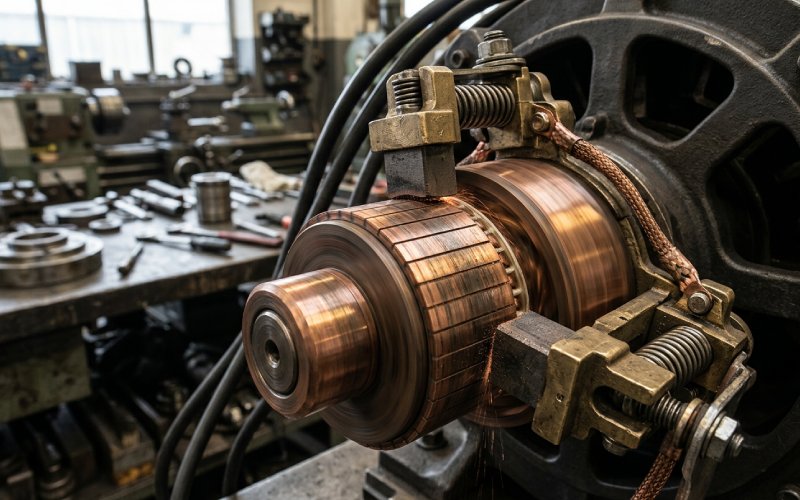
- Visible scar on part of the commutator:
- deep discoloration / blue copper on several adjacent bars
- pitted or eroded bars under one brush track
- bars worn down more on one side, almost “faceted”
- High noise and arcing only when brushes pass a certain sector.
Most OEM and troubleshooting manuals link these patterns to localized electrical or mechanical problems: overheating, high resistance joints, winding faults, or out-of-round commutators that create “high bars” and excessive arcing.
2. Four main ways a commutator bad spot is created
You don’t need a long theory section here, so just the essentials.
2.1 Local electrical fault at one or two segments
Typical signs:
- One bar (or a tight cluster) is dark, rough, or burnt, while others still look reasonable.
- Brush film refuses to build on that bar.
- Resistance tests between bars show an odd reading, or bar-to-winding connection looks suspect.
High-resistance connections between the winding and commutator bar are classic for this. The joint heats up, the bar underneath runs hot, and over time you get burning that can progress into a flat spot.
Winding shorts or open commutator leads can show as spot burn marks repeated every few bars, tied to the coil pitch.
2.2 System-level overheating
The bad spot is not really “local” here; it just shows worst at the places with the highest current density.
Typical scenario:
- Driver holds the starter in “start” for too long during difficult starts.
- Engine is jammed / very stiff, so the starter barely rotates.
- Someone uses the starter to move the vehicle on its own power.
Under those conditions, current shoots up, speed drops, and the commutator surface overheats. Many failure reports show brown / blue discoloration across the commutator surface, burning of the pole windings, and thermally discolored armatures when starters are abused this way.
One particular arc can still look worst: where brush loading and cooling are poorest. That becomes “the bad spot” everyone blames.
2.3 Brush / commutation set-up issues
Here the root cause is outside the commutator copper itself:
- wrong brush grade (too hard, too soft, wrong resistivity)
- incorrect brush spring force
- neutral plane not set correctly
- interpole strength off in larger DC machines
Those produce:
- alternating light and dark bars (slot bar marking)
- etched trailing edges of some bars
- repeat burn marks every few segments under the same brush path
From the workshop view, though, it’s just: there’s a nasty patch; the rest looks decent.
2.4 Mechanical geometry: out-of-round or misaligned
If the commutator is not truly round, or the armature is bent:
- some bars become “high bars”
- brushes hammer on them, leading to chipping and pitting
- arcing grows at those points, which accelerates local wear
Technical notes from DC motor service companies warn that out-of-round commutators and poor balance can break brushes, overstress brush springs, and cause excessive arcing at isolated areas.
Many OEM manuals give a maximum commutator runout around 0.4 mm for light vehicle starters; beyond that, resurfacing or replacement is typically specified.
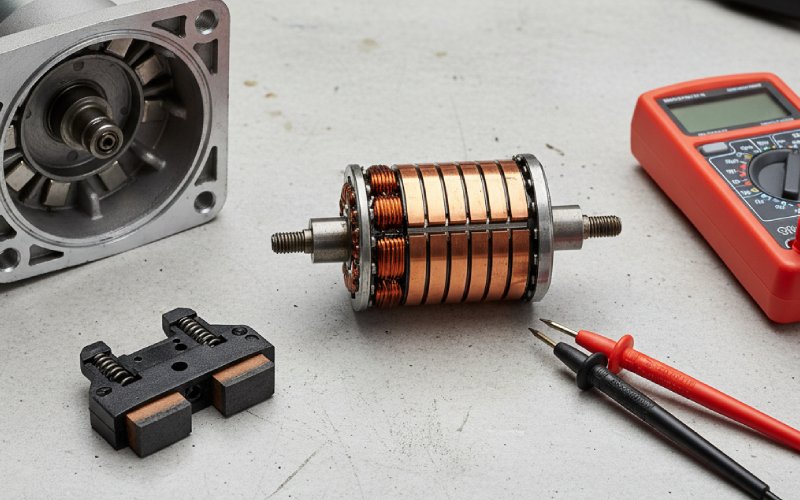
3. Field symptom → bad spot pattern → likely cause
Here is a compact way to classify what you see on the bench.
You already know how to strip and test; this is just a sorting tool.
| Field symptom / test result | Comm. appearance at “bad spot” | Likely root cause group | First action |
|---|---|---|---|
| Intermittent no-crank, always stops in same sector | One or two bars very dark / burnt; rest acceptable | High-resistance joint or local winding fault | Bar-to-bar resistance test; check commutator leads and solder joints |
| Weak crank, heavy arcing in one arc of rotation | Alternating light/dark bars under one brush track | Incorrect neutral setting, mis-matched brush grade, poor interpole in larger machines | Check brush grade vs spec; check neutral position; reset and re-run |
| Brushes wearing fast, noise as brushes pass one area | Local high bar(s); facet seen around circumference | Commutator out-of-round, poor turning or mounting | Measure runout; if over OEM spec, skim and undercut or replace armature |
| Starter dead after repeated long cranking attempts | Broad brown / blue discoloration, burn marks all around, worst in one sector | System-level overheating from misuse or engine issue | Check for engine hard-start problems; replace assembly; review driver instructions |
| Good insulation tests, but one bar refuses to build a stable film | Single bar with scattered pitting; sometimes cracked mica nearby | Marginal brush current sharing, partial open circuit, or poor impregnation | Check internal connections; if multiple returns show same pattern, escalate to supplier design review |
Sources for these patterns include technical bulletins on commutator wear, burn marks, and slot bar marking from motor service specialists and brush manufacturers.
4. Quick checks for a suspected starter motor commutator bad spot
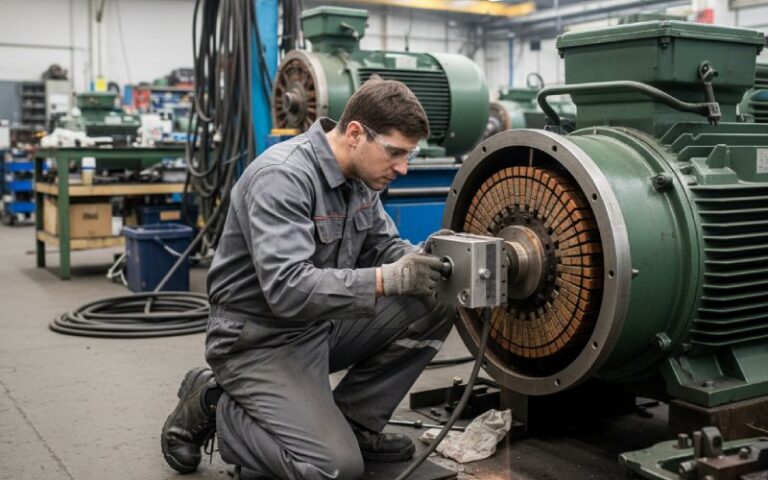
You don’t always have time for a full lab-grade teardown. For B2B work, speed on incoming warranty returns is important.
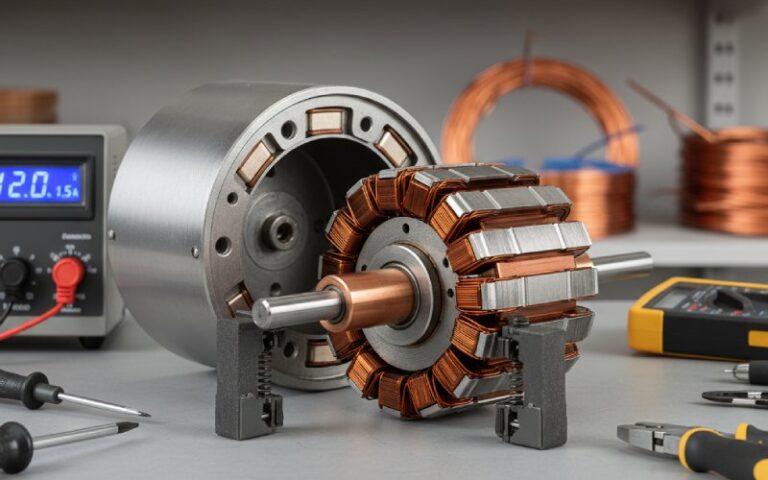
Here’s a very lean procedure, assuming standard tools:
- Index the armature
- Mark 0°, 90°, 180°, 270° on the shaft or commutator hub.
- Record symptom at each index on the test bench (current draw, no-load speed, noise).
- A true “bad spot” usually lines up with one index position every time.
- Visual under magnification
- Use a loupe or basic microscope.
- Check for: lifted bars, micro-cracks, local erosion of copper, odd film color changes.
- Bar-to-bar tests
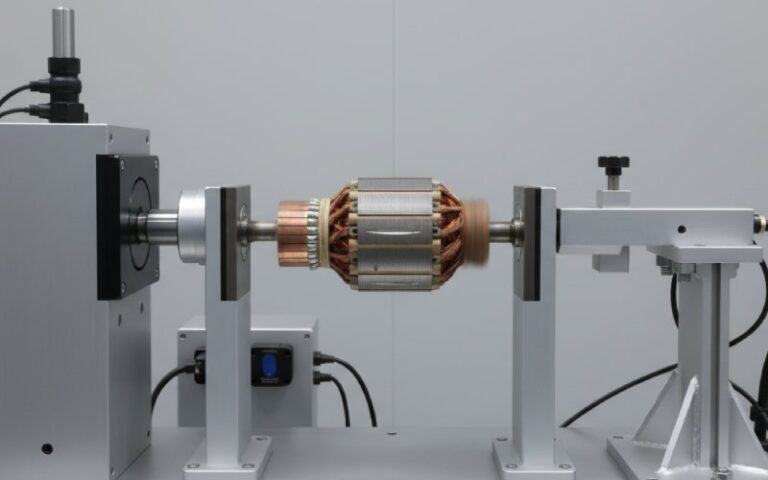
- Use bar-to-bar resistance measurements or a growler method, depending on your set-up. Guides for armature testing usually recommend a 180° resistance comparison, rotating and recording each reading.
- Any significant jump at the “bad” position points to a coil or connection issue rather than pure mechanical wear.
- Runout check
- Set the commutator up on centers; use a dial indicator around the copper surface.
- Compare with OEM service limits (often around a few tenths of a millimeter).
- Brush track alignment
- Re-assemble loosely. Confirm that brush tracks sit squarely on the commutator, not skewed or sitting on edge.
This doesn’t replace full failure analysis, but it will quickly tell you whether you are dealing with:
- a manufacturing problem in the commutator / armature
- a brush / assembly problem in your own process
- or abuse / system issues at the vehicle level
5. Repair, re-turn, or scrap? Simple decision logic
Not every commutator with a bad spot deserves a new armature. But some absolutely do.
Think about it in three buckets:
5.1 “Clean and monitor” cases
Appropriate when:
- copper wear is shallow
- no bars are loose
- insulation tests and bar-to-bar readings are stable
- burn marks are light and limited
Typical action:
- light skim or polish with appropriate abrasive (not conductive),
- careful cleaning of slots and dust removal,
- new brushes with correct grade and spring force.
Use this mostly for internal equipment or low-risk aftermarket where you control the re-installation and follow-up.
5.2 “Re-turn and undercut” cases
Appropriate when:
- commutator is out-of-round but diameter is still above minimum
- bad spot is more about geometry than localized burning
- you have capability for concentric re-turning and mica undercutting
Actions:
- machine the commutator true, maintaining correct diameter
- undercut mica to the specified depth and clean edges
- bed in new brushes, then run a short controlled test to build a stable film.
This is the common answer for many industrial DC machines and can be valid for certain starter sizes where the business case supports the machining time. Many service notes state resurfacing is required when trailing edges show etching or burning patterns from slot bar marking.
5.3 “Scrap and learn” cases
Replace the armature (or entire starter) when you see:
- lifted or cracked commutator bars
- severe burning on multiple bars with enamel damage to windings
- repeated failures with identical bad-spot geometry across a batch
- commutator diameter below OEM limit
Technical bulletins on thermally overloaded starter motors show exactly this: burnt pole windings, discolored commutators, and damaged enamel. At that point, repair is mostly cost-prohibitive and unreliable.
The key is documenting these decisions. Over a few hundred units, patterns emerge that a single teardown won’t show.
6. Design and sourcing choices that reduce bad spots
This is where a B2B buyer or engineering team can actually move the needle.
6.1 Copper and commutator design
A few design levers that matter:
- Copper grade and hardness Silver-bearing copper or similar alloys can support higher current density but need consistent manufacturing to avoid high-resistance joints.
- Bar geometry and number of segments More bars mean lower voltage per segment, which helps commutation, but the layout and coil pitch still need to avoid recurring burn patterns every few bars.
- Mica system and undercut Depth and profile of the undercut influence brush edge wear and arc control.
When sending RFQs or drawings, make sure commutator suppliers receive:
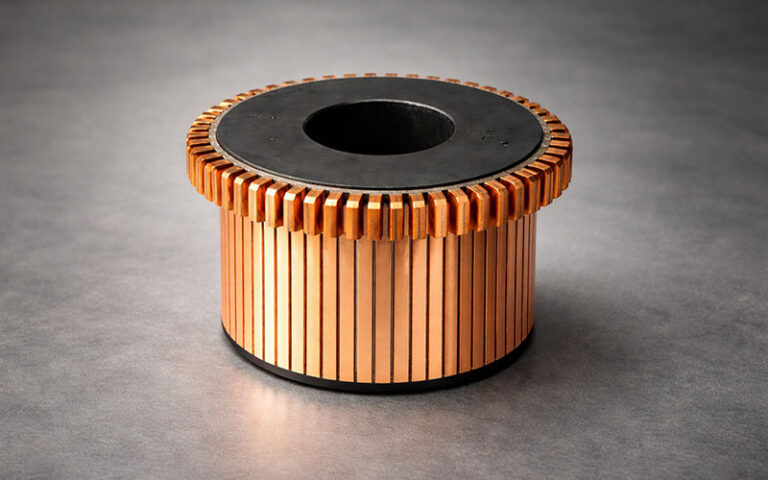
- OD, ID, total height, copper height
- bar count and type (hook, riser, etc.)
- insulation system and required dielectric performance
- allowed runout and bar-to-bar deviation
Many motor component makers specifically ask for these data points as a minimum to quote correctly.
6.2 Brush and commutator pairing
A commutator bad spot is often just the visible symptom of a brush / commutator mismatch:
- wrong resistivity or grade gives unstable film formation
- dimension mismatch makes the brush heel or toe one bar more than the other
- poor spring force causes intermittent contact and local arcing
Maintenance notes on DC motors repeatedly link pitting, burning, and threading of commutators to incorrect brush choice and spring tension.
So in your sourcing specs, treat brush + commutator + holder as a system, not separate line items that purchasing can swap independently.
6.3 Build control in your own line
Even if you buy complete starters, some of this still applies during your incoming inspection:
- Check runout on sample starters from each lot.
- Monitor brush length and spring force against spec.
- Inspect neutral position or brush holder alignment on a small sample.
You’ll catch many bad-spot risks before they become field returns.
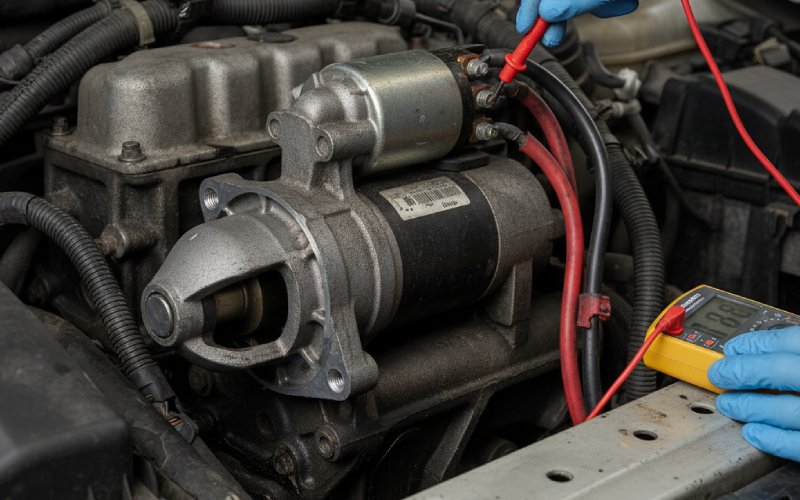
7. Warranty analysis: using bad spots as a diagnostic shortcut
For fleet operators and rebuilders, a consistent “starter motor commutator bad spot” is sometimes the cheapest diagnostic tool you’ll ever have.
Set up a simple process:
- Take high-resolution photos of every returned commutator, always from the same angles.
- Tag with build data: supplier, lot, build date, brush batch, application.
- Classify the bad spot type: local bar, slot-related pattern, global overheating, mechanical high bar.
- Plot vs. engine model and usage: urban delivery, off-road, stop-start, etc.
After a while, patterns become hard to ignore:
- One engine platform causing consistent global discoloration? That’s a system issue (long crank, fueling).
- One commutator supplier repeatedly showing high bars after low mileage? Manufacturing / design problem.
- Failures clustered after your own brush change? That’s on your process or sourcing.
You don’t need complex analytics; even a spreadsheet and a few photos per unit can be enough.
8. Practical FAQ on starter motor commutator bad spots
Q1. Does a starter motor commutator bad spot always mean the armature is scrap?
No. Light burning with good insulation readings and acceptable runout can often be salvaged with proper cleaning, resurfacing, slot cleaning, and new brushes. Deep burning, lifted bars, or damage to coil insulation usually justify replacing the armature or the entire starter.
Q2. How do I tell if the bad spot came from abuse or from manufacturing?
Rough rules:
Abuse / system issue: overall discoloration, burn marks around most of the commutator, and often discoloration of pole windings and armature enamel.
Manufacturing issue: one or a few bars affected, often repeatable across a batch, with good windings elsewhere and normal general appearance.
Set-up / brush issue: repeating pattern every few bars, especially alternating light/dark bars or etched trailing edges.
Q3. We see intermittent no-start and a bad spot, but insulation tests pass. What now?
Look for high-resistance joints and poor brush contact rather than outright shorts:
Perform detailed bar-to-bar resistance tests.
Check for cracked solder at risers and commutator leads.
Inspect brushes and holders for mechanical sticking.
A high-resistance joint can behave intermittently and still pass a simple go / no-go insulation test.
Q4. Is it worth re-turning starter commutators in-house?
Only if:
you have proper tooling (accurate turning equipment, undercut tools, balancing)
your volumes justify the set-up
and you can control quality at least as tightly as your suppliers
Many service manuals allow limited re-turning as long as final diameter and runout stay within spec. For low-cost, small starters, replacement is often cheaper than machining once labor and test time are added.
Q5. What should I require from a commutator supplier to reduce bad spots?
At minimum:
Clear data on copper material, bar count, and insulation system
Guaranteed tolerances on OD, runout, and bar-to-bar height
Test method for high-resistance joints between windings and bars
Traceability per batch and failure-analysis support
Also specify brush grade and expected operating conditions so they can validate the commutation design, not just dimensions.
Q6. The bad spot always lines up with a particular brush. Could that brush alone be the problem?
Yes. A single brush with wrong grade, wrong dimension, or weak spring can create localized heating and wear just where it rides. Notes on brush maintenance show that poor contact pressure or mis-sized brushes cause pitting and burn marks in limited areas.
Swap brushes around and re-test; if the bad spot follows the brush, the commutator might be innocent.
Q7. Is a commutator bad spot dangerous for other components?
It can be, indirectly:
High local arcing stresses the brushes and holders.
Overheating near one sector can damage nearby insulation and, in extreme cases, field windings.
So even if the starter still “works most of the time,” letting a serious bad spot run in a fleet environment is usually not a good idea.