Difference Between Split Ring and Commutator
A practical guide for B2B motor and generator projects
Table of Contents
1. Quick sanity check: what are we comparing?
Very short version:
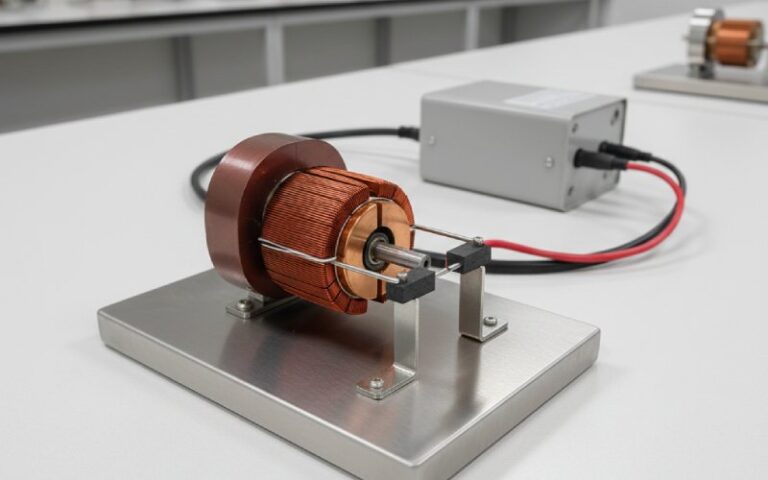
- Split ring
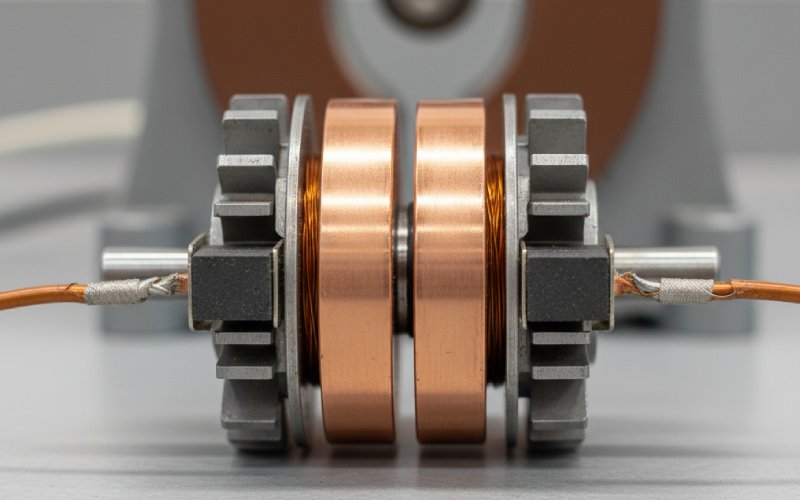
- Two copper segments with an insulation gap
- Classic textbook DC motor or hand-cranked DC generator
- Used to reverse current every half turn in a single-coil (or very simple) armature
- Commutator (industrial sense)
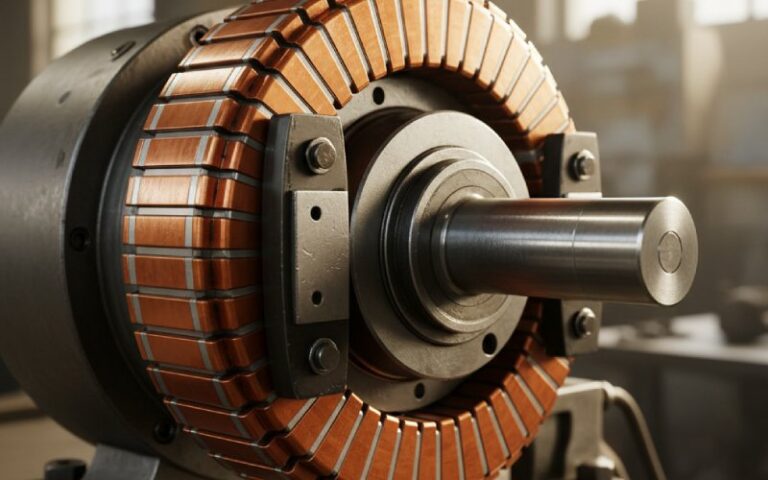
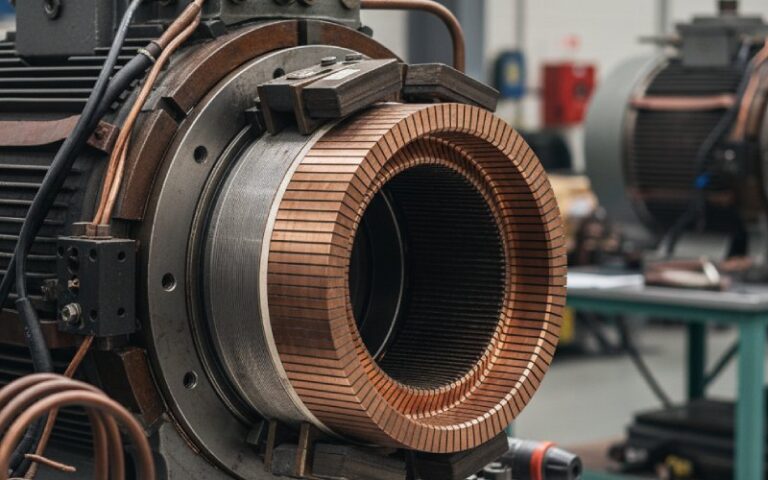
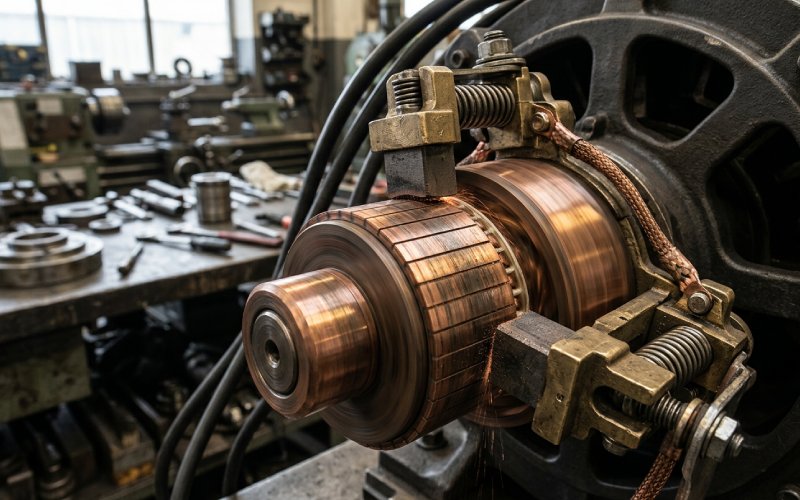
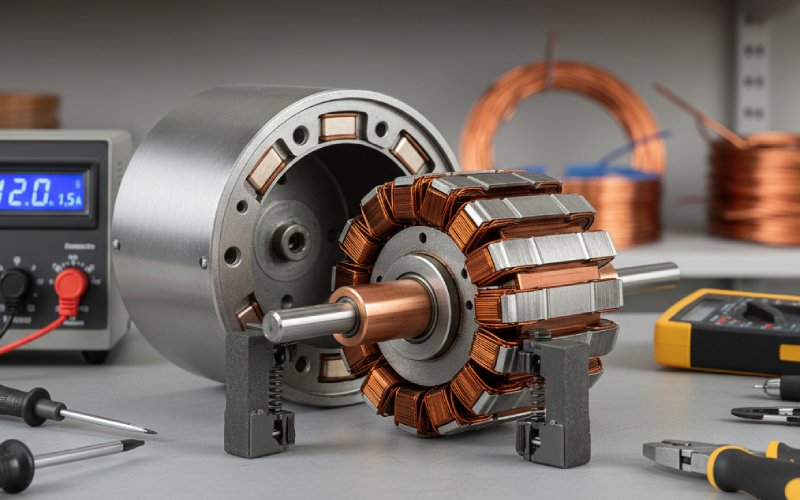
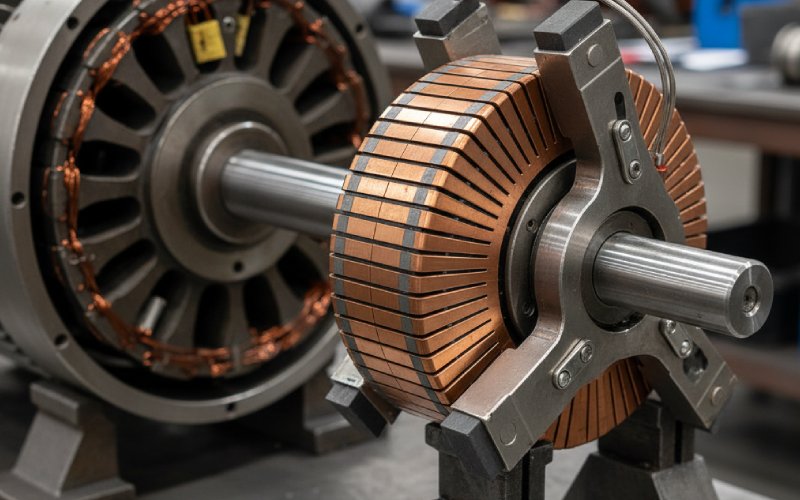
- Many insulated copper segments around a cylinder on the rotor shaft
- Each segment tied to a different armature coil
- Used in real DC motors and generators to switch current between many coils and keep torque and output smoother
Formally, a split ring is the simplest two-segment commutator. Even notes that “commutator (electric)” is also called split rings. But engineers usually draw a line between:
Textbook, two-segment split ring vs. Multi-segment production commutator
That’s the distinction we’ll use here.
2. Structural difference, at a glance
Here’s a compact comparison you can drop straight into a design spec or training deck.
| Aspect | Split Ring (2-segment) | Multi-segment Commutator | What it means in practice |
|---|---|---|---|
| Segment count | 2 semicircles | 3 to hundreds of bars | More segments = smoother torque / voltage, higher power capability |
| Typical geometry | Flat or small ring, often shown as “C-shaped” pieces | Cylindrical drum with stepped copper bars | Commutator integrates into rotor stack; split ring often lives in small demo motors |
| Number of coils supported | Usually 1 (sometimes 2) | Many coils in series/parallel patterns | Multi-segment designs let you scale voltage, speed, torque without crazy ripple |
| Current switching logic | Swaps connections between the two coil ends every 180° | Continuously re-assigns which coil is under load as rotor turns | Commutator timing can be tuned with brush position and interpoles |
| Typical devices | School motors, toy motors, simple DC generators | DC traction motors, industrial DC motors, universal motors, DC generators | Split ring is fine for teaching and tiny drives; not fine for a 15 kW crane hoist |
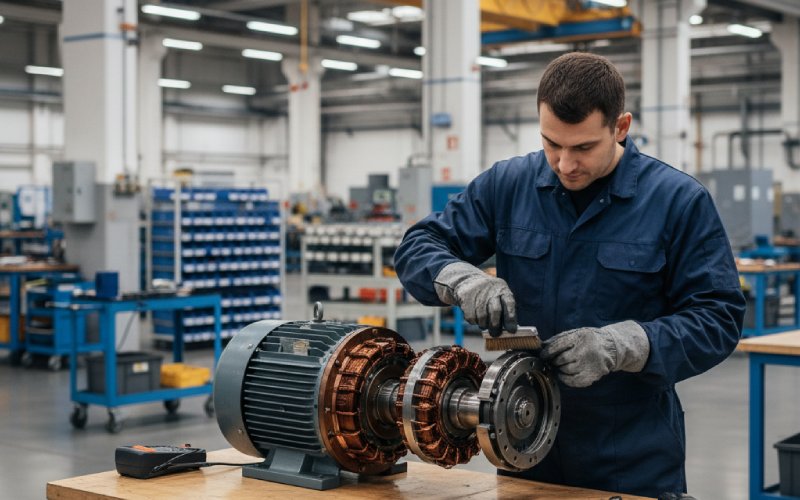
| Manufacturing | Simple turning and slotting; often non-repairable molded part | Precision machined, insulated, banded; often repairable | Industrial commutators can be resurfaced and even “refilled” with new segments |
| Maintenance pattern | Usually “run to failure and replace motor” | Brush wear, periodic turning/undercutting, cleaning | Drives maintenance planning and spare-parts strategy |
So when someone in the meeting says “We only need a split ring”, the real question is:
Are we still in high-school-lab territory, or are we now in field-service-contract territory?
3. How each one behaves electrically
You already know the Fleming rules. Let’s jump straight to what changes when you scale from a split ring to a full commutator.
3.1 Split ring: one coil, one big pulse
In a basic DC motor:
- The split ring reverses current through a single armature loop every half turn, so torque keeps pushing in roughly the same direction.
- Torque is highly pulsating. Two strong kicks per revolution, with a dead-ish region near the neutral plane.
In a basic DC generator:
- The induced EMF in the coil is naturally AC.
- The split ring swaps coil connections to the brushes right when EMF changes sign.
- At the terminals, you see pulsating DC with big ripple, same polarity, magnitude swinging.
This is perfectly fine for a demo board. Charging a serious DC bus from that? Not so much.
3.2 Multi-segment commutator: many coils, overlapping conduction
With more segments and more coils:
- At any instant, several coils share conduction through different commutator bars.
- As the rotor moves, coils enter and leave the active region smoothly, because brushes span more than one segment at once.
- Torque and generated voltage become much smoother, and commutation can be tuned using brush shift and interpoles to control sparking.
Result:
- Better efficiency for the same frame size
- Higher voltage/current capability
- Less mechanical stress on couplings and gears
So in practice, the electrical “difference between split ring and commutator” is not the principle (both reverse current). It’s the granularity and controllability of that reversal.
4. Where a split ring still makes sense
You probably don’t ship industrial drives with simple split rings. But they show up in supply chains in a few places.
4.1 Education kits and demo rigs
- Low voltage, low current
- Short duty cycles
- Cost per unit beats any concern about repair
Here, a two-segment split ring is almost ideal:
- Easy to see and explain
- Tolerant of rough handling
- Can be stamped or molded cheaply
If you sell into STEM kits or training boards, having a basic split-ring SKU is still useful. Just don’t reuse that hardware in a serious application, even if the current rating technically fits.
4.2 Tiny brushed DC motors
Look inside some toy motors and you’ll see something that looks like a split ring but is actually a tiny multi-segment commutator: three or more copper arcs on a plastic hub.
But truly minimal designs still exist:
- Very small pumps
- Disposable consumer devices
- Simple actuators where lifetime is measured in hours, not years
In those cases, a de-facto “split ring” approach is just a cost play.
5. When you clearly need a real commutator
If any of the below is true for your project, you’re in commutator territory, not split-ring territory.
5.1 You care about torque smoothness and speed control
Applications like:
- Conveyor drives
- Hoists and cranes
- Older DC traction drives
- Precision process lines
need torque ripple low enough that mechanical resonance and control loops behave. That’s hard to achieve with a single active coil and a two-segment ring. Multi-segment commutators distribute torque around the rotation, which is why classic DC drives used so many armature slots and commutator bars.
5.2 Voltage is above “battery toy” level
Higher voltage and power need:
- More surface area for current
- More segments to keep brush voltage per segment within safe limits
- Better cooling around copper bars and insulation
A split ring gives you exactly two contact areas. A commutator lets you split the same current across many bars and reduce brush heating and arcing. There’s a reason megawatt DC machines never used simple split rings.
5.3 You expect maintenance instead of replacement
In larger DC motors and generators:
- Brushes are replaceable.
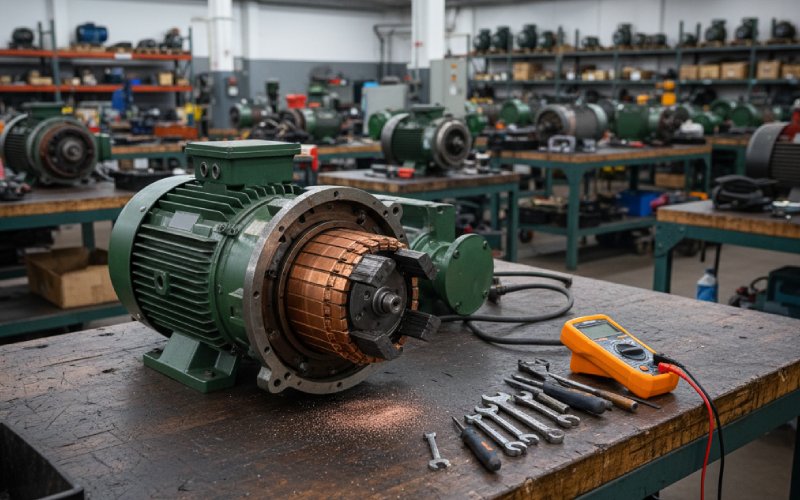
- Commutators can be resurfaced (turned), undercut, and sometimes partially refilled.
That whole ecosystem—skimming tools, mica undercutters, brush grades—assumes a proper commutator, not a throwaway split ring.
6. Design and sourcing trade-offs
When your team writes an RFQ or a drawing, these are the practical questions behind “split ring vs commutator.”
6.1 Cost vs life
- Split ring
- Lowest part cost
- Usually bonded into a cheap rotor; motor is replaced, not serviced
- Commutator
- Higher initial cost from copper and machining
- Lower life-cycle cost in equipment that will be overhauled (brush changes, turning, etc.)
So the break-even is mostly about whether the motor is disposable or part of a maintainable asset.
6.2 Commutation quality and EMI
Poor commutation → arcing → heat, brush dust, EMC issues.
- A split ring gives you exactly one instant where the reversal happens. If geometry is off, that instant gets noisy.
- A tuned commutator distributes commutation across multiple segments with the help of interpoles and brush design, so the voltage change per unit time is lower.
If your product has strict EMC limits or sits near sensitive electronics, this matters.
6.3 Mechanical limits
Split rings are structurally simple but not ideal at high speed or high torque:
- Limited surface for brush contact
- Higher local current density
- More sensitive to misalignment and wear
Industrial commutators use dovetail or banded construction and robust insulation systems specifically to survive high peripheral speeds and thermal cycling.
7. How to specify what you actually want
When you’re writing specs for a vendor or internal manufacturing team, these phrases reduce confusion.
If you truly want a basic split ring (textbook style):
- “Two-segment split-ring commutator, copper, OD = X mm, ID = Y mm, segment angle = 180°, insulation: [material]. Duty: [voltage, current, duty cycle].”
If you want a proper DC commutator:
List at least:
- Required shaft size and commutator OD/length
- Expected armature current and voltage
- Target speed range and duty cycle
- Number of segments and connection layout (single/double/triple pitch, riser type)
- Brush material family and number of brush arms
That way, no one ships you a toy-grade split ring when you expected a 3 kW motor commutator.
8. FAQ: split ring vs commutator
8.1 Is a split ring the same as a commutator?
Conceptually yes. A split ring is just the simplest two-segment commutator whose job is to reverse current every half turn. In practice, engineers use “split ring” for simple educational or very small motors, and “commutator” for multi-segment industrial designs.
8.2 Why do textbooks treat them like different components?
Because it helps beginners:
First, they see a split ring reversing current in a single loop.
Later, they meet multi-segment commutators in real machines.
From a design perspective, one is just a scaled-up, segmented version of the other.
8.3 Can I swap a commutator for a simple split ring to save cost?
Usually no.
You would lose torque smoothness, reduce power capability, and likely cause severe sparking.
Armature winding design and magnetic circuit are built around a certain segment/slot count; changing it is a redesign, not a cost tweak.
If you’re at the point of swapping commutator types, you are already re-engineering the motor.
8.4 How is a split ring different from a slip ring?
Slip ring – continuous ring used mainly to pass power/signals between stationary and rotating parts without switching polarity; common in AC generators and rotating joints.
Split ring – ring cut into insulated segments whose whole purpose is to swap connections and reverse current.
Same mechanical idea (brush on copper ring), different job.
8.5 If I move to brushless or induction motors, can I ignore commutators completely?
You won’t buy commutators anymore, but the idea lives on:
Electronic commutation in BLDC motors imitates what the mechanical commutator did, just with transistors and software.
Understanding split rings and commutators still helps you read waveforms, diagnose torque ripple, and talk meaningfully with drive suppliers.
9. Short wrap-up
So, the “difference between split ring and commutator” is mostly scale and intent:
- Split rings are simple, two-segment devices for very small or educational machines.
- Commutators are multi-segment, engineered components that let DC and universal motors handle real power, with controllable commutation and service life.
If your product lives beyond the lab bench, you’re almost always talking about a commutator, not just a split ring—and treating it that way in specs, sourcing, and maintenance will save you trouble later.