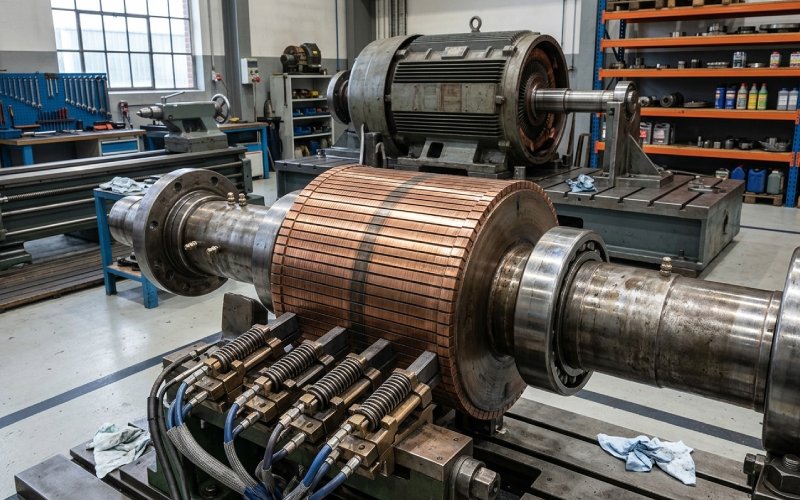
What Is Mica Undercutting in a Commutator, and Why Is It Strictly Necessary?
Key takeaways
- Mica undercutting is part of the working geometry of a commutator, not a cosmetic post-machining step.
- If the mica remains too high after turning, the brush loses a stable copper path. Chatter, streaking, edge burning, and fast wear usually follow.
- In shop practice, acceptable mica recess often falls in controlled ranges such as 0.8 to 1.3 mm or roughly 1/64 to 5/64 inch, depending on the design and duty. Depth alone is not enough. Edge chamfer, slot cleanliness, surface finish, and runout all matter.
Mica undercutting is the controlled recessing of the insulation between commutator bars so the brush runs on copper, not on the insulation line.
That sounds basic. It is not.
After a commutator is turned, the copper surface is restored to round. The mica is not automatically restored to the correct running condition. If it stays too high, the brush starts crossing a hard ridge where it expected an open slot. Contact becomes irregular. Sometimes the first sign is just noise. Sometimes a dirty film. Sometimes brush wear that makes no sense until the commutator comes back to the bench.
That is why undercutting is not optional.
Table of Contents
What Problems Does High Mica Cause on a Commutator?
High mica changes brush behavior before it shows obvious electrical damage.
The brush should ride the copper face, then pass the slot cleanly. When mica stands too close to the copper diameter, the brush stops seeing a clean transition. It lifts. It taps. It loses part of the contact patch. Then people start chasing the wrong cause.
Typical symptoms look like this:
- brush chatter
- ticking or squeal at the brush track
- uneven film build on the bar surface
- streaking across several bars
- fast brush wear
- edge burning at bar corners
- unstable running after resurfacing
None of these signs proves high mica by itself. But when several appear together after turning, the slot condition is one of the first things we inspect.
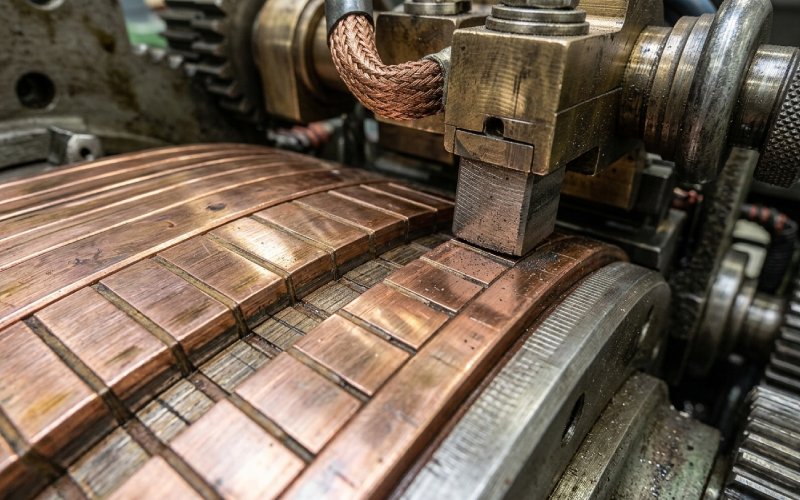
Common Commutator Faults Caused by Poor Mica Undercutting
| Visible condition | What it usually points to | What we check first |
|---|---|---|
| Brush chatter or noise | Brush disturbed at slot crossings | Mica recess, burrs, bar edge condition |
| Streaking on commutator face | Unstable contact across bars | Slot geometry, surface finish, runout |
| Fast brush wear | Brush riding insulation or torn edges | High mica, mica fins, copper feather edges |
| Edge burning | Harsh bar-to-slot transition | Chamfer quality, burr removal, brush seating |
| Dust packed in slots | Incomplete post-machining cleaning | Slot cleanliness, debris removal process |
| Intermittent sparking after turning | Copper restored, slot geometry not restored | Recess depth, edge break, holder alignment |
A commutator can be freshly machined and still be wrong. That happens more than it should.
When Should Mica Be Undercut After Turning?
In our factory, if turning has reduced the original recess, undercutting follows. No debate there.
We also undercut when inspection shows:
- proud mica
- partly closed slots
- mica fins at the bar walls
- copper dragged into the slot during machining
- chatter or streaking after resurfacing
- repeated film instability on an otherwise sound assembly
Turning restores roundness. It does not restore slot geometry. Those are separate conditions. Treating them as one step is where rebuild quality starts drifting.
What Is the Correct Mica Undercutting Depth?
There is no single universal depth. There never was.
But that does not mean the answer is vague. In actual shop work, acceptable recess values tend to cluster within practical ranges.
For many medium and heavy-duty commutators, a common working reference is around 0.8 to 1.3 mm. In inch-based rebuild work, you will often see practical targets discussed around 1/64 to 5/64 inch. On some jobs, the original drawing calls the final number. On others, the service history decides it. Either way, the recess has to be deep enough that the brush does not ride the mica, and controlled enough that the slot does not become a dirt pocket.
We do not release a commutator by depth alone. We check four things together:
- Recess depth: enough clearance below the copper running surface
- Slot form: no residual mica lip along either bar wall
- Edge condition: no copper burrs pushed into the slot
- Surface condition: no rough machining marks that upset the brush path
That is the difference between a cut slot and a finished slot.
What Surface Finish and Runout Should Be Controlled After Undercutting?
This part gets skipped in too many shops.
A commutator with the right mica recess can still run badly if the surface finish is coarse, the bar edges are torn, or the running diameter is not true enough. For many rebuild applications, a practical post-machining surface finish target often lands around Ra 0.9 to 1.8 µm. Smaller or more sensitive commutators may need tighter finishing. Rougher than that, and the brush starts fighting the surface instead of bedding onto it.
Runout matters too. In a lot of rebuild work, keeping total indicated runout within about 0.002 inch is a common control point. Not a magic number for every design. Still a useful shop reference. Once runout opens up, brush behavior becomes harder to read because slot geometry and mechanical movement start stacking on each other.
So, yes, mica depth matters. But if the commutator is out of truth or too rough, the machine will not care that the recess measured correctly.
Why Chamfering and Slot Cleaning Matter After Undercutting
Undercutting is not finished when the cutter stops.
The brush crosses each slot at the bar edge. That edge has to be controlled. If it is left sharp, burred, or feathered, the brush sees a mechanical hit at every transition. On many rebuild jobs, a small controlled bar-edge chamfer in the range of roughly 1/64 to 1/32 inch is enough to calm that transition without weakening the bar top.
Then there is the slot itself. If mica dust and copper debris stay packed inside, the groove is not ready for service. We clean every slot completely. Not because it looks tidy. Because trapped debris causes real trouble:
- abrasive action at the brush face
- contamination of the running track
- misleading inspection results
- in some cases, conductive bridging where it should not exist
Depth without cleaning is not finished work.
Common Mistakes in Commutator Mica Undercutting
1. Cutting too shallow
This is the most common problem we see.
The recess exists, but not enough. The brush still touches insulation once the unit beds in. That usually shows up as chatter, streaking, or odd brush wear a little later, not always on day one.
2. Leaving mica fins along the bar walls
From above, the slot looks open. Under magnification, one side still carries a thin mica remnant. That is enough to disturb the brush path.
3. Raising copper burrs during cutting
Poor tooling or rushed handling can push a copper feather edge into the groove. Then the slot is technically open, but the transition is still bad.
4. Ignoring bar edge treatment
Correct depth with sharp edges is still a bad commutator. The brush feels the edge every revolution.
5. Measuring depth in a dirty slot
A slot filled with dust can hide the true recess and hide burrs at the same time. We inspect only after the groove is fully cleaned.
How We Judge a Finished Mica Undercut in Production
A finished result is not just “mica removed.”
We expect to see:
- uniform recess around the full circumference
- clear clearance below the copper running face
- no loose mica particles or compacted dust
- no copper burrs at either slot wall
- clean chamfer at bar entry and exit
- smooth brush travel from bar to slot to next bar
That last one matters more than the paperwork. The brush reacts to what it touches, not to what the process sheet says.
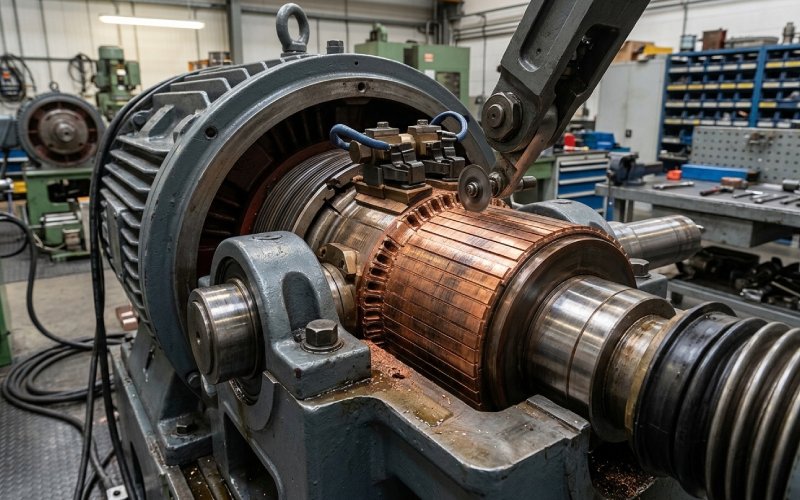
Why Mica Undercutting Has a Direct Effect on Service Life
Poor undercutting usually does not destroy a commutator in one event. It shortens life by making current transfer unstable, then forcing every related part to absorb the damage.
Brush wear rises. Film quality drifts. Heat marks begin at the bar edges. Operators start changing brushes, adjusting pressure, cleaning surfaces, trying to quiet the machine. Sometimes that buys time. It does not correct the geometry.
A commutator does not need theory repeated back to it. It needs the copper path, the slot, the edge, and the running truth all brought into control at the same time.
That is the real purpose of mica undercutting.
Need a Commutator Review Before Production or Rebuild?
If you are dealing with short brush life, chatter after turning, recurring streaking, or edge burning that keeps coming back, send us your drawing or inspection photos.
We review the points that usually get missed first:
- commutator bar layout
- mica recess condition
- slot form
- bar-edge treatment
- surface finish and running truth
It is better to correct the geometry before production or rebuild than to troubleshoot the same failure after assembly.
FAQ
Is mica undercutting always required after turning a commutator?
If turning has reduced or removed the original recess, yes. In most real rebuild cases, that means undercutting is part of the normal sequence.
Can high mica cause sparking?
Yes. Often the earlier signs are chatter, streaking, unstable film, or fast brush wear. Sparking tends to arrive after the contact condition has already been poor for some time.
What is a common mica undercutting depth range?
A lot of medium and heavy-duty work falls around 0.8 to 1.3 mm, or roughly 1/64 to 5/64 inch in inch-based shop practice. Final targets still depend on commutator design, speed, and duty.
Is correct depth enough by itself?
No. Edge chamfer, slot cleanliness, surface finish, runout, brush seating, and holder condition all affect the final result.
What surface finish is usually acceptable after machining?
For many rebuild jobs, a practical reference range is around Ra 0.9 to 1.8 µm. Some smaller or more demanding commutators need a finer finish.
What runout level should be checked?
For many rebuild applications, around 0.002 inch TIR is a common control point. The acceptable limit still depends on the specific design and service requirement.
What is the most common undercutting mistake?
Too shallow a recess, followed closely by poor deburring at the bar edges. That combination causes a lot of brush trouble that gets blamed on other parts first.