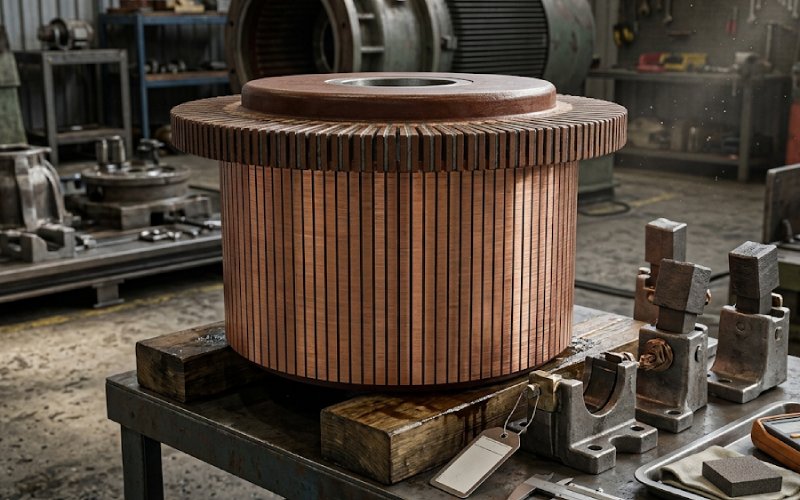
Large Industrial Commutator Repair and Maintenance: 7 Essential Technician Skills, Tolerances, and Troubleshooting Checks
When a large industrial commutator starts sparking, chattering, dragging copper, or burning bar edges, the repair is rarely just surface work.
Too many failures get treated backwards. The copper looks bad, so the copper gets cut. Then the machine goes back into service with the same weak spring force, the same holder misalignment, the same neutral error, the same contamination path. A cleaner surface. Same machine. Same trouble, just delayed.
That is why large industrial commutator repair is less about one operation and more about technician range. Measurement. Fault isolation. Brushgear setup. Controlled machining. Electrical testing. Restart discipline. Miss one of those and the job may still look finished. It just is not finished for long.
Table of Contents
Key takeaways for industrial commutator service
Before getting into the details, here are the field checks that usually decide whether a repair lasts:
- Read the wear pattern before touching the surface.
- Measure runout from the journals, not from the commutator face by eye.
- Check for loose, lifted, or unstable bars before machining.
- Verify brushholder clearance, stand-off, spacing, and free brush travel.
- Measure spring pressure across all holders and correct the spread, not just the low ones.
- Treat undercut depth, mica condition, and edge chamfer as part of the repair, not cleanup.
- Use electrical testing to confirm whether the fault is mechanical, magnetic, or both.
- Seat new brushes under controlled conditions before full load.
A few common working targets appear again and again in shop practice:
| Check | Typical field target or alert point |
|---|---|
| Brushholder stand-off | Often around 2.5 to 3.2 mm from the commutator surface |
| Brush spring pressure | Common working range around 4.0 to 6.0 psi, depending on duty and brush grade |
| Runout concern | Roughly 3 mils / 75 µm and above usually deserves immediate attention |
| Brush seating contact | About 75% to 80% contact before normal service loading |
| Undercut depth | Often around 1 to 1.5 times slot width |
| Edge chamfer | Light chamfer, commonly around 0.2 to 0.5 mm |
These are not universal limits. Machine-specific values still win. Still, they are good filters. Good enough to stop bad assumptions early.
Why large industrial commutator repairs fail after “successful” service
The short answer: the visible defect gets repaired, the system defect stays.
A badly marked surface can come from several different chains of failure:
- weak or uneven brush pressure
- holder geometry that looks acceptable until load comes on
- out-of-round running
- high mica or poor undercut finish
- contamination in the contact path
- poor current sharing across brushes
- field, interpole, or neutral position problems
That is the first skill requirement. Not machining. Not cleaning. Reading the pattern correctly before the machine gets stripped into guesses.
The commutator surface is evidence. The brush face is evidence too. If those two stories do not match, stop there and sort that out first.
1. How to read commutator wear patterns and surface film
A technician working on large commutators needs pattern recognition that goes beyond “good color” and “bad color.”
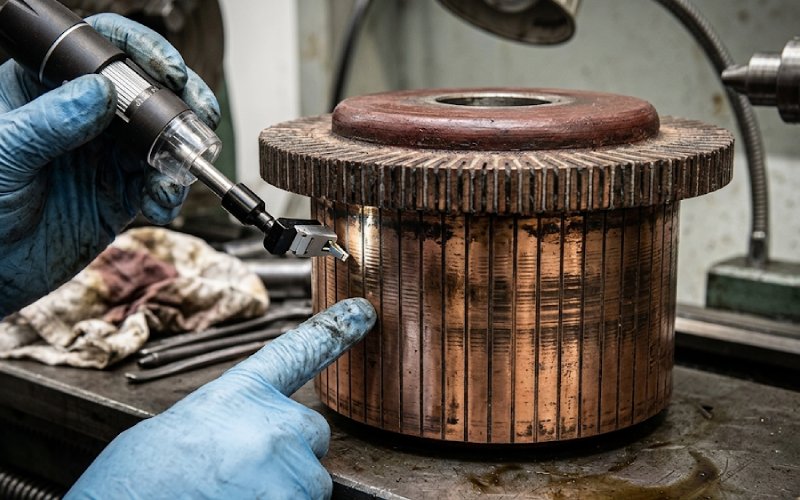
Surface appearance matters, but not in the lazy way people use it. A dark, even track can be stable. A bright commutator can be unstable. Patchy film, trailing edge distress, rail marks on brush sides, local bar-edge burning, grooving, slot marking, chatter marks, copper drag, and broken brush corners tell more than overall color ever will.
A few examples:
- Localized edge burning often points to commutation instability, poor brush seating, wrong holder position, or unequal current sharing.
- Grooving may point to contamination, abrasive debris, poor brush grade fit, or hard particles moving through the contact path.
- Chatter marks often bring mechanical issues into the frame: runout, high bars, high mica, unstable spring force, loose holders.
- Copper drag or smeared copper should make you think about overheating, poor film, severe arcing, or a surface that was cut but not finished for actual service conditions.
The important part is this: do not classify the mark and then stop. Classify it. Map it to a failure path. Then test that path.
That is the job.
2. Mechanical measurement and commutator runout control
Large industrial commutators do not forgive visual judgment. They especially do not forgive visual judgment after a technician has already decided what they want to find.
Runout has to be measured properly. Indicate from the journals. Check shaft-to-commutator relationship. Confirm whether the problem is commutator eccentricity, shaft issue, bearing condition, or a stack-up between them. Looking at the surface while rotating slowly proves very little.
This is where a lot of weak repairs begin. The commutator gets skimmed because it looks uneven. No one proves whether the base geometry is stable. No one checks whether the bar pack is secure. No one checks whether a raised bar is actually loose. The repair becomes cosmetic.
A technician servicing large industrial commutators should be comfortable with:
- dial indication from the journals
- checking radial and axial behavior separately
- identifying bar movement versus general out-of-round
- checking for loose or lifted bars before machining
- distinguishing a surface defect from a structural defect
Loose bars deserve special attention. If a bar is unstable, machining the surface can make the track look cleaner for a short period, then fail again once load and heat cycle back in. The bar pack has to be mechanically trustworthy before surface correction means anything.
3. Brushholder setup, clearance, and spring pressure checks
A surprising number of “commutator problems” are brushholder problems that stayed unmeasured.
Holder stand-off matters. Holder alignment matters. Equal spacing matters. Brush freedom inside the box matters. A brush that sticks, rocks, cocks, or drags inside the holder cannot maintain a stable contact pattern even if the commutator surface is nearly perfect.
This area separates parts changers from technicians.
The core checks are simple:
- verify holder distance from the commutator
- verify holder face is square to the surface path
- verify brush shunts are not interfering with movement
- verify brush side clearance is controlled, not sloppy
- verify all brushes move freely under spring force
- verify spring pressure across the full set, not one pocket at a time
Spring pressure deserves its own paragraph because this is where many repeat failures hide. Low pressure is bad. Unequal pressure is sometimes worse. One or two weak holders can create a pattern that gets blamed on the entire machine. Then the whole brush set gets replaced, the pattern changes slightly, and the actual cause stays in service.
A capable technician measures every holder. Records the spread. Corrects the system.
Not glamorous. Very expensive when skipped.
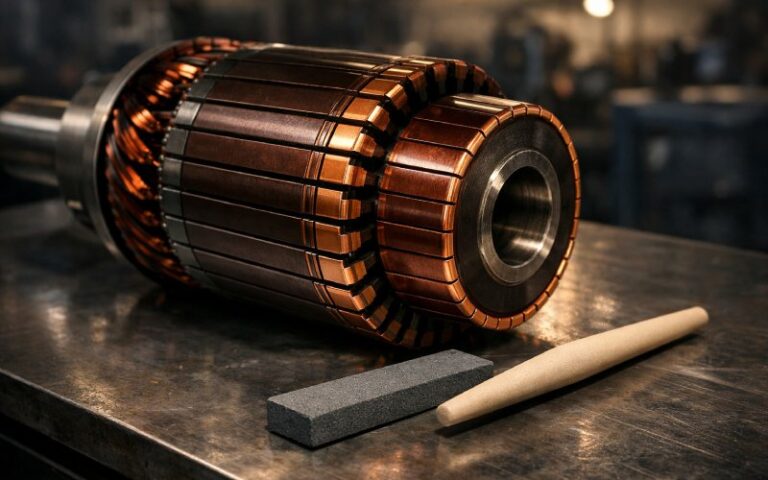
4. Commutator machining, undercutting, and edge chamfer control
Turning a commutator is not the repair. It is one part of the repair. Sometimes a small part.
The objective is not to produce the prettiest copper surface in the shop. The objective is to restore a stable contact path with minimum material removal and no fresh defects introduced in the process.
That means the technician needs judgment in five areas:
Material removal discipline
Cut only what is needed to restore geometry and remove the damaged layer. Large commutators do not benefit from casual stock removal. Every unnecessary cut reduces future life and narrows later repair options.
Surface finish judgment
An overly rough surface can tear up brushes during startup. An overly glossy surface can delay proper film development. The right finish is not a beauty standard. It is a service condition decision.
Undercut quality
Undercut depth often lands around 1 to 1.5 times slot width. That is a common guide, not a sacred rule. What matters is that the mica is below the copper surface enough to avoid mechanical interference, while the slot remains clean and stable.
Mica fin removal
If the undercut leaves fins, ragged edges, or loose debris, the job is not done. Fins will break off. Or they will abrade the brush path. Neither outcome is interesting.
Bar edge chamfer
Sharp copper edges chip and disturb brushes. The edge needs to be lightly broken. Not rounded into laziness. Not left sharp out of haste.
This is a good place to say what experienced people already know but still ignore on rushed jobs: a poor undercut can ruin a good skim. A sharp edge can ruin a good brush. A dirty slot can ruin both.
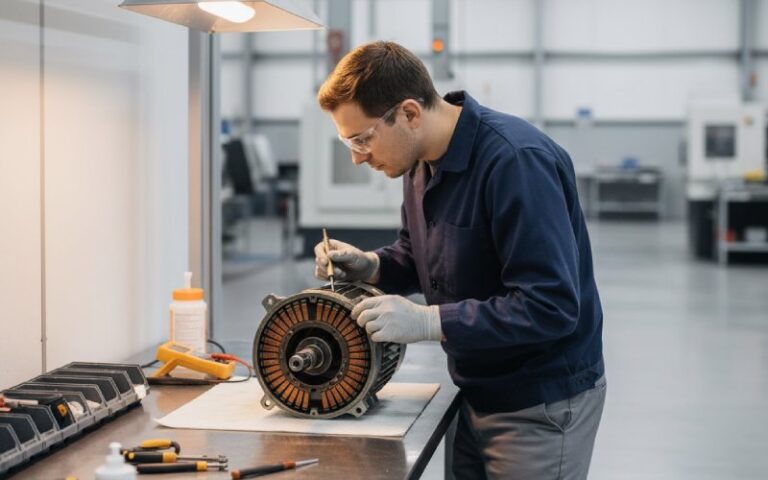
5. Electrical tests that confirm a commutator fault
A large industrial commutator can show a mechanical symptom that starts from an electrical cause. That is why good technicians do not stop at the surface.
The minimum expectation is a test sequence that can answer these questions:
- Is the insulation to ground sound?
- Are bar-to-bar readings uniform around the circumference?
- Is there evidence of shorted or open elements?
- Are field and interpole circuits behaving correctly?
- Is polarity verified?
- Is brush position relative to neutral actually correct under service conditions?
Bar-to-bar work is especially useful when treated as a pattern, not a single reading. One odd reading matters. A sequence trend matters more. On large machines, the point is not to prove that one bar is “bad.” The point is to prove whether the electrical structure is uniform enough to support clean commutation.
This is also where many repairs get misclassified. The machine sparks. Brushes wear fast. The surface is ugly. Everyone assumes the commutator caused the problem. Sometimes it did. Sometimes the commutator is just where the magnetic mistake becomes visible.
That distinction is expensive.
6. Industrial commutator cleaning and contamination control
Cleaning is part of service quality, not an afterthought at the end.
Carbon dust, copper fines, oil mist, process dirt, and old cleaning residue all change the contact interface. They also create the conditions for false diagnosis. A contaminated path can mimic a surface problem, a brush problem, or an electrical instability depending on where the debris sits and what it mixes with.
Technicians working on large commutators should control three things:
Debris generation
Machining, seating, stoning, and undercut cleanup all produce debris. Plan for it before the work starts.
Debris removal
Vacuuming is usually safer than blasting contamination deeper into the machine. Windings, holders, and insulation systems do not benefit from airborne carbon packed into corners.
Surface handling after cleaning
A clean surface can still be mishandled. Oily rags, dirty gloves, contaminated abrasives, and reused shop wipes all leave traces that change early film formation.
This sounds basic until a machine comes back with unstable film and no one can explain why. Then suddenly it is not basic.
7. Controlled recommissioning after brush replacement or commutator repair
This part gets rushed because everyone thinks the hard work is over.
It is not over.
New brushes need seating. Re-machined surfaces need observation. Spring settings need confirmation under motion. Sparking behavior needs to be watched across the full brush set, not from one convenient side of the machine. Heat needs to be checked. Noise matters. Smell matters too, within reason. Machines tell on themselves early if someone is paying attention.
A proper recommissioning sequence usually includes:
- confirming the machine is mechanically clean and electrically safe
- verifying holder setup and spring pressure one more time
- running at low or controlled load first
- watching brush track development and spark behavior
- checking temperature rise and localized hot spots
- increasing load in steps instead of jumping to full duty
- reinspecting brush face contact after initial operation
Brush seating is not complete because the machine ran for a while. It is complete when contact is broad enough and stable enough to support normal loading without edge distress, noise, or unstable film. Until then, the repair is still in progress.
Practical troubleshooting table for large industrial commutator service
| Visible symptom | Likely fault path | Technician skill required | First useful check |
|---|---|---|---|
| Heavy sparking across multiple brush arms | Neutral error, field/interpole issue, poor current sharing | Electrical diagnosis plus brushgear review | Confirm brush position, polarity, and bar-to-bar pattern |
| Localized bar-edge burning | Uneven pressure, poor seating, holder misalignment, unstable bar | Pattern reading and holder setup | Compare spring force and inspect holder geometry |
| Brush chatter or broken corners | Runout, high mica, high bars, weak pressure, holder instability | Mechanical measurement | Indicate from journals and inspect mica/bar condition |
| Rapid uneven brush wear | Sticking brushes, uneven pressure, contamination, poor seating | Brushgear inspection | Check free movement and pressure spread |
| Grooving on the commutator track | Debris, abrasive contamination, unstable brush contact | Surface diagnosis and cleaning control | Inspect dust source and holder condition |
| Copper drag or smeared copper | Severe arcing, poor film, overheating, wrong finish condition | Fault isolation plus recommissioning control | Check spark pattern, surface finish, and load history |
| Good-looking surface but recurring trouble | Root cause never removed | Full-system diagnosis | Recheck electrical, mechanical, and setup data together |
The technician skills that matter most
If this has to be reduced to one list, use this one.
A technician servicing large industrial commutators should be able to:
- read surface and brush wear patterns without jumping to one-cause explanations
- measure runout, bar stability, and mechanical truth from the correct reference points
- set up brushholders with proper stand-off, clearance, alignment, and freedom of movement
- measure and normalize spring pressure across the full brush system
- machine the commutator with restraint, then finish the undercut and edges correctly
- use electrical tests to separate commutator symptoms from winding or magnetic causes
- manage contamination before, during, and after the repair
- recommission the machine under controlled load and verify that the repair is actually stable
That is the real skills list. Not vague “attention to detail.” Not “mechanical aptitude.” Those phrases belong in interviews. This work belongs in measurements.
Final word
Large industrial commutator maintenance is usually presented as surface care. It is not. It is contact-system control.
The copper is only one part of that system.
A technician who can cut copper but cannot read wear patterns will miss the cause. A technician who can read patterns but does not measure holder force will miss the spread. A technician who does both but skips electrical confirmation may still send out a machine with the original fault intact.
That is why the best commutator repairs tend to look almost plain. No drama. No excessive cutting. No mystery marks left unexplained. Just a stable surface, a stable brush system, and a restart that does not argue.
FAQ: Large Industrial Commutator Repair and Maintenance
What causes excessive sparking on a large industrial commutator?
Usually not one thing. Common causes include poor brush seating, weak or uneven spring pressure, incorrect brush position, runout, high mica, contamination, and magnetic issues tied to field or interpole behavior. If sparking is widespread, do not assume the commutator surface caused it. Confirm the electrical side too.
What spring pressure should be used for industrial commutator brushes?
A common working range is around 4.0 to 6.0 psi, but that is only a starting point. Brush grade, speed, load, and machine duty matter. The more important issue in practice is pressure consistency across all holders.
How much runout is too much on a commutator?
A common guide is about 1 to 1.5 times slot width. The point is not to hit a ritual number. The point is to leave the mica low enough and clean enough that it does not interfere with brush passage or debris control.
Do new brushes need to be fully seated before full load?
They need enough stable contact area before normal service load is applied. A practical target is often around 75% to 80% face contact. Rushing that step is one of the simplest ways to damage a fresh repair.
Should a commutator be polished to a mirror finish?
Not automatically. Surface finish should support film formation and stable contact, not shop pride. Too rough is a problem. Too glossy can also be a problem. The finish has to match the brush system and service conditions.
How do you know whether a commutator problem is actually an electrical fault?
Run the evidence chain. If surface damage is paired with abnormal bar-to-bar readings, polarity issues, poor neutral setting, or field/interpole imbalance, then the visible commutator damage may be the result, not the root cause.
What is the most common mistake in large industrial commutator repair?
Treating it like a machining job only. The repair that lasts usually comes from combining surface diagnosis, mechanical measurement, brushgear correction, electrical confirmation, contamination control, and controlled recommissioning.