Is a Slip Ring a Commutator? A Practical Guide for Engineers
Short answer: no. But it’s not quite that tidy, especially once marketing names and legacy drawings get involved.
Table of Contents
1. Quick answer
If you only read one section, make it this one.
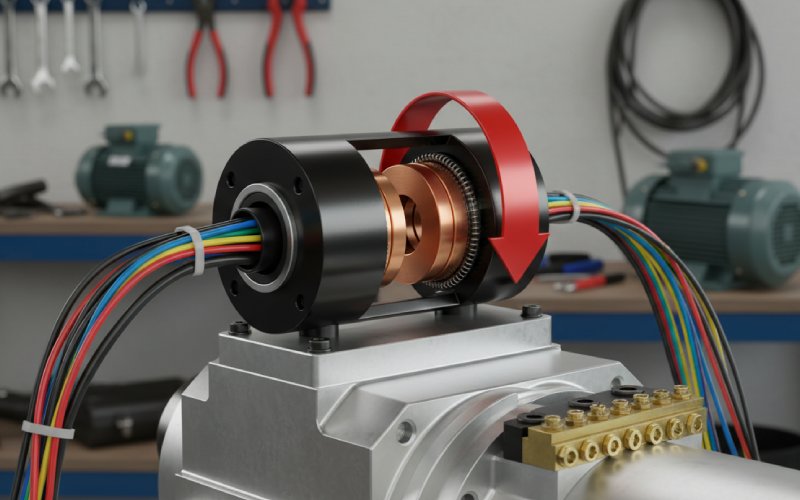
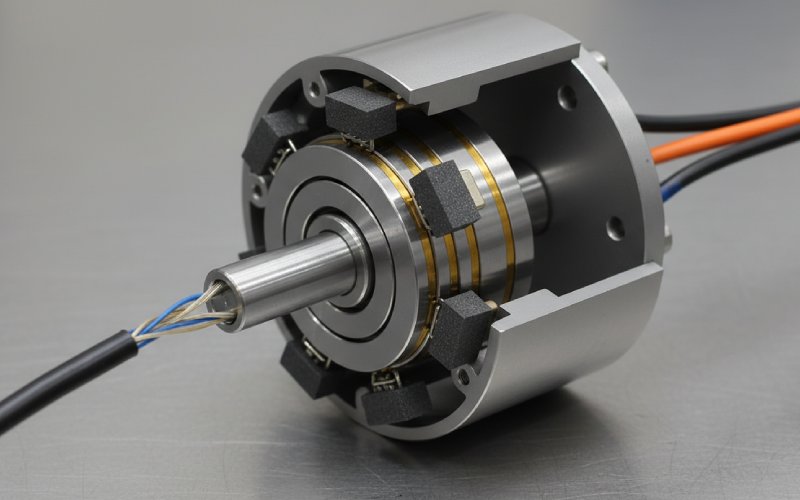
- A slip ring is a continuous rotary electrical interface; it passes power/signals between stationary and rotating parts without intentionally changing the waveform or polarity.
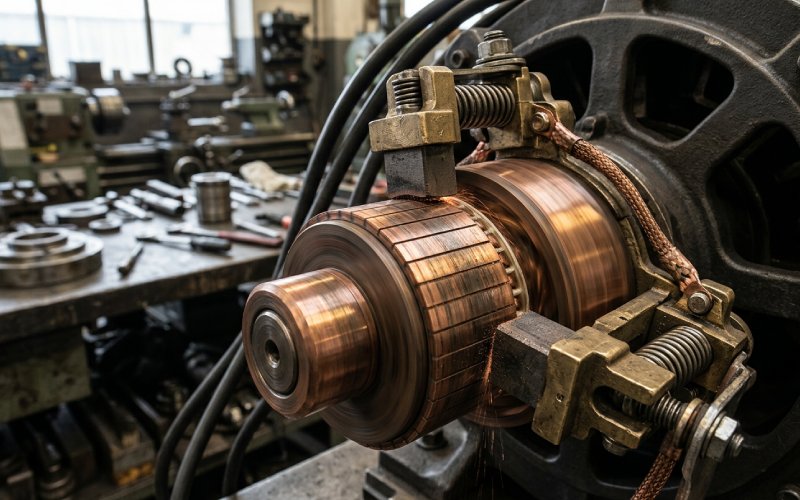
- A commutator is a segmented rotary switch used mainly in DC motors and generators to reverse current direction in the armature.
- So:
- All commutators are rotary electrical interfaces.
- Not all rotary interfaces are commutators.
- A normal slip ring is not a commutator because it doesn’t perform the switching/reversal role.
Where it gets messy:
- Some suppliers use the phrase “slip ring commutator” for assemblies in generators or motors that combine continuous transfer with specific switching patterns.
- Some older documentation casually calls a slip ring a “commutator ring,” especially in DC machine context.
- Translation issues (Chinese, German, etc.) sometimes blur the terms in datasheets.
So when someone asks “is a slip ring a commutator”, what they usually need is:
“Do I need a continuous rotary connector, or a current-reversing segment structure for a DC machine?”
2. Slip ring vs commutator at a glance
Here’s a compact comparison you can drop into internal documentation or send to a supplier when clarifying specs.
| Aspect | Slip Ring | Commutator |
|---|---|---|
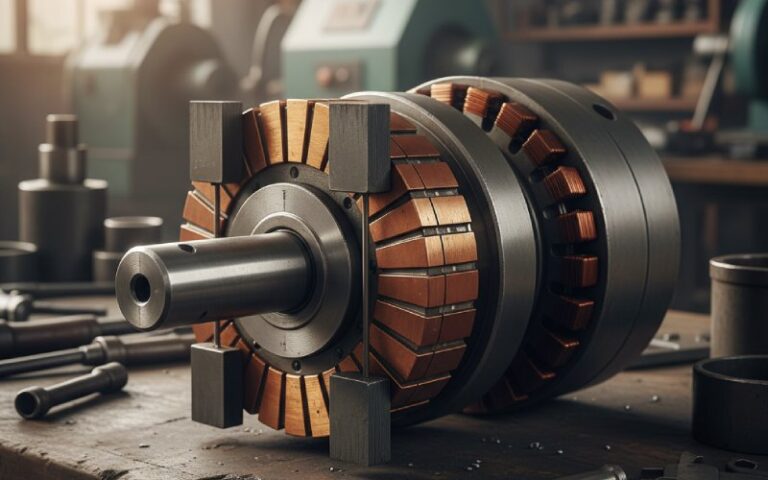
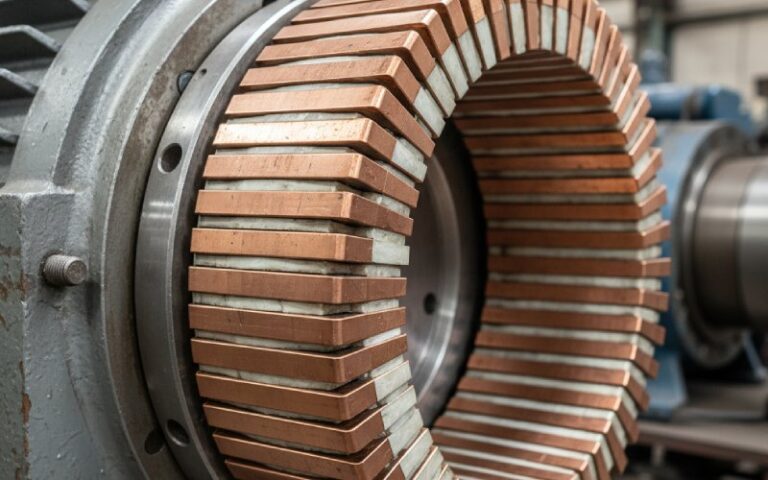
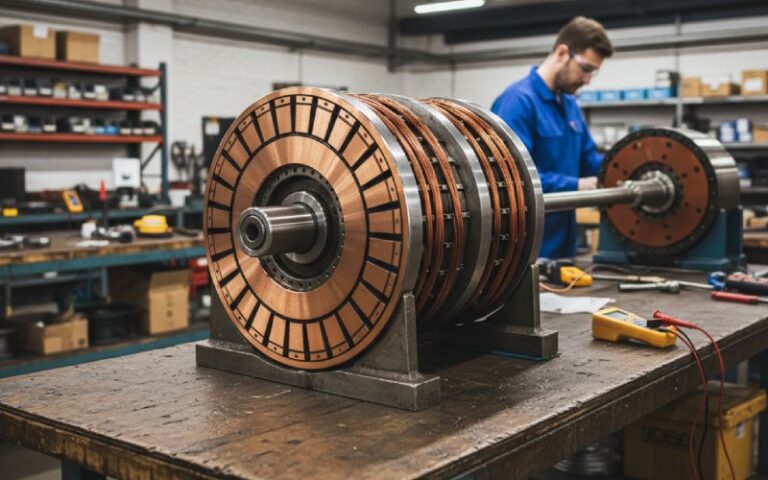
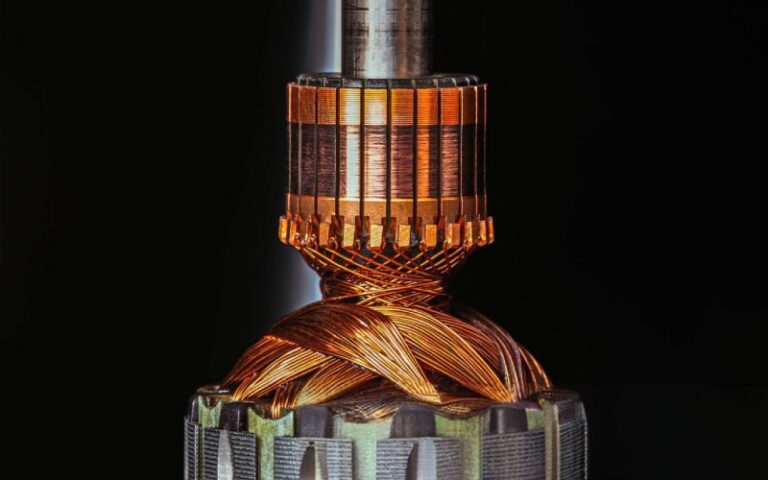
| Basic geometry | One or more continuous conductive rings | Segmented copper bars insulated from each other |
| Main job | Maintain electrical continuity between stationary and rotating parts | Reverse / switch current in armature windings in sync with rotation |
| Typical machines | AC generators, wound-rotor induction motors, wind turbines, rotary tables, radar, packaging machines | DC motors and DC generators, some universal motors |
| Waveform effect | Ideally no change to waveform; just transmission | Intentionally converts internal AC to external DC (or vice versa) by mechanical switching |
| Contact style | Stationary brushes on smooth ring surface | Brushes on segmented ring, switching segments periodically |
| Direction of rotation | Unlimited, continuous | Also continuous, but switching timing is critical |
| Key failure concern | Noise, contact resistance, wear debris, mixed-signal integrity | Segment wear, arcing, brush bounce, timing irregularities |
| Can one replace the other? | Only if the original part was never a true commutator, just a continuous ring | Usually no; you lose the required switching function |
The row that matters most for selection is the “main job” row. If the device must change polarity or routing in step with rotor position, you’re in commutator territory.
3. Why people keep mixing the terms
Your team probably sees all of these phrases floating around:
- “slip ring motor”
- “slip ring commutator”
- “commutator ring”
- “collector ring”
And then Wikipedia politely says: some people also use commutator for slip rings, but they’re different; commutators are specialized for DC machines and are segmented, while slip rings are continuous.
A few reasons this mess persists:
- Historical naming Early machine builders weren’t following IEC naming discipline. A rotating copper ring got called whatever the local engineer preferred. Over time, some names stuck in particular industries.
- Translation and catalog shorthand OEMs in one language export to another; “collector ring”, “commutator ring”, “slip ring” get swapped around in brochures. Some sources even say a slip ring “can be named as a commutator” based on application, then immediately admit they are different parts.
- Hybrid products Some vendors sell “slip ring commutators” as a single assembly because they combine multiple functions in one rotor stack. These are still designed with clear internal roles: continuous paths vs switching segments, even if the marketing label is fuzzy.
- Low-level education material Intro physics diagrams often show “slip ring commutator” as one vague object, especially when comparing AC vs DC generators. The difference gets compressed for teaching, and that simplification leaks into practice later.
Practically, when your spec says “commutator”, most serious suppliers will think DC machine unless you explicitly say otherwise.
4. So, is a slip ring ever a commutator?
From a strict engineering perspective:
A slip ring is not a commutator.
Because:
- Slip rings are designed for continuous conduction, not for direction reversal.
- Commutators are segmented with insulation gaps and are designed around controlled switching events.
But there are three edge zones where the confusion is understandable:
4.1 Combined “slip ring commutator” stacks
Some AC generators and special machines integrate what vendors call a “slip ring commutator”: multiple circuits, some continuous, some switching, all on the same rotating hub.
From outside the housing, it’s one assembly. Internally, though:
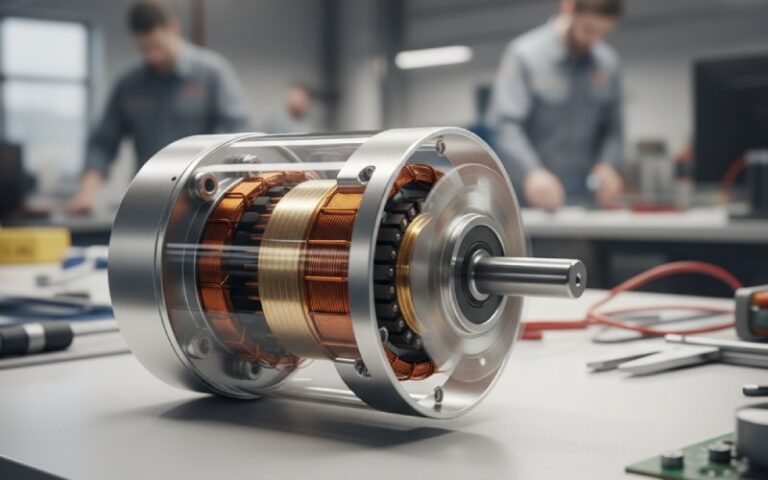
- Slip ring sections: smooth rings carrying excitation, data, or auxiliary power.
- Commutator sections: segmented parts handling position-dependent routing.
Calling the whole thing “a commutator” is convenient, but imprecise. If you’re replacing it, you have to match both functions, not just the mechanical envelope.
4.2 Mis-labeled continuous rings on DC machines
Some older DC machine documentation calls the smooth rotor rings “commutator rings” even when they are just slip rings feeding rotor circuits. Newer sources explicitly distinguish these as slip rings, with commutators reserved for the segmented parts.
So you might open a 30-year-old drawing that says “commutator ring” and find… a standard three-ring slip ring.
4.3 Non-motor rotating interfaces using “commutator” in name
Certain industrial slip ring suppliers use “commutator” in product pages purely as an SEO hook or colloquial term, even when the product is a standard rotary electrical joint for robots, wind turbines, or test rigs.
In those cases, you can safely treat it as a slip ring; there is no hidden DC motor commutation going on.
5. Design and procurement implications
This is where the distinction starts to affect real projects.
5.1 When you absolutely need a true commutator
You need a true commutator when:
- You have a DC motor or DC generator that depends on mechanical switching to produce DC output or torque in the correct direction.
- Timing of current reversal vs rotor angle is part of the electromagnetic design.
- Electronic commutation (e.g., with IGBTs or MOSFETs) is not available or not part of the architecture.
Swapping this for a normal slip ring would leave coil currents un-reversed. The device might stall, vibrate, or simply fail to deliver rated performance.
5.2 When a slip ring is the correct tool
Use a slip ring when you only need:
- Continuous AC or DC power transfer across a rotating joint.
- Signal and data transfer: fieldbuses, encoder signals, Ethernet, RF (with appropriate design), etc.
- Interfaces for wind turbines, rotary tables, packaging machines, radar, cameras, medical gantries, cable reels.
The slip ring doesn’t care about phase relationship or polarity as such. It just has to meet current, voltage, bandwidth, insulation, and environmental requirements.
5.3 Maintenance and failure differences
From a maintenance manager’s viewpoint, confusing the two can hide the real failure modes.
- Slip ring typical issues:
- Contact resistance drift from wear or contamination
- Noise and intermittent signals, especially on low-level instrumentation lines
- Debris build-up causing tracking or temperature rise
- Commutator typical issues:
- Uneven segment wear, “bar burning”
- Arcing from misaligned brushes or overload
- Commutation failure under transient loads
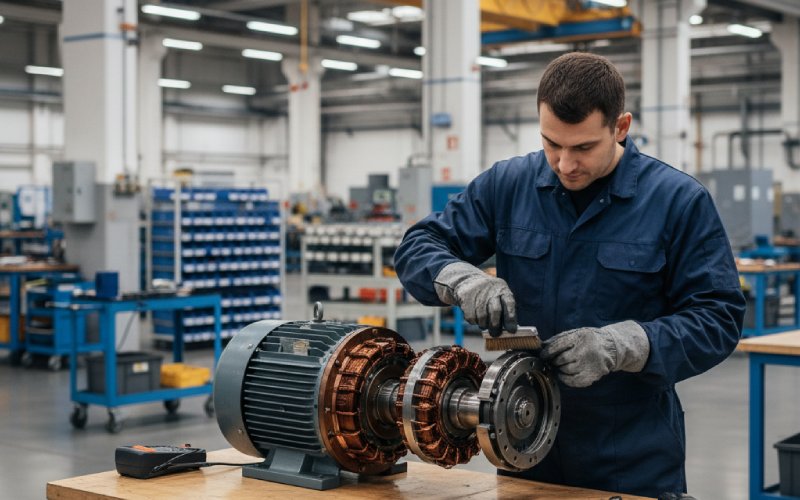
Your preventive maintenance plan and spare parts strategy need to reflect which device you actually have. Calling everything a “commutator” tends to hide these nuances.
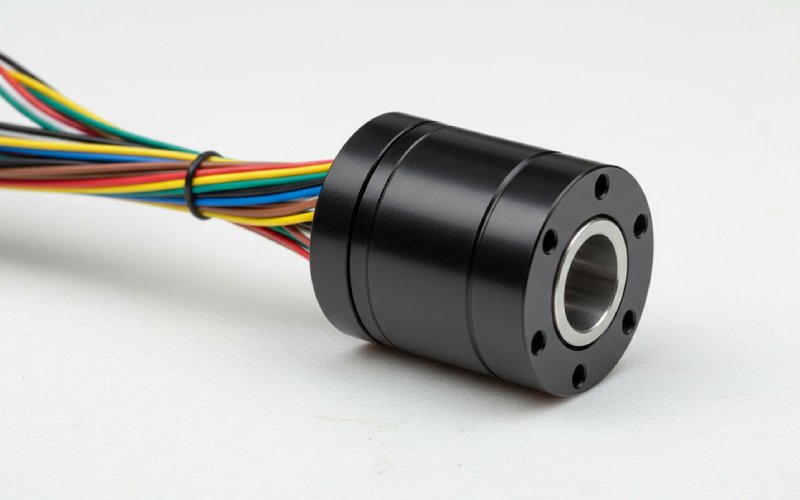
6. Practical checklist: slip ring or commutator?
When someone in the team drops the question “is this just a slip ring, or a commutator?”, run through this quick checklist:
- What machine type is it?
- DC motor / DC generator → probably includes a commutator.
- Wound-rotor induction motor → uses slip rings to route rotor resistance.
- Wind turbine, robot, CT gantry, rotary table → almost always slip rings.
- Is any function explicitly described as “reversing current” or “commutating DC”?
- Yes → you need a commutator (or electronic equivalent).
- No → likely a slip ring.
- Are the rings continuous or segmented?
- Smooth rings, no radial insulation gaps → slip ring.
- Individual copper bars with visible gaps → commutator.
- What happens electrically over 360° rotation?
- Connection map stays the same at all angles → slip ring behavior.
- Connection map changes with angle (e.g., A+ becomes A− every half turn) → commutator behavior.
- What does the latest standard or OEM manual call it?
- If the OEM drawing uses both terms, pay attention to context:
- “slip ring motor” but “commutator segments” is a red flag that both may be present in the system.
- If the OEM drawing uses both terms, pay attention to context:
Once you answer those, the original question “is a slip ring a commutator?” usually collapses into a much more useful one:
“Which contact system is this machine actually designed around, and what specs do I need to match when I buy or redesign it?”
7. FAQ: Slip rings vs commutators
Q1. Why do some datasheets call a device a “slip ring commutator”?
Because the assembly combines continuous rings and switching segments, or because the vendor is using looser terminology for marketing/SEO reasons. Technically, the slip ring part and the commutator part inside that assembly still do different jobs.
Q2. Can I replace a commutator with a slip ring if I add electronics?
Sometimes, but it becomes a redesign, not a like-for-like replacement.
You could route armature coils through a slip ring and perform commutation electronically with power electronics.
That changes the machine into something closer to a brushless DC or AC machine.
Mechanical footprint might be similar; electromagnetic behavior will not be the same as the original design without careful engineering.
Q3. Are slip rings only for AC and commutators only for DC?
Not exactly:
Slip rings can carry AC or DC, including mixed signals and data; they’re agnostic to waveform.
Commutators are closely tied to DC behavior in the external circuit, but internally they handle induced AC that gets mechanically rectified.
So the AC/DC separation often taught in basic courses is a simplification, helpful for exams but not fully precise.
Q4. Why does Wikipedia say some people call slip rings “commutators”?
Because in everyday use, some engineers and technicians historically used “commutator” as a general term for “the copper rotating thing with brushes”.
The same source then immediately clarifies that commutators are segmented and specific to DC machines, while slip rings are continuous and used in more general rotary interfaces.
Q5. For my B2B project, what should I write in the spec: “slip ring” or “commutator”?
If you want clear communication with vendors:
Use “slip ring” for any continuous rotary electrical interface that doesn’t do commutation.
Use “commutator” only when you really mean the segmented DC machine component.
If you’re sourcing a combined assembly, you can specify “rotor assembly including slip rings and commutator segments” and then define each section separately.
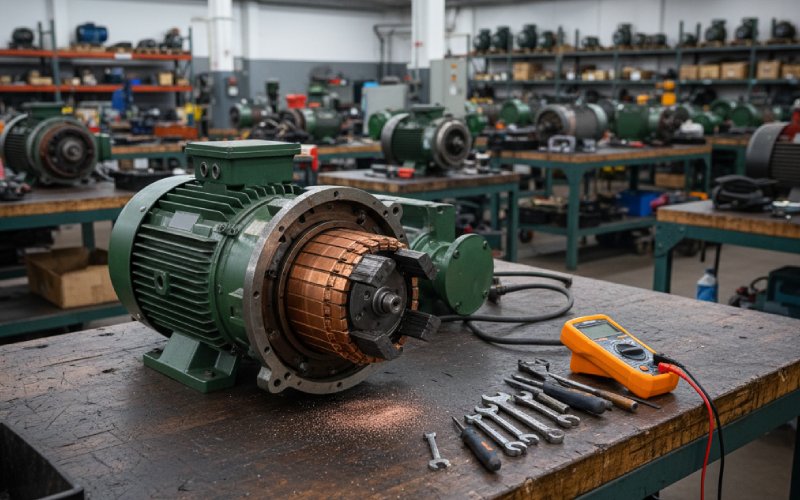
That way, your RFQs go to the right suppliers, you get fewer misunderstandings, and your maintenance team knows exactly what they’re dealing with when the machine comes apart on the shop floor.