How to Check a Commutator for Roundness or Runout
Most bad readings start before the indicator touches copper.
That is usually the whole job, really. Not the gauge. Not the number. The datum. If the armature is not referenced from the bearing journals or true centers, the reading can look like a commutator problem when it is actually shaft error, journal error, or a setup issue. We use V-blocks for a fast screen. For final judgment, we prefer the armature rotating on the same axis the machine will actually live on.
In our factory, we split the check into two questions:
- Is the brush track rotating true to the shaft axis? That is runout.
- Is the copper surface itself staying round and even, bar to bar, across the working width? That is the part many people skip, then wonder why the machine still sparks.
A commutator can pass a casual TIR check and still be wrong. One high bar. A shallow flat. Mica creeping too high. A cold rotor that goes bad only when hot. Those are different failures. Same symptom at the brushes.
Table of Contents
What we check before we record any number
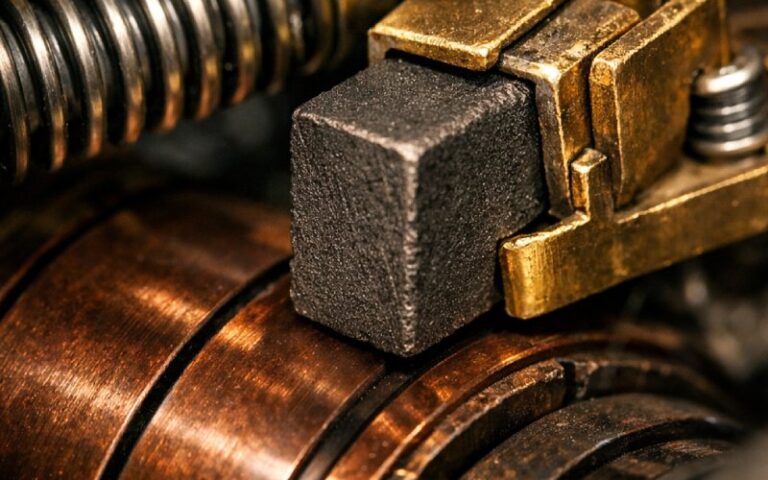
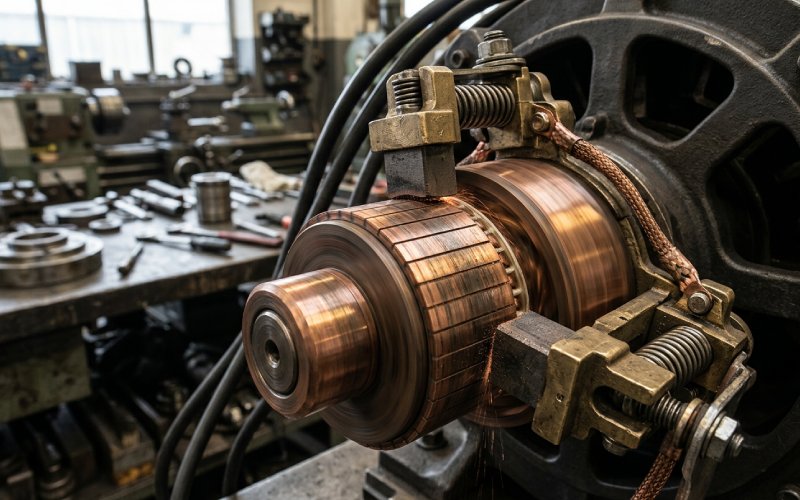
We do not put an indicator on a dirty, smeared, copper-dragged surface and pretend the number means anything. The brush track gets cleaned first. Slots get cleared. Carbon dust and loose debris come out. Then we inspect for arcing marks, pitting, dark edge burning, flats, and obvious raised bars. If the track already shows one polished bar followed by rough or burned bars, we treat that as a high-bar pattern until proven otherwise.
Then we check the setup:
- bearing journals or centers clean and undamaged
- no wobble from the support method
- armature rotated slowly by hand, not snapped through a revolution
- indicator tip square enough to the surface to avoid a false reading
- measurement taken near the actual brush path, not somewhere convenient but irrelevant
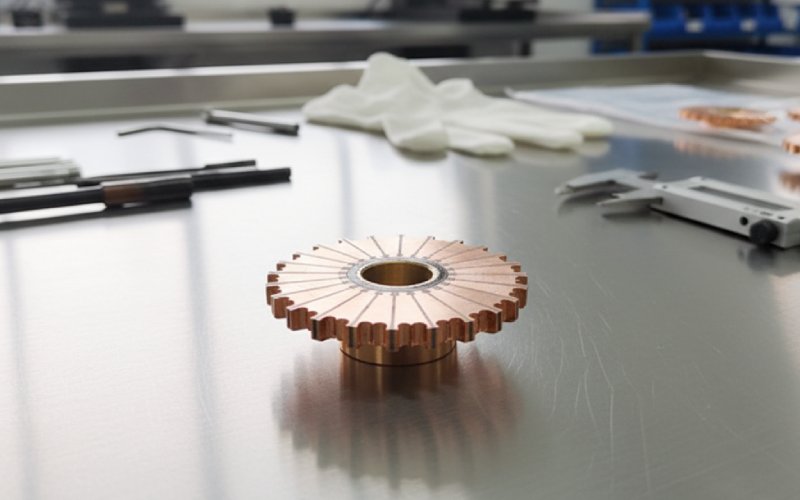
Our factory method for checking commutator runout
1) Reference the correct axis
For a quick incoming inspection, V-blocks on the bearings are fine. For machining setup or final acceptance, we indicate from the bearing journals and center the armature first. If the journals are not running true, the commutator reading is already contaminated. On rebuild work, we hold the journals very tight before any cut is taken.
2) Put the dial indicator on the brush track
We place the indicator on the commutator surface where the brush actually rides. Not on the riser end. Not on a damaged edge if the working track is elsewhere. Then we rotate one full turn and record total indicator runout, low point to high point. That number is useful, but it is not the whole story.
3) Repeat at more than one axial position
We check near one edge of the brush track, then near the other edge, then near the middle if the width is large enough. Why. Because taper and barrel shape hide inside one pretty number. A commutator can look acceptable at the center and still kick the brush at the edge.
4) Check adjacent bar height, not just full TIR
This is where bad commutators survive weak inspections. A machine may tolerate modest overall runout better than it tolerates one abrupt bar-to-bar step. On our bench, adjacent bar difference gets its own check whenever the brush track shows localized distress or when sparking history is already known. High bars and camming create brush lift, then the following bars take the damage.
5) Compare the number with machine severity, not with wishful thinking
A lot of industrial work still uses 0.05 mm / 0.002 in as a practical screening limit for total runout. That is not universal. Higher peripheral speeds are held tighter. Some repair criteria drop maximum TIR to around 0.038 mm / 0.0015 in, with even tighter quadrant control, while adjacent bar height stays around 0.005 mm / 0.0002 in.
Working tolerance guide we use on the shop floor
| Check item | Practical factory guide | What it tells us |
|---|---|---|
| Quick-screen total runout | ≤ 0.05 mm / 0.002 in | Good starting limit for many industrial commutators |
| Adjacent bar step | ≤ 0.005 mm / 0.0002 in | Helps catch high bars that a broad TIR reading hides |
| Higher-speed service total runout | often tightened to 0.038 mm / 0.0015 in | Brush stability gets less forgiving as surface speed rises |
| Journal setup before turning | about 0.013 mm / 0.0005 in or better | Prevents cutting a “true” commutator on a false axis |
| Post-machining surface roughness | around Ra 0.9 to 1.8 µm for industrial units | Smooth enough for brush life, not threaded, not torn |
These are working shop values, not a substitute for the machine drawing. If the machine class is severe, we go tighter. If the history says the brushgear is sensitive, tighter again.
How we tell roundness trouble from runout trouble
This part gets missed.
If the commutator shows a steady sinusoidal rise and fall over one revolution, we suspect axis error, eccentricity, or setup/reference error first. If the indicator stays mostly calm and then jumps at one location, that is usually a local bar problem, flat, dent, or raised mica. If the cold reading is acceptable but the machine misbehaves only under speed and load, we start thinking about loose bars or a thermally active high-bar condition. A commutator can be round on the bench and bad in service. That happens.
A few patterns we use:
| Reading pattern | Likely cause | What we do next |
|---|---|---|
| Smooth, repeatable once-per-rev swing | Eccentric setup, journal issue, bent shaft, true runout | Re-check datum and journals before touching copper |
| Small TIR, one abrupt spike | High bar, burr, raised mica, local damage | Inspect bar-to-bar height and slot condition |
| Acceptable cold, unstable hot | Loose bar or thermal movement | Check clamping condition, service history, brush witness marks |
| Good geometry, still sparking | Brushgear, spring pressure, holder motion, electrical issue | Stop blaming the copper and inspect the rest of the system |
If the commutator is out, what we do next
If the surface is only lightly marked and geometry is still inside limit, we may dress it lightly and re-check. If runout or local bar height is outside limit, the commutator gets turned or ground. After that, we do not leave a threaded finish. We want a clean, fine surface. On industrial units, a post-machining roughness around Ra 0.9 to 1.8 µm is a sensible target. Rougher than that and brush wear usually rises.
Then the slots. Always inspect the slots.
After machining, mica must sit below the copper again, with no burr dragged over the bar edges. A practical bench rule is to restore real undercut depth rather than a token scratch: often about the mica thickness, and on many designs roughly 1 to 1.5 times slot width, followed by a light chamfer so the brush does not hit a sharp copper edge every segment change.
If a commutator repeatedly develops the same high-bar zone after cleanup, we stop cutting and start looking for structural causes: loose bars, weak clamping, shaft or bearing problems, vibration, brush holder motion. Re-machining a moving target just gives you a smooth failure.
The short version from our production bench
We do not ask, “Is the commutator round enough?”
We ask:
- Is the reference axis trustworthy
- Is the brush track true over one full revolution
- Is any single bar standing proud
- Will the surface stay stable when hot
- Did machining restore slot depth, chamfer, and finish
That sequence finds the problem faster than chasing a single number.
FAQ
What is the difference between commutator roundness and runout?
Roundness is the shape of the copper surface itself. Runout is how that surface moves relative to the shaft axis during rotation. In service, brushes react to runout first. In repair, poor roundness often shows up as local bar problems even when total runout looks passable.
Can I check commutator runout with V-blocks only?
Yes, for screening. No, not as your best final answer on critical work. V-blocks are fast, but they can mix support error into the reading. For finish machining and acceptance, measuring from the bearing journals or true centers is more reliable.
What is an acceptable commutator runout value?
For many industrial applications, 0.05 mm / 0.002 in TIR is a common practical limit. Faster or more sensitive machines are often held tighter, and adjacent bar height commonly stays around 0.005 mm / 0.0002 in max. Use the machine drawing when available. Use the tougher limit when the service is severe.
If total runout is acceptable, can I ignore bar-to-bar variation?
No. One high bar can lift the brush and damage the bars immediately after it, even when overall TIR does not look dramatic. That is why we separate broad runout from local bar height during inspection.
Should mica be undercut after turning?
If machining reduces the existing undercut, disturbs the edge, or leaves burrs, yes. The slot needs enough depth that mica stays below the copper during early wear, and the bar edges need a light chamfer so the brush transition stays clean.
Why does a commutator pass inspection cold but spark in service?
Usually because the cold check missed a service condition: loose bars, thermal movement, vibration, poor brush holder freedom, spring-pressure variation, or another mechanical/electrical fault outside the copper itself. A cold bench reading is useful. It is not a guarantee.