How Commutator Size Scales with Motor Horsepower
Horsepower matters. It just does not talk to the commutator directly.
In a brushed commutator machine, the first-pass size relation comes from the usual machine output equation, so active size tracks power and speed as D²L ∝ P/N. If proportions stay in the same neighborhood, diameter follows a much slower trend, roughly with the cube root of P/N. Then the commutator diameter is commonly chosen as about 0.6D to 0.8D, so it inherits that slow growth. Bigger horsepower, yes. Not linearly. Usually not close.
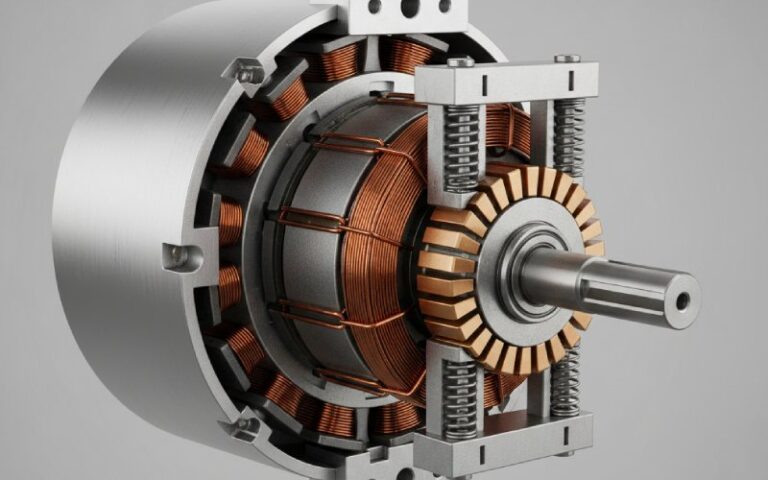
The part that grows faster is usually the part touching current: brush area, brush count, axial length, sometimes the number of brush arms. That is why two motors with very different horsepower can have commutators whose diameters are not wildly different, while their brush hardware looks nothing alike.
Table of Contents
The clean answer
If speed and voltage stay fixed within the same motor family, commutator diameter tends to rise slowly with horsepower, while commutator length and total brush contact area rise much more directly with armature current. If horsepower rises by raising speed instead, diameter may barely move at all because commutator surface speed becomes the choke point. Different route, different penalty.
Why horsepower is a weak sizing variable by itself
Horsepower can go up three ways:
- more torque at the same speed
- more speed at the same torque
- some of both
The commutator does not react to those three cases in the same way. More torque at the same voltage usually means more armature current, so brush area and copper interface loading climb fast. More speed pushes peripheral velocity, shortens commutation time, and can stop diameter from growing even when output rises. Same horsepower number on the nameplate. Different design trouble.
There is also a scope boundary that should be said early: this scaling logic is for brushed commutator machines under similar design assumptions, not for all motors lumped together. Once the winding layout, voltage class, cooling, duty, or brush grade moves far enough, the neat scaling picture starts to bend. Sometimes a lot.
The four limits that actually push commutator size
1) Brush current density
Traditional carbon-brush design values sit around 5.5 to 6.5 A/cm² in the design notes used for machine sizing. Published brush-grade data for other graphitic families show higher practical ranges, often around 6 to 12 A/cm² for some electrographitic grades, with higher speed capability as well. That is useful, but it does not erase the basic rule: when current goes up, required contact area goes up with it. Almost one for one.
2) Commutator surface speed
A common sizing check is v_c = π D_c N / 60. A conservative target keeps commutator surface speed at about 15 m/s or less where possible. So at higher rpm, the diameter cannot keep expanding freely. Sometimes horsepower increases and the commutator diameter barely changes. Length has to do the work. Or brush grade. Or both.
3) Volts per segment
To keep bar-to-bar stress from getting ugly, traditional design guidance limits voltage between commutator segments to about 15 to 20 V, with about 10 V per conductor in the simple single-turn case. That means higher voltage output usually needs more segments, but more segments at the same diameter squeeze segment pitch. So one limit fights the other. It is never just a diameter problem.
4) Segment pitch and brush geometry
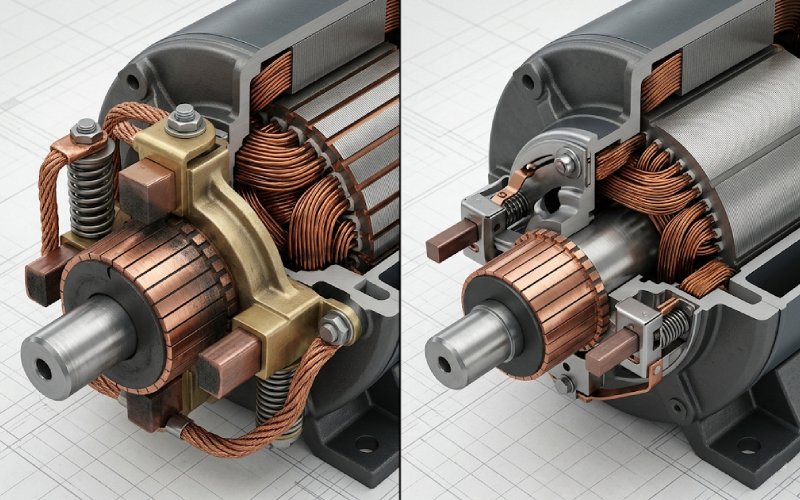
Segment pitch is commonly kept at 4 mm minimum for mechanical strength, and brush thickness is commonly capped at about 4τc for machines above 50 kW and 5τc below that. This matters more than people expect. When current rises, you cannot just keep making the brush thicker and pretend the commutator will absorb it. After a point, the machine wants more width, more brushes, more length, or a different overall layout.
What tends to grow first when horsepower rises
This is the usual sequence in a same-speed, same-voltage family:
| Change as horsepower rises | Typical behavior |
|---|---|
| Armature current | Rises almost in step with horsepower |
| Required brush contact area | Rises almost in step with current |
| Commutator axial length | Often increases early |
| Commutator diameter | Increases slowly |
| Segment count / winding pressure | Starts to matter once voltage per segment and pitch get tight |
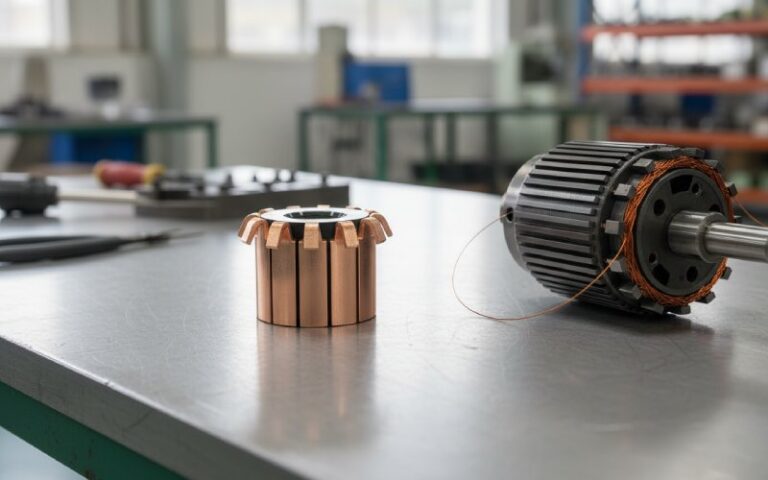
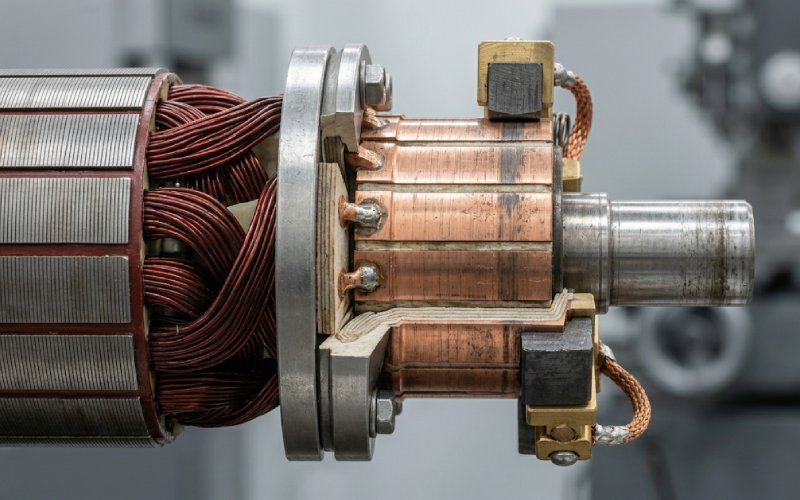
The interesting mismatch is this: current-related hardware scales fast, diameter does not. That mismatch is why commutators in heavier low-voltage machines often look long before they look large.
A rough similarity table makes the point:
| Horsepower multiplier | Current multiplier* | Brush area multiplier* | Diameter multiplier** |
|---|---|---|---|
| 1× | 1.00 | 1.00 | 1.00 |
| 2× | 2.00 | 2.00 | 1.26 |
| 4× | 4.00 | 4.00 | 1.59 |
| 8× | 8.00 | 8.00 | 2.00 |
Assumes same voltage and same speed. *Assumes similar machine proportions so diameter follows roughly the cube root of P/N.
That table is the whole argument in small form. Four times the horsepower does not mean four times the commutator diameter. It often means something more awkward: around 1.6× diameter, but roughly 4× the brush current-carrying demand if voltage did not rise with it. So the commutator gets longer, more crowded, and less forgiving.
A worked example that shows where the size pressure really lands
Take a 5 hp, 1750 rpm brushed DC motor. Compare two voltage options, 90 V and 180 V, with the same assumed efficiency of 85%. The required current is about 48.8 A at 90 V and about 24.4 A at 180 V. If you size against a carbon-brush current density of about 6 A/cm², the effective required contact area scales to about 8.1 cm² versus 4.1 cm². Same horsepower. Same speed. Nearly double the brush-area demand at the lower voltage.
That is why low-voltage horsepower is harsh on commutators. The diameter may not need to move much, especially if surface speed is already close to the limit. But the commutator usually wants more axial room, more brush width, more brushes per arm, or a higher-duty brush system. Usually more than one of those.
Now flip the problem. Keep voltage fixed, keep speed fixed, and move from 5 hp to 20 hp. Current and required brush area climb about 4×, while diameter under similarity scaling only wants to grow about 1.59×. That is the same mismatch again, just louder.
Why higher rpm can block diameter growth
A faster machine can make more horsepower without huge torque. Fine. But the commutator sees speed at the rubbing surface, not just output. Once v_c starts approaching the practical limit, extra diameter becomes expensive. Not in money first. In commutation margin. So fast machines often keep diameter tighter than intuition suggests, and recover the lost current-handling capacity with length, brush selection, or a less aggressive duty point.
There is a second catch. Higher speed also pushes the voltage-per-conductor relation, because conductor emf scales with active length and peripheral speed. So the voltage-per-segment check and the surface-speed check start leaning on the design at the same time. That is where simple horsepower talk stops being useful.
What undersizing usually looks like before it fails
First sign is often not catastrophic sparking. It is the layout getting cramped.
More brush stacks. More stagger. Less comfortable pitch. More friction loss. Then heat. Traditional commutator loss estimates split into brush contact loss and brush friction loss, and the same design notes that size the hardware usually keep commutator temperature rise below about 55°C. If the commutator is forced too small, the machine tends to spend that margin quickly.
That is also why a commutator can be “electrically enough” on paper and still be a bad design. The arithmetic closes. The surface does not.
A better way to estimate commutator growth during concept work
Use this order. It is faster, and it misses less.
- Estimate active size from
D²L ∝ P/N. - Pick a provisional commutator diameter as roughly
0.6Dto0.8D. - Check commutator surface speed.
- Check voltage per segment and segment pitch.
- Size brush area from armature current and allowable current density.
- Only then decide whether the commutator must grow in diameter, in length, or both.
That last step matters. A lot of wrong estimates assume “more horsepower” means “larger diameter.” Often the cleaner answer is “a bit larger diameter, much longer commutator.” Different machine. Same keyword.
FAQ
Does commutator diameter scale linearly with motor horsepower?
No. Under similar design assumptions, active machine size follows D²L ∝ P/N, and diameter rises much more slowly than power. In a comparable family, diameter often behaves closer to a cube-root trend than a linear one.
Why do low-voltage motors often need longer commutators?
Because lower voltage means higher current for the same horsepower, and brush contact area tracks current much more directly than diameter tracks horsepower. The extra capacity usually shows up as more brush area and more axial length before it shows up as a huge jump in diameter.
What limits commutator diameter at high rpm?
Mainly surface speed. A common conservative target keeps commutator peripheral speed near 15 m/s or below where possible. As rpm rises, diameter runs into that limit quickly, so the design often shifts burden into length and brush system changes instead of simply increasing diameter.
Is horsepower enough to predict commutator size?
No. You need at least speed and voltage as well. Better still: current, proposed brush current density, and a voltage-per-segment target. Without those, horsepower alone is too blunt to size a commutator well.
What usually grows first: diameter or length?
Length, or total brush real estate. Diameter rises slowly and is held back by surface speed and pitch limits. Current-driven requirements show up first in brush area, brush count, and axial commutator length.
Can better brush material solve the problem by itself?
Sometimes it buys margin. It does not cancel the rest of the design checks. Higher-duty brush families can allow higher current density and higher speed, but segment voltage, pitch, friction, and temperature rise still stay in the loop.
If you want the plainest version of the answer, it is this: commutator size scales with horsepower only indirectly. Diameter follows power and speed slowly. Current-related parts do not. So when horsepower rises, the commutator usually gets longer before it gets dramatically larger around the rim.