How Brush Spring Tension Affects Commutation Performance
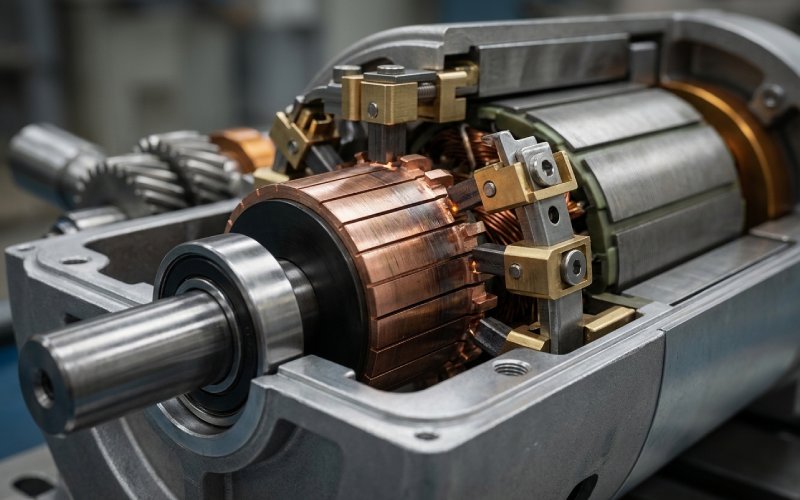
Brush spring tension directly affects contact stability, contact voltage behavior, and frictional wear in a commutator machine.
Too little force and the brush stops riding cleanly through vibration, runout, and bar transition. Too much force and the spark may look better for a while, but the machine pays for it in heat, drag, and brush wear. The right setting is not the spring number by itself. It is the effective pressure at the brush face under real operating conditions.
Table of Contents
Key takeaways
- Low brush spring tension usually shows up first as unstable contact, uneven current sharing, weak film, edge damage, or intermittent sparking.
- High brush spring tension improves contact continuity, but raises friction, temperature, and mechanical wear. Not a free fix.
- The number that matters is specific pressure at the brush face, not nominal spring force on paper.
What brush spring tension actually changes
In production work and rebuild work, we treat brush spring tension as a commutation variable, not a maintenance detail. It changes three things at once:
- Contact stability
The brush has to stay down through bar edges, mechanical runout, holder clearance, and vibration. If it lifts, even briefly, commutation starts to fall apart. - Contact voltage behavior
Spring pressure changes the electrical drop at the brush-commutator interface. That shifts how the machine handles current reversal under the brush. - Friction and heat
More pressure usually means more rubbing force. More rubbing force means more heat, more wear, and less forgiveness when the surface condition is already marginal.
That is why spring tension adjustments often look successful in the short term and wrong in the longer one.
Low brush spring tension: where commutation starts to break
Low brush spring tension does not only cause visible sparking. Sometimes sparking is late. We usually see these signs first:
- weak or patchy commutator film
- bright tracking marks
- unstable brush seating
- hot flexibles on selected brushes
- edge marking at bar exit
- uneven brush wear across the same arm
The problem is simple enough: the brush is no longer staying in consistent electrical and mechanical contact with the commutator surface. But the symptoms spread fast. Once contact becomes unstable, current density stops distributing evenly across the brush set. One brush runs hotter. One starts carrying more than it should. Another starts chattering in the holder. Then the surface begins to tell the story.
Low effective pressure becomes even more damaging when it stacks with other faults:
- commutator runout
- poor holder alignment
- worn bearings
- rough bar edges
- dust or oil contamination
- reduced spring force from ageing
- stiff shunts or restricted brush travel
At that point the machine is not short on one thing. It is short on margin.
High brush spring tension: better contact, more friction
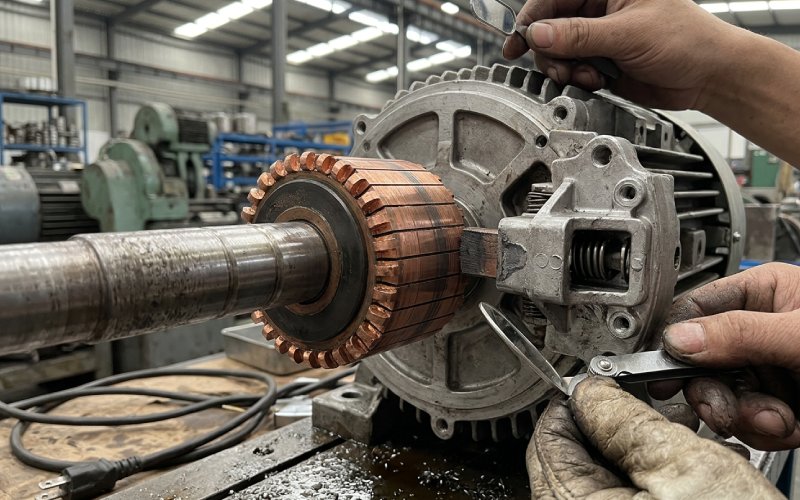
Higher spring tension usually helps the brush stay planted. On machines with shock, vibration, or unstable riding conditions, that matters. It may reduce brush bounce. It may reduce intermittent sparking. Sometimes that is exactly the move.
But then the other side appears.
Higher pressure increases friction. Friction raises heat. Heat changes brush wear rate, film behavior, and surface condition. The brush may look calmer while the wear pattern gets worse. We see this often on machines that were “fixed” by simply tightening springs after a spark complaint.
There is also the electrical side. As brush pressure rises, contact drop usually falls. That can improve some unstable running conditions, but it can also reduce part of the brush interface behavior that was helping the machine through commutation. So yes, more force can suppress one problem and expose another. That trade is real.
Recommended brush spring pressure ranges we use
These are starting windows, not universal numbers. Final settings depend on brush grade, surface speed, current density, vibration level, holder condition, and the geometry of the brush box.
| Application condition | Starting pressure | Starting pressure | What usually happens below this range | What usually happens above this range |
|---|---|---|---|---|
| General stationary commutator duty | 18-20 kPa | 180-200 g/cm² | unstable contact, weak film, uneven sharing, streaking | extra friction, higher brush temperature, faster wear |
| Soft graphitic brush duty | 13-18 kPa | 130-180 g/cm² | poor riding under vibration, film breakdown, scattered marking | mechanical wear rises faster than commutation improves |
| High vibration or shock duty | 36-55 kPa | 360-550 g/cm² | brush lift, chatter, edge burning, visible sparking | drag, heat, aggressive brush wear, holder loading |
| Large industrial DC machines needing stable face pressure | keep effective pressure above about 28 kPa when design allows | above about 280 g/cm² | electrical wear tends to increase quickly once effective pressure falls too low | wear becomes friction-led instead of commutation-led |
A few shop-floor notes:
- We calculate pressure from applied force divided by brush cross-section.
- We do not trust nominal spring data alone.
- We always check pressure at working brush length, not only with a new brush.
- On multi-brush rigs, uniformity matters almost as much as absolute pressure.
A balanced set running slightly conservative is often better than one or two heavy brushes inside a loose group.
Why nominal spring force is not the real number
This part gets missed all the time.
The spring rating is not the same as the pressure at the commutator face. Real machines lose effective pressure through:
- spring fatigue
- shorter brush length
- friction in the holder
- side loading from holder geometry
- stiff or poorly routed shunts
- brush position around the commutator
- vibration at operating speed
So two machines with the same spring specification can behave very differently. On paper they match. On the commutator they do not.
And pressure imbalance inside the same brush arm is not a small defect. A higher-pressure brush usually runs with lower contact drop and tends to take more current. That leads to local overheating, uneven wear, and surface damage that gets blamed on the wrong component.
Before increasing spring force, check these first
We do not increase spring tension first. We check the basics that usually distort the result.
- Brush freedom in the holder
The brush must move freely through the full travel range without side drag. - Holder alignment and clearance
A holder that is skewed, worn, or too tight can imitate low spring tension perfectly. - Commutator runout and roundness
Runout turns a marginal pressure setting into a bounce problem. - Bar edge condition and mica condition
High bars, rough edges, or poor undercut work against contact stability. - Spring condition at actual working length
A spring that tests fine with a new brush may fall out of range later in service. - Shunt flexibility and routing
A stiff shunt can resist brush movement and steal effective pressure. - Bearing and vibration condition
External vibration often gets misread as an electrical problem. - Load pattern
Light or unstable load can disturb film and make the pressure diagnosis look wrong.
If those checks are skipped, a spring adjustment often gives a temporary improvement and a worse surface a week later.
Troubleshooting matrix for brush spring tension
| Symptom on the machine | Likely pressure direction | What we check first |
|---|---|---|
| Intermittent sparking under vibration | Usually too low effective pressure | vibration source, runout, brush freedom, spring loss |
| Edge burning at bar exit | Often too low, but not always | holder clearance, bar condition, pressure uniformity |
| Uneven brush wear in the same arm | pressure imbalance | spring variation, holder friction, shunt stiffness |
| Hot flexibles on selected brushes | current is not sharing evenly | individual brush pressure, contact condition, brush seating |
| Stable commutation but very fast brush wear | often too high | actual face pressure, surface speed, temperature |
| Weak or patchy commutator film | often low pressure or unstable riding | contamination, load pattern, pressure consistency |
| Copper smearing or drag marks | may involve low pressure, bounce, or heat | surface condition, vibration, pressure window, material match |
This matrix is not a substitute for inspection. It is just where we start.
How we set brush spring tension in practice
We use a simple rule: set pressure as part of the whole commutation system.
Our sequence is usually this:
- Verify holder geometry and brush movement.
- Measure spring pressure across the full brush set.
- Correct pressure spread before changing average pressure.
- Re-seat brushes if surface contact is incomplete.
- Run under real load and read the surface, wear pattern, and temperature.
- Adjust in small steps. Then check again.
We do not like large force jumps. A big correction can hide the original failure mode and create a new one. Small steps read cleaner.
FAQ
Does increasing brush spring tension always reduce sparking?
No. It often improves contact continuity, especially on machines with vibration, runout, or weak brush riding. But once pressure goes too high, friction and heat rise, brush wear accelerates, and the commutator surface may deteriorate for a different reason.
What is more important: average spring pressure or pressure uniformity?
Both matter. In real service, pressure uniformity across the brush set is often the first thing to correct. A machine with one or two brushes running noticeably heavier or lighter than the rest will struggle with current sharing even if the average number looks acceptable.
Why does a machine still spark after spring force was increased?
Because spring tension may not be the root cause. Holder friction, poor brush travel, runout, rough bar edges, vibration, contamination, and wrong operating load can all keep the spark active even after pressure is raised.
Can low spring tension cause electrical wear even when brush wear looks moderate?
Yes. That is common. A machine may show modest mechanical wear while electrical distress is already developing at the contact surface. Weak film, edge marks, hot selected brushes, or patchy color on the commutator usually show up before severe material loss.
Is there one correct pressure for all commutator machines?
No. There are working windows, not one magic number. Brush material, surface speed, current density, holder design, and vibration level all shift the usable range. That is why we set pressure from operating behavior, not from catalog habit.
How often should brush spring tension be checked?
On critical equipment, we check it whenever brushes are changed, when commutator surface condition shifts unexpectedly, after a spark event, or when selected brushes begin to run hotter or wear differently from the rest.
Final note from our engineering team
Brush spring tension is one of the few settings that can make a commutator machine look better while quietly making it wear faster. That is why we never judge it by spark alone.
When spring adjustment does not stabilize commutation, the problem is usually deeper: commutator geometry, brush grade matching, holder alignment, surface condition, or thermal loading. Our team reviews those factors together when supporting replacement commutators, custom commutator manufacturing, and matched brush system evaluations for DC motors and generators.
If your machine is showing electrical wear, unstable film, repeated sparking, or unexplained brush temperature spread, send us the operating data and failure photos. We can review the commutator condition and help narrow the fault before the surface damage becomes permanent.