Electric Motor Commutator Brushes: What Actually Decides Service Life
Most DC motors don’t fail in the stator. They fail where copper, carbon and mechanics all argue with each other: the commutator and its brushes.
Datasheets explain the theory. This page is about everything that happens after the motor leaves the catalog: film, wear, arcing, sourcing, and what a purchasing manager or design engineer can realistically control in a B2B environment.
Table of Contents
1. The commutator–brush system in one short paragraph
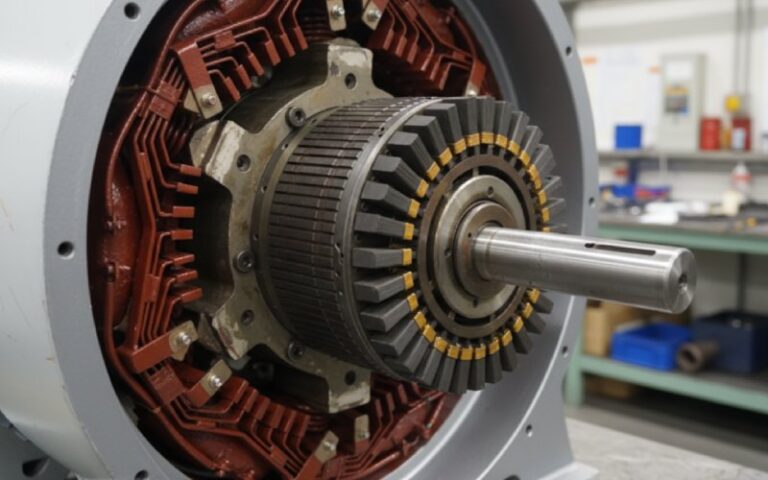
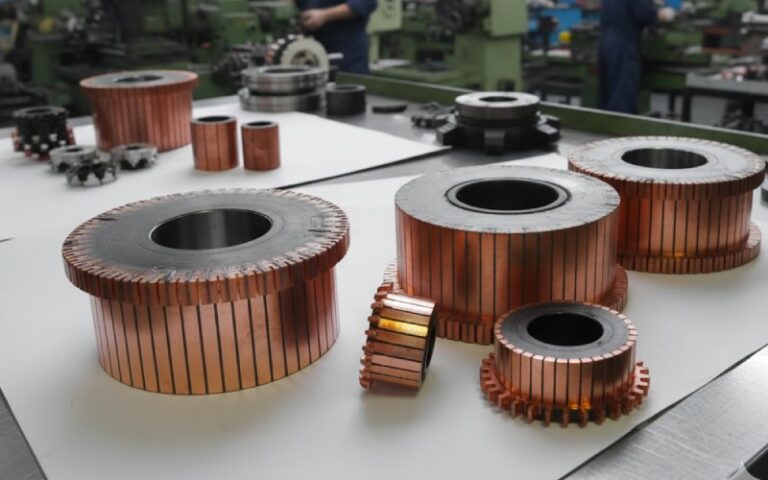
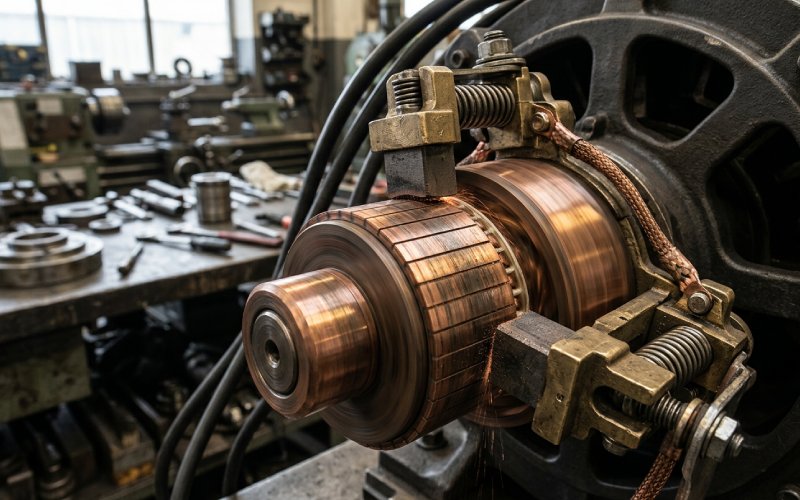
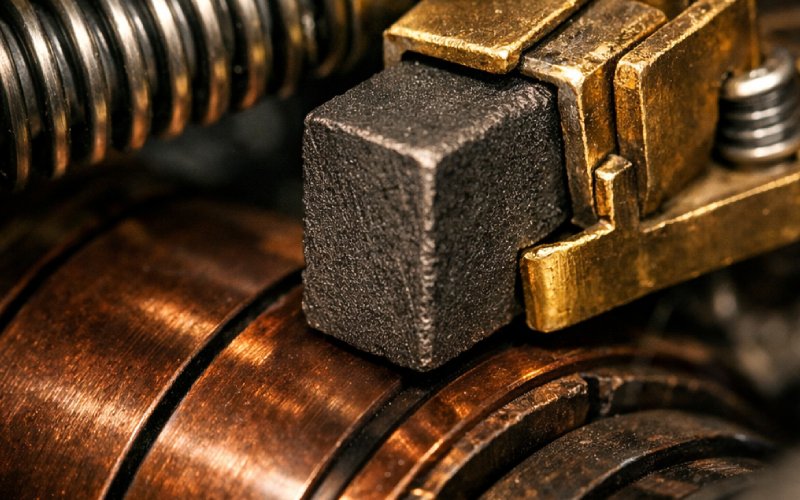
A commutator is a segmented copper cylinder on the rotor; brushes sit on it and feed current into armature coils while the rotor spins. Each segment is insulated (often with mica or engineered plastics), and one or more brushes slide across, switching the current and producing torque.
On paper that’s simple. In operation, it’s a dry sliding contact with a tribolayer, local heating, magnetic distortion, mechanical runout and airborne contamination all stacked together.
If you treat “commutator + brushes” as a single, tuned system rather than two separate parts, troubleshooting gets much easier.
2. Five knobs that really control brush behavior
Most issues with electric motor commutator brushes come back to one or more of these five factors:
- Brush material and grade
- Contact pressure and geometry
- Commutator surface condition
- Environment (air, humidity, contamination)
- Operating pattern (duty cycle and speed)
We’ll walk through them with sourcing and maintenance in mind, not classroom definitions.
2.1 Brush materials: not just “carbon”
In a typical DC motor you’ll see one of these families:
- Electrographitic carbon
- Resin-bonded carbon
- Copper-graphite
- Silver-graphite (special cases)
Carbon-based brushes wear more evenly and usually cause less damage to commutator copper than pure metal brushes. Copper brushes, on the other hand, suit very low voltage / very high current systems but are harder on the surface and give lower contact resistance.
From a B2B standpoint, material choice decides:
- Acceptable current density
- Allowable temperature and duty cycle
- Electrical noise level
- How often your team will be changing brush sets
Modern technical guides stress that surface film behavior is just as important as bulk resistivity. Stable films reduce wear and arcing, but the “right” film depends on grade, roughness and operating load.
If you’re specifying brushes to a supplier, the minimum useful data set looks like:
- Motor type and frame
- Voltage and max continuous current
- Peripheral speed at commutator
- Duty profile (start/stop frequency, reversals, overloads)
- Environment (dust, oil mist, high humidity, altitude, enclosure type)
Any supplier that can’t work with that list will struggle with more complex questions later.
2.2 Contact pressure and geometry
Brush pressure is usually set by the holder spring. Too low and you get intermittent contact and excessive film; too high and you get rapid wear and overheating. Good practice targets a narrow pressure window for each grade, typically given in N/cm².
Geometry details that quietly matter:
- Contact angle relative to rotation
- Whether the brush is leading or trailing
- Brush overhang vs commutator edges
- Chamfers on the edges to manage current density
A small change in angle or spring force can fix what looks like a “bad grade” problem.
2.3 Commutator surface: roughness, runout, and film
Most field troubleshooting articles boil commutator condition down to a few essentials:
- Roundness / runout – Out-of-round commutators cause cyclic loading and irregular wear.
- Surface roughness – Too glossy and the brush skates; too rough and you cut the brush and disturb film formation.
- Mica undercut – High mica edges can chip brushes and disturb current transfer.
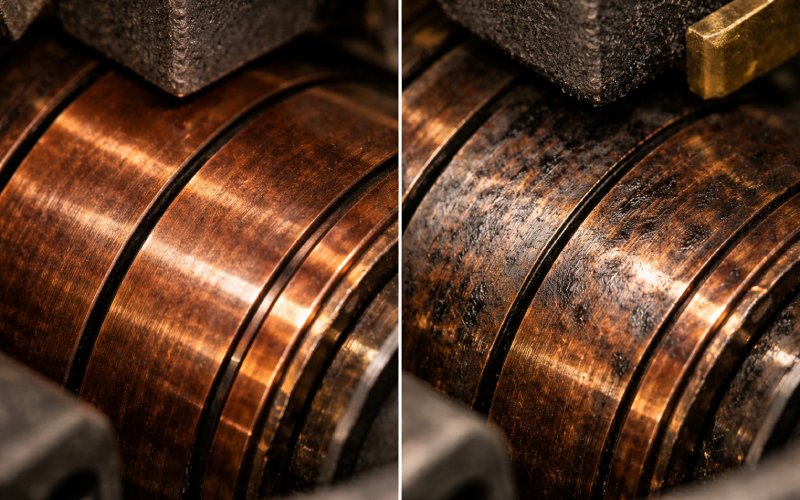
- Uniform copper oxide film – A stable tan-brown film is usually a good sign.
Technical guides from major brush manufacturers explicitly warn against surfaces that are either mirror-polished or heavily scored; small, controlled roughness is preferred.
If you only have time for one check during shutdown, many maintenance teams start with: “Is the film even and is the surface round?”
2.4 Environment and cooling air
The brush–commutator interface is sensitive to:
- Relative humidity
- Dust load
- Oil vapor / process fumes
- Cooling air temperature and speed
Dry air tends to increase wear; contaminated air changes film chemistry and can trigger threading or streaking on the surface.
For a plant that keeps losing brushes early, sometimes the cheapest experiment is simple: clean ducting, better filters, and a short visual inspection schedule.
2.5 Operating pattern
Datasheets usually quote “continuous rating” at nominal load. Real motors see:
- Short overloads
- Frequent starts and reversals
- Regenerative braking
- Low-load idle operation
Research on brush wear shows that downsized, high-speed motors are especially sensitive to these patterns, because current density and temperature peaks rise while contact area shrinks.
Design engineers should share realistic duty profiles with brush suppliers early; it saves trial-and-error later in production.
3. Reading commutator wear patterns like a report
You don’t always need instruments. A good light, a magnifier, and a few comparative patterns already tell you a lot. Many maintenance guides group what you see into “normal film” and a handful of abnormal conditions.
Common visual symptoms and what they usually mean
| Visual symptom on commutator | Likely cause in brush/commutator system | Typical first check or action |
|---|---|---|
| Even tan to charcoal-brown film, smooth touch | Healthy film, correct grade and load | Record, photograph, and leave it alone |
| Darker bands in fixed zones, light elsewhere | Uneven current distribution, local heating, or poor contact in one area | Check brush pressure balance and bar-to-bar resistance |
| Spiral marks or “threading” | Combination of roughness, film instability, and certain graphite grades | Verify roughness, consider slight re-turning and grade review |
| Grooves under brush tracks | Contamination, abrasive particles, misaligned brushes | Inspect air path, filter condition, and holder alignment |
| Heavy burning on individual bars | High current on specific coils, poor commutation, or wrong neutral setting | Check armature circuit, field settings, and position of brush holders |
| Copper “drag” or smeared edges | Overheating, softening of copper, often linked with overload | Review load profile and cooling airflow |
This kind of structured visual check fits nicely into a quarterly or annual maintenance procedure for DC drives, cranes, rolling mills, and similar installations.
4. Specifying electric motor commutator brushes for new designs
When you’re on the OEM side, brush selection becomes part electrical, part mechanical, part supply-chain.
4.1 Start from the electrical envelope
For each new motor family, define:
- Max continuous current and any short-term overload
- Voltage and insulation class
- Permitted current density at the brush face (aligned with chosen material)
- Commutation limits at speed (field weakening, if used)
Your brush supplier will map this to candidate grades and recommended contact area.
4.2 Decide brush size, quantity and layout
Typical trade-offs:
- More brushes → lower current per brush, but more holders and assembly time
- Larger brush face → lower current density, but higher friction torque and more heat
- Different stagger patterns → different commutation behavior and noise
Once you lock geometry, pressure settings and holder design have less room to move, so it’s better to iterate here before tools are frozen.
4.3 Surface and film strategy
Many industrial DC motors leave the factory with a freshly machined commutator and a controlled pre-run to form an initial film. Key decisions:
- Target roughness range after turning
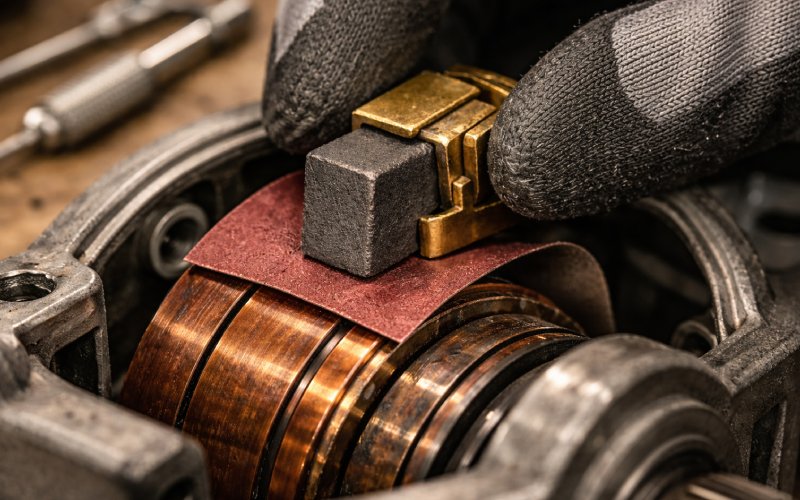
- Whether to seat brushes on a brush-seating stone before shipment
- How long the initial run-in period should last, and under what load
Documenting this helps your end customers later when they replace brush sets or recondition the commutator in the field.
4.4 Qualification tests that actually catch problems
Instead of only running a basic load test, consider adding:
- Step-load test with film inspection between steps
- Start/stop cycling to mimic the actual duty cycle
- Electrical noise and radio-frequency emission checks
- Endurance run to a defined brush wear depth, with commutator inspection at intervals
If you gather data here, your B2B clients see fewer “mystery” failures a year after commissioning.
5. Replacing brushes in existing motors: practical rules
Many plants inherit DC motors with unknown brush grades and incomplete records. So the replacement strategy has to work in imperfect conditions.
5.1 OEM vs third-party brushes
OEM brushes are usually safe when:
- The application is critical (steel mill drives, overhead cranes, propulsion)
- The duty cycle is demanding or poorly documented
- Motors operate close to their thermal limit
Third-party or custom brushes can make sense if:
- OEM lead times are long
- You’re consolidating multiple brush types across a fleet
- You need minor grade tweaks for better life in your particular environment
The key is to change one thing at a time: grade, pressure, or roughness—not all three.
5.2 When to replace brushes
Brush wear guides usually define a minimum length so the commutator never touches the internal shunt wire or brush hardware.
Some simple rules that sites use:
- Replace when brush length reaches 50–60% of original, unless manufacturer states otherwise
- Track wear rate over at least one interval, not just length at one visit
- Avoid “patchwork” replacement; replacing a full set keeps spring pressure distribution even
5.3 Managing grade substitutions
If you must change grade:
- Never mix different grades on the same commutator unless the manufacturer explicitly allows it
- Run-in carefully and inspect film early and often
- Log all changes; a simple spreadsheet beats relying on memory two years later
6. Maintenance checklist for commutators and brushes
Many technical papers on DC motor maintenance boil down to regular, structured inspections focusing on commutator life, minimal arcing and controlled brush wear.
A short, repeatable checklist might look like this:
At every planned shutdown
- Isolate, remove covers, lock-out.
- Visual check: film color, presence of streaks, grooves or bar burning.
- Check brush lengths and record min/max per motor.
- Verify brush tension with a calibrated gauge where available.
- Check holder insulation, clearance, and freedom of brush movement.
- Clean dust and copper debris from the area; check filters and air paths.
Annually or at major outages
- Measure commutator runout and diameter.
- Inspect mica undercut depth and condition; correct if high.
- Refinish commutator if roughness or runout exceed limits.
- Review wear records and, if needed, discuss grade or pressure changes with your brush supplier.
A few hours here often costs less than an unscheduled line stop later.
7. What to ask a commutator brush supplier (B2B focus)
When you source electric motor commutator brushes as a business buyer or design engineer, good questions filter out weak suppliers quickly:
- Can you cross-reference our current grade and explain the differences, not just “equivalent”?
- What operating envelope (voltage, current density, speed) do you consider safe for this grade?
- How do you control brush dimensions and shunt positioning tolerances?
- Do you provide test data on wear rate, film behavior and commutator condition after defined test cycles?
- What is your typical lead time for repeat orders and small engineering changes?
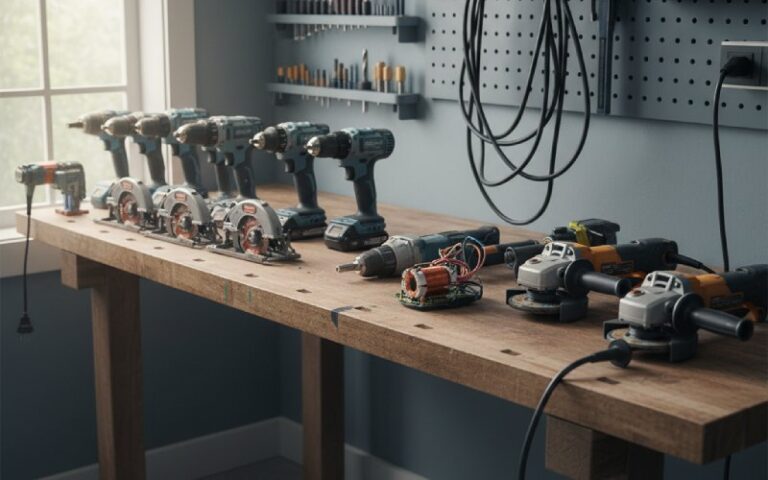
- Can you support mixed fleets (industrial DC motors, traction motors, small appliance motors) with a rationalized set of grades?
You’re not only buying carbon blocks. You’re buying the time between shutdowns.
FAQ: Electric Motor Commutator Brushes
1. Can I mix different brush grades on the same commutator?
Generally no. Different grades have different resistivity, film behavior and wear rate. Mixing them can give uneven current sharing and non-uniform film, which shows up as bands or bar burning. Stick to one grade per commutator unless the motor and brush manufacturers have explicitly approved a mixed set.
2. How smooth should the commutator surface be?
Technical guides recommend a “finely turned” surface with controlled roughness, not mirror-polished and not visibly scored. A slightly matte finish lets the brush seat and supports a stable film. Too smooth and brushes can skate; too rough and you cut the film and the brush face.
3. When is brush wear considered excessive?
Look at both wear rate and pattern:
If brushes reach minimum length much sooner than historic intervals or manufacturer expectations, that’s excessive.
Uneven wear between poles or between brushes on the same holder also counts, even if length is still acceptable.
The usual response is to check load, cooling, commutator condition and spring pressure before blaming the grade.
4. What’s the practical difference between carbon brushes and copper brushes?
Carbon brushes:
Better for general industrial DC motors
Lower commutator damage
Higher contact resistance, which can help with commutation
Copper brushes:
Suited for very low voltage, very high current applications
Lower resistance but more aggressive on the copper surface
Usually need cleaner commutator geometry and more careful cooling
Most modern industrial DC motors use carbon-based grades unless there is a special reason not to.
5. Does humidity really matter for brush life?
Yes. The brush–commutator interface is a dry sliding contact with a thin film whose chemistry depends partly on ambient air. Very dry air can increase wear and make film control harder; contaminants or high humidity can change the oxide layer and contribute to abnormal patterns like threading.
For motors that move between climates, it’s worth noting operating humidity in your maintenance records.
6. How often should we inspect commutators and brushes in heavy duty service?
Typical advice for demanding DC drives is:
Visual checks at every planned shutdown
More detailed inspection (measurements, runout, roughness) at least annually, or during major outages
Some aerospace and high-duty industrial applications use even tighter intervals focused on film quality, arcing level and brush wear.
The right answer depends on duty cycle and criticality, but a written schedule is always better than “when we remember.”
7. Is light sparking always a problem?
Not necessarily. Light, uniform sparking at the brush face can be normal in many DC motors at certain loads. What you want to avoid is heavy, bright sparking and visible bar burning, which indicate poor commutation or overload.
If sparking changes suddenly compared to past behavior at the same load, treat that as a warning sign.