
Does an AC Motor Have a Commutator? A Practical Guide for OEMs
“Does an AC motor have a commutator?”
Most of the time: no. But some AC machines absolutely do, and they still show up in catalogs and legacy equipment.
If you’re responsible for specs, sourcing, or redesigning old gear, what you really care about is:
- When AC motors avoid the commutator
- When an AC commutator motor is still the right tool
- What this does to BOM, EMC, footprint, and service life
This article keeps the physics short and pushes the decision-making part to the front.
Table of Contents
1. Short answer: usually no — except AC commutator motors
For standard industrial AC motors:
- Three-phase induction motors
- Synchronous motors
- Most modern “brushless AC” or “servo” style drives
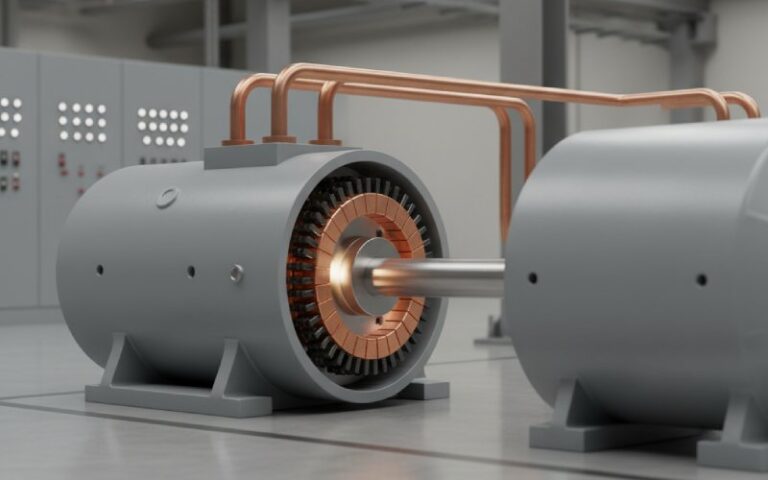
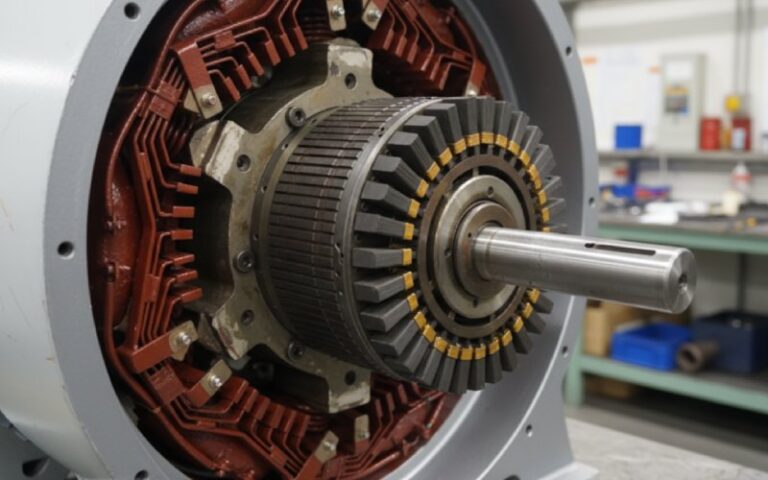
…the answer is no mechanical commutator. Rotor is cage, wound rotor, or magnets; commutation is handled by the supply or the drive, not by copper segments and brushes.
But there is a whole family of AC commutator motors:
- “AC series motors”
- Universal motors (the one you actually meet in tools and appliances)
- Historical repulsion / repulsion-start designs
Manufacturers sometimes group these under “AC commutator motors” and then note that the practical units are almost always run from AC.
So the more precise statement is:
Most modern AC motors are brushless and have no commutator. A smaller, still-relevant group of AC commutator motors uses a commutator even on AC supply — mainly universal motors.
2. Why most AC motors skip the commutator
Skipping deep field theory here, just the design reality.
In a typical AC machine:
- The stator creates a rotating field (polyphase supply or inverter).
- The rotor current is either induced (induction motor) or fixed (excited synchronous / permanent magnets).
- Torque direction follows the rotating field directly. No need to mechanically flip rotor current every half cycle.
So you get:
- No commutator
- Often no brushes at all
- Better sealing options, less conductive dust, simpler maintenance routines
That’s why these machines dominate pumps, fans, compressors, conveyors, and almost anything that just needs to turn all day.
But then the obvious question pops up:
If AC already changes polarity, why does a universal AC motor still bother with a commutator?
Because of how torque is kept one-way in that topology.
In a series-wound universal motor:
- Field winding and armature winding are in series, same current, same phase.
- When the AC supply reverses, current in both field and armature reverses together.
- The commutator keeps the armature conductors “re-oriented” relative to the field so the product of field flux and armature current — and therefore torque — stays in the same direction each half-cycle.
So yes: AC polarity flips. But the commutator ensures that field and armature flip in sync, so the mechanical torque doesn’t.
That single idea is why universal motors need a commutator even on AC, while an induction motor is perfectly happy without one.
3. AC commutator motors: the family, not just the universal motor
To avoid terminology drift:
- AC commutator motor = broad family: any AC motor whose rotor current is commutated mechanically.
- Universal motor = the most common member of that family in today’s tools and appliances.
3.1 Universal (AC series) motors
You already know the construction; the sourcing-relevant bits are:
- Works from AC or DC, series-wound with a commutator
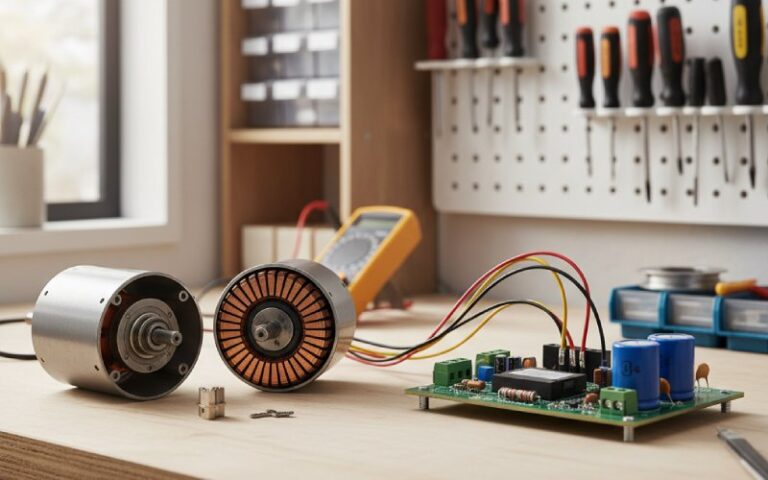
- Very high speed, high starting torque, compact frame size
- Simple, cheap control on AC: phase-angle control, tapped windings, basic triac modules
Typical uses:
- Handheld power tools
- Mixers, blenders, small kitchen appliances
- Vacuum cleaners, sewing machines, smaller “tool built into product” drives
Trade-offs your service team already sees:
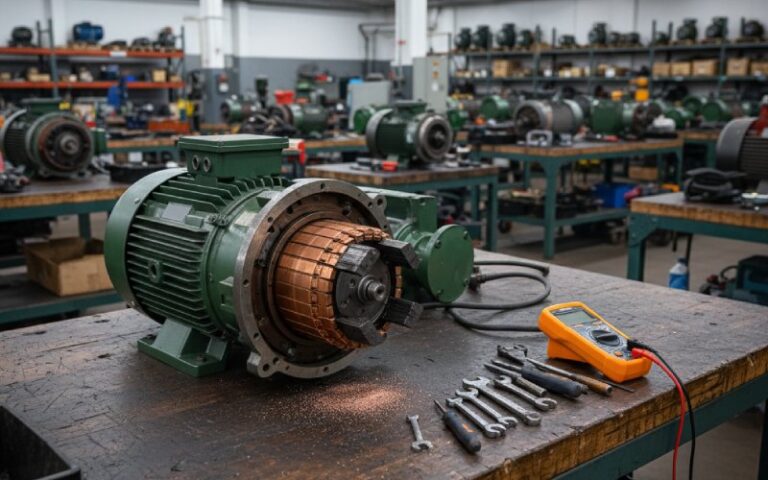
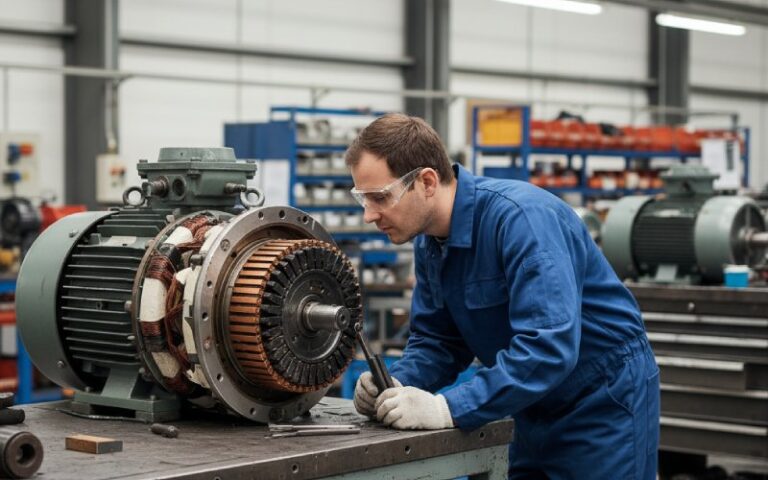
- Brushes and commutator wear → scheduled replacements
- Audible noise, especially at high speed
- EMI/EMC headaches: brush arcing throws out broadband noise that needs capacitors, RC snubbers, common-mode chokes, or more advanced filters to pass modern standards
So universal motors are great when:
- Duty is intermittent
- Space is tight
- Simple AC speed control is acceptable
- You are OK with a bit of maintenance and extra EMC components in the BOM
3.2 Repulsion and repulsion-start motors
Historically, repulsion and repulsion-start induction motors gave:
- High starting torque on single-phase AC
- Commutator and brush structure on the rotor
- Then, in some variants, a transition to induction-like running once up to speed
Today:
- In new OEM design work, these are effectively obsolete. Newer induction and permanent-magnet solutions plus drives have replaced them in most roles.
- You mainly see them in legacy machines that are still worth keeping alive.
So for a new product platform, treat repulsion motors as a “maintenance and retrofit topic”, not a live candidate.
3.3 Niche AC commutator designs
There are more exotic machines: Schrage motors and other hybrid designs that combine slip rings and commutators to get variable speed directly from mains.
They belong mostly in retrofit and museum conversations now. In modern platforms, power electronics give you that flexibility with a standard brushless machine instead.
4. Commutation vs slip rings vs drives: keep the roles clean
A lot of confusion around “does this motor have a commutator?” comes from mixing three ideas.
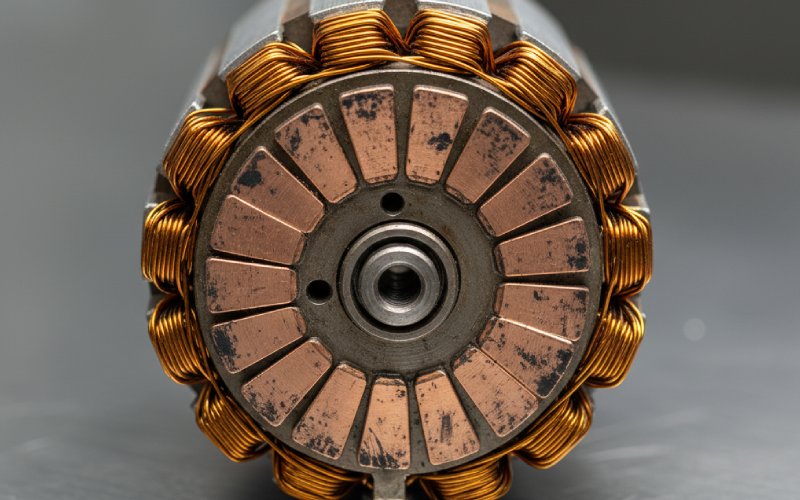
4.1 Mechanical commutator
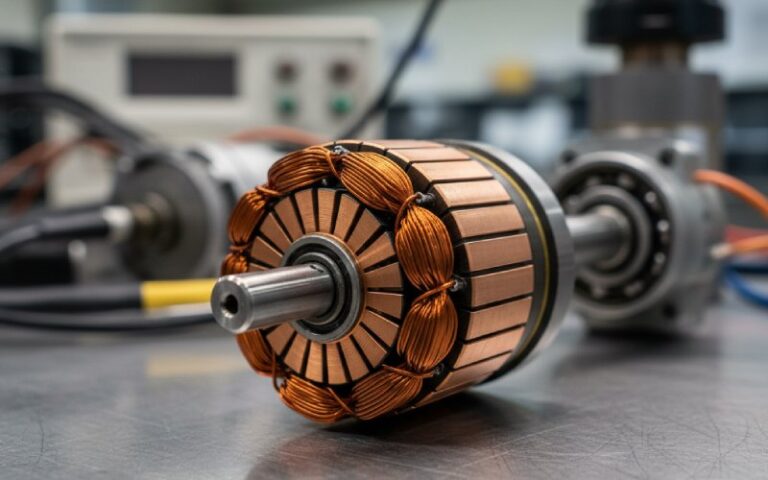
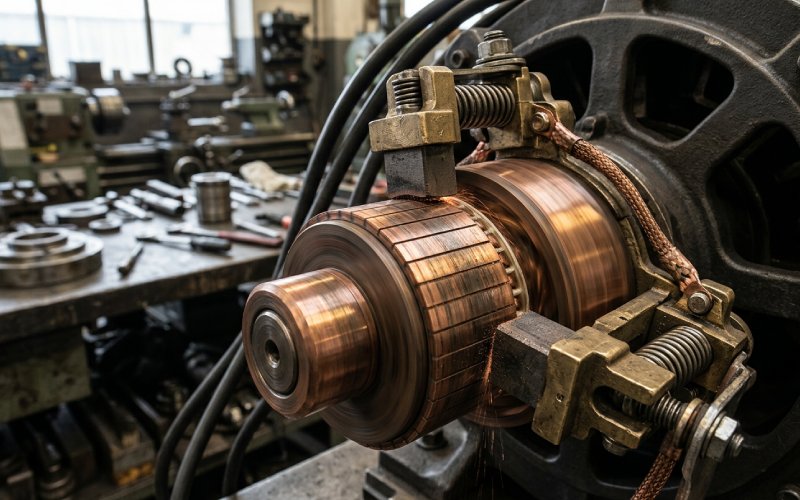
- Segmented copper ring on the rotor
- Brushes sit on segments, current hops from one segment to the next
- Actively reverses armature current relative to rotor position
- Classical DC series motor and universal AC motor behavior
This is where wear, carbon dust, arcing and EMI come from.
4.2 Slip rings
- Continuous rings, not segmented
- Brushes just carry current into a rotating winding, no switching pattern
- Typical in wound-rotor induction motors and some synchronous machines
So:
Slip rings ≠ commutator. Same brushes, very different job.
From a maintenance plan, both mean brush checks. From an electrical-function perspective, only the commutator is doing actual switching.
4.3 Electronic commutation vs frequency control
Two different things that are easy to blur:
Brushless DC / PMSM motors
- Rotor uses permanent magnets
- Drive energizes stator phases in a pattern tied to rotor position
- This phase switching is commonly called electronic commutation, replacing the mechanical commutator entirely
Induction motor + VFD
- Rotor current is induced, not directly switched
- VFD sets voltage and frequency to shape the rotating stator field
- No mechanical commutator was ever there; the drive is not emulating one, it’s controlling speed/torque via frequency and flux settings
Both use power electronics. Only the brushless DC / PMSM case is really about “who is doing commutation now?”.
5. Quick comparison table: commutator presence and design impact
From a sourcing and design point of view, this is usually the relevant comparison:
| Motor type | Supply / drive | Commutator present? | Brushes? | Control style | Notes for OEM projects |
|---|---|---|---|---|---|
| Squirrel-cage induction AC motor | Mains or VFD | No | No | Fixed frequency or VFD | Workhorse for pumps, fans, conveyors; minimal maintenance. |
| Wound-rotor induction motor | Mains + rotor circuit | No | On slip rings | Rotor resistance / starters | High-torque starts; brush wear but no commutation. |
| Synchronous AC motor (field-excited) | Often inverter-fed | No | Sometimes | Frequency + field control | High efficiency, position accuracy in drives. |
| Brushless DC / PMSM | DC bus + inverter | No | No | Electronic commutation | High efficiency, but requires dedicated drive. |
| Universal AC commutator motor | AC or DC | Yes | Yes | Phase control / simple controllers | Compact, cheap, noisy, EMC filtering adds hidden BOM. |
| Repulsion / repulsion-start motors | AC | Yes | Yes | Fixed speed, legacy schemes | Largely obsolete for new designs; seen in older machinery. |
If a spec sheet says “AC motor” and you see a commutator, you’re almost certainly holding one of the last two rows.
6. Design and sourcing consequences
Now the part that usually doesn’t show up in datasheets.
6.1 Duty profile and maintenance model
- Continuous or high-duty industrial drives → default to brushless AC (induction or synchronous) unless there’s an extreme constraint saying otherwise.
- Short duty, consumer-style loads (power tools, handhelds, kitchen appliances) → universal motor + simple control is still cost-effective.
If your product is supposed to run 24/7 in a plant, a commutator in the rotor is usually an avoidable maintenance contract.
6.2 EMC and hidden BOM around the commutator
Every commutator and brush pair is a small RF source:
- Brush arcing generates broadband noise on the supply and radiated from the wiring.
- Passing modern EMC rules usually means:
- Capacitors across the motor
- Sometimes networks from each terminal to ground
- Common-mode chokes or more integrated EMI filters
Those extra parts:
- Add line items, testing time, and layout effort
- Can offset part of the “cheap motor” advantage, especially in export markets with strict EMC limits
For a brushless AC solution, you shift the EMC problem into the drive electronics instead. Different set of challenges, but no commutator sparks.
6.3 Environment and safety
Commutator motors are not happy with:
- Dusty or conductive contamination
- Explosive atmospheres
- Situations where brush dust is unacceptable
You can enclose and filter, but at some point it becomes simpler to:
- Use a sealed brushless machine
- Keep all switching inside a protected electronics compartment
6.4 Weight, volume, and packaging
When teams talk about “replacing the universal motor with an induction motor”, the conversation often stops not at torque curves, but at CAD:
- For the same output power, an induction motor is usually larger and heavier than a high-speed universal motor plus gearbox, especially in small ratings.
- Housing, brackets, and even the user’s hand (for tools) may not tolerate that growth.
So the realistic choices sometimes are:
- Keep a universal motor and refine EMC and cooling
- Or redesign the whole mechanical stack for a different motor class
6.5 Retrofit and backwards compatibility
On legacy platforms where you find an AC commutator motor:
- If you must keep the existing gearbox and mounting points, a drop-in brushless replacement may not exist.
- If you can touch the surrounding mechanics and control system, switching to induction or PMSM with a compact drive can pay off quickly in maintenance and efficiency.
Having the “does it have a commutator?” question on your checklist is a good early filter before promising a timeline to management.
7. FAQ: AC motors and commutators
1. Does an AC motor have a commutator or not?
1. Most AC motors you buy today (induction, synchronous, brushless PM) do not have a commutator.
2. AC commutator motors, especially universal motors and some historical repulsion types, do use a commutator on AC supply.
So the quick rule: if it’s a pump/fan/drive motor, assume “no commutator” unless stated otherwise. If it’s a small tool or appliance motor, check.
2. Which AC motor types definitely use a commutator?
Common cases:
1. Universal / AC series motors
2. Repulsion and repulsion-start induction motors
3. Rare specialty AC commutator machines
All of them share: rotor with a commutator, brushes, and associated wear and EMI.
3. Are slip-ring induction motors commutator motors?
No. Slip rings are smooth rings that just feed current into a rotor winding; they do not segment or switch current by rotor position.
Maintenance looks similar (brushes to service), but from a circuit viewpoint they are not commutators.
4. Is a VFD acting like an electronic commutator?
Depends what it’s driving:
1. With brushless DC / PMSM, the drive really is taking over commutation — switching stator phases in sync with rotor position.
2. With an induction motor, the VFD mainly controls frequency and voltage; rotor current is induced and not “commutated” segment-by-segment in the classical sense.
So electronic commutation is the right phrase for brushless machines, not for an induction motor plus VFD.
5. Why can a universal motor run on both AC and DC?
Because of the way field and armature are connected:
1. They are in series, same current, same phase.
2. When AC reverses, current in both reverses together.
3. The commutator keeps the armature conductors aligned so torque direction stays the same.
So the machine doesn’t care much whether that current started as AC or DC, as long as it passes through that series path.
6. Can I replace a universal motor with an induction motor of the same power rating?
Not as a simple swap:
1. Starting torque and speed range will differ.
2. Frame size and mass will almost certainly increase for the induction motor.
3. EMC behavior changes; you lose commutator noise but add a drive, with its own EMI pattern.
In many handheld or compact products, the size and weight increase are what actually kill the idea, before you even start torque calculations.
7. When is it still reasonable to choose an AC commutator motor today?
Typical justifications:
1. Low-cost, compact drive for a small, intermittent-duty appliance or tool
2. Strong legacy requirement (drop-in replacement with minimal mechanical change)
3. Markets and usage patterns where brush maintenance and EMC filtering are acceptable trade-offs
If none of these apply, your default short list for new designs is usually brushless AC: induction or PMSM with an appropriate drive.
This should give you a clean yes/no answer to “does an AC motor have a commutator?” and, more importantly, a way to tie that answer to BOM, packaging, EMC, and long-term service plans.