DC Motor Commutator Maintenance: Field Notes for B2B Teams
This guide treats dc motor commutator maintenance as an everyday reliability process, not an emergency chore.
Table of Contents
1. Typical DC motor commutator failures you actually see on site
You know the textbook list. Let’s just anchor on what you actually notice during shutdowns:
- Dark, patchy film; some bars almost bare copper, others coated.
- Light threading marks running along rotation.
- Grooves or ridges that catch a fingernail.
- Mica starting to show proud or sunken.
- Edge burning on a few bars, others perfectly fine.
- Brushes chattering, intermittent sparking, or changing spark level with load.
- Smell of hot carbon when the line has been running hard.
Those are the early “maintenance window is shrinking” signals. Most public guides mention them, but stop at descriptions. You need “what next” that fits line uptime and your budget.
2. Setting a realistic commutator maintenance strategy (not just “inspect regularly”)
“Inspect regularly” sounds neat in manuals. In a factory, you have crews, shifts, and angry planners.
A simple way to structure dc motor commutator maintenance:
- Link tasks to run hours and environment.
- Make inspections visual-first, measurements second.
- Decide up front what triggers removal, turning, or full rewind.
A practical interval matrix you can adapt:
| Environment / Duty | Brush & commutator quick check | Full internal inspection | Typical notes |
|---|---|---|---|
| Clean, controlled, light duty | Every 2,000–3,000 run hours | Every 12–18 months | Small tools, lab kit, test benches. |
| Standard workshop / light dust | Every 1,000–1,500 run hours | Every 9–12 months | Most industrial sites. |
| Heavy dust, humidity, vibration | Every 500–1,000 run hours | Every 6–9 months | Mining, wood, cement, some ports. |
| High criticality, 24/7 operation | Every 250–500 run hours | Every 3–6 months | Any line where a trip stops the plant. |
Intervals of this order are in line with many DC motor maintenance guides, which tie brush and commutator checks to operating hours and duty severity.
You won’t hit these numbers exactly. But they stop commutator care from being “whenever someone remembers” and move it into a schedule that reliability software can track.
3. Walk-through: your standard commutator inspection routine
Skip the obvious safety steps; assume lock-out / tag-out is handled.
Think of the inspection as three short passes rather than one long one.
Pass 1 – quick visual and feel (2–5 minutes)
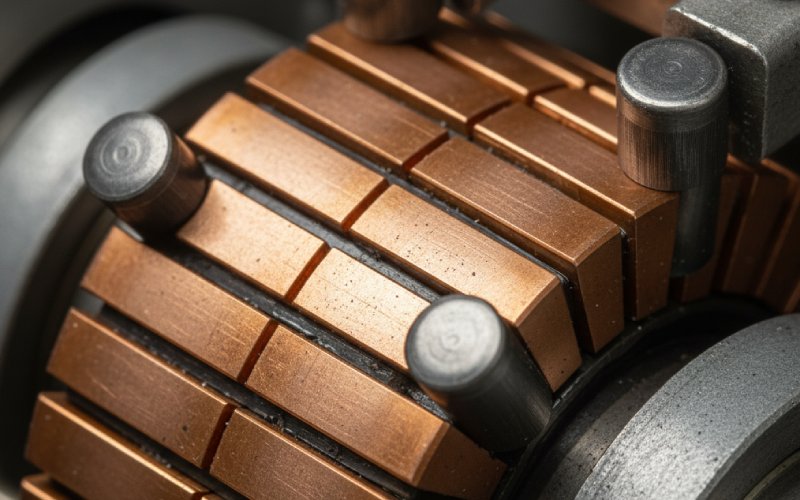
- Surface color: You are aiming for a continuous, even brown/gray film. Bright copper streaks or dull black islands mean uneven current sharing.
- Spark memory: Ask the operator how the motor looked and sounded just before shutdown. Rising spark level with load usually hints at brush pressure or commutation angle issues.
- Finger test: With gloves, very lightly drag a finger or plastic stick across the commutator. Feel for ridges, flats, or steps between bars.
Decision: if everything feels smooth and film is even, you probably stay in “clean and monitor” mode.
Pass 2 – focused checks (10–20 minutes)
- Bar-to-bar condition: Look for high bars, low bars, bar edge burning or copper dragged over the mica slots.
- Mica depth: Confirm undercut depth along several positions. Inconsistent mica exposure can disturb brush seating.
- Brush seating: Check contact pattern on each brush. Less than ~80% contact on a mature brush suggests misalignment or stone work needed.
- Brush holders: Check for sticking, side clearance, and the usual—holders square to the commutator and at the specified neutral position.
- Spring tension trend: Measure or at least compare visually with a known good spring. Unequal pressure between brushes shows up later as striped film.
Decision: if you see local defects (few bars, one brush set), you plan corrective work but probably not a full strip-down yet.
Pass 3 – deeper tests (planned shutdown)
On planned outages you add:
- Runout measurement: Check roundness with a dial indicator at several positions.
- Insulation checks: Armature insulation resistance, field circuits, basic health of the system around the commutator.
- Vibration and alignment review: Especially for large units where mechanical issues show up as commutator patterns long before bearings scream.
Here, you decide: clean and stone only, light skim cut on a lathe, or escalate to repair/rewind.
4. Cleaning DC motor commutators without creating new problems
Most failures come after “a quick clean” done in a hurry.
Guidelines that help:
- Avoid emery or metallic abrasives. Particles can embed in the copper and raise the risk of tracking.
- Use a proper commutator stone or non-conductive fine abrasive. Work along the axis of rotation, lightly, while rotating the armature.
- Vacuum first, then wipe. Compressed air alone just redistributes carbon dust inside the frame.
- Protect the bearings. Any abrasive dust near open bearings shortens their life long before the commutator shows trouble.
Common cleaning patterns:
- Light deposit, film still healthy: Vacuum, wipe with a lint-free cloth, minor stone work if needed.
- Heavy carbon and visible threading: More thorough stone work, and be prepared to dress brushes or replace them.
- Deep scoring or flat spots: Cleaning alone won’t help; plan for machining and proper re-forming of the film.
After any heavy cleaning or machining, schedule a controlled run. Let the brushes seat and the commutator film rebuild under monitored load instead of throwing it straight into worst-case duty.
5. Brush settings that quietly destroy commutators
Most commutator issues start at the brush.
Key areas to watch:
- Brush grade drift. Over time, substitutions happen. Someone grabs “similar” stock from another motor. Track grade changes and match them to film behavior and sparking history.
- Spring pressure. Too high, you wear the commutator fast. Too low, arcing and bar edge burning appear. Periodic checks with a spring scale are far more reliable than looking and guessing.
- Holder alignment. Holders that are a few degrees off neutral can create directional wear and unstable commutation at different loads.
- Brush box cleanliness. Dust and chips inside holders cause sticking, uneven contact and strange patterns that look like electrical problems.
If you standardize the settings (grade, pressure range, neutral mark, box clearances) across a motor family, troubleshooting becomes much quicker. You can rule out a whole set of mechanical causes in minutes.
6. When to machine, when to rewind, when to walk away
Not every ugly commutator needs a full restoration. Some do. The hard part is drawing the line in a consistent way.
A simple decision view you can tune to your site:
| Observed condition | Typical root cause mix | Common action |
|---|---|---|
| Smooth, minor threading, film slightly patchy | Normal wear, some load variation | Clean, light stone, adjust brushes. |
| Local high bars or copper dragged over mica | Bar loosening, poor undercut, thermal cycling | Plan skim cut, re-undercut; check for loose bars. |
| Deep grooving, multiple directions | Wrong brush grade, aggressive abrasives, misaligned holders | Skim cut, correct settings; review brush supply. |
| Repeated bar burning in same sector | Poor commutation, segment insulation issues, local heating | Detailed electrical checks; machining may not be enough. |
| Severe out-of-round, heavy sparking at all loads | Long-term neglect, major mechanical/electrical issues | Consider full rebuild or replacement motor. |
Tie this technical decision to business logic:
- Downtime cost per hour.
- Lead time on replacement motors or armatures.
- Age and history of the machine.
Some plants quietly adopt a rule such as: “third major commutator repair = plan replacement” to avoid pouring money into a unit that eats budget every shutdown.

7. Making commutator maintenance boring (this is a good thing)
You want this work to feel routine, almost dull. That only happens when it is standardized.
Practical actions:
- Use a simple visual rating scale. For example, a 1–5 commutator condition score and a separate 1–5 brush condition score stored in your CMMS.
- Photograph the same views every time. One radial photo, one axial, one close-up of the worst area, one of brushes in place. Short notes, date, run hours.
- Tag causes, not just symptoms. “Grooves” is not a cause. “Grooves – wrong brush grade after last shutdown” is useful six months later.
- Close the loop with purchasing. If brush grade or supplier changes correlate with more film problems, you want that visible on a simple chart.
Within a year or two of consistent data, you start seeing patterns: specific motors that misbehave, shifts where cleaning is rushed, environments that need shorter intervals.
That is where “dc motor commutator maintenance” stops being a one-off job and becomes part of your reliability system.
8. FAQ: DC motor commutator maintenance in real operations
Q1. How often should I inspect a commutator in continuous industrial service?
Most plants land somewhere between every 500 and 1,500 run hours for a quick brush/commutator check on heavily loaded machines, and less often in cleaner, light-duty environments. Adjust based on how fast film and brush wear change on your specific motors.
Q2. Is light threading always a problem?
Not always. Very fine, stable threading that doesn’t grow between inspections is often acceptable. Sudden, coarse threading that appears between two shutdowns is a warning—usually a mix of contamination and brush issues.
Q3. Do I really need proper commutator stones, or is fine sandpaper enough?
Stones and dedicated abrasives are designed to avoid embedding conductive particles and to give a controlled surface roughness. Improvised materials can work once, then quietly set up problems that show up months later as grooving or unstable film.
Q4. When should mica be re-undercut?
When the mica starts to approach the same height as the bar surface, or when you see brushes riding on mica instead of copper. This is easiest to control immediately after any skim cut.
Q5. How do I know if the issue is electrical (commutation) or mechanical?
Mechanical problems tend to show as repeatable patterns locked to rotation: consistent high spots, grooves, or bar edge damage. Electrical issues often follow load changes, temperature, or brush grade changes. Combining vibration data, film photos, and operator comments usually separates them.
Q6. Can I switch to a different brush grade to “fix” a bad commutator?
Sometimes changing grade helps stabilize sparking, but it should be done against manufacturer guidance and test data, not guesswork. Treat brush grade as part of the whole design, not a quick patch.
Q7. What’s the first thing to standardize if my commutators look different on every shutdown?
Start with inspection: same photos, same simple rating scale, same basic measurements. Once the way you see the commutator is consistent, the right maintenance rules become much easier to agree on.