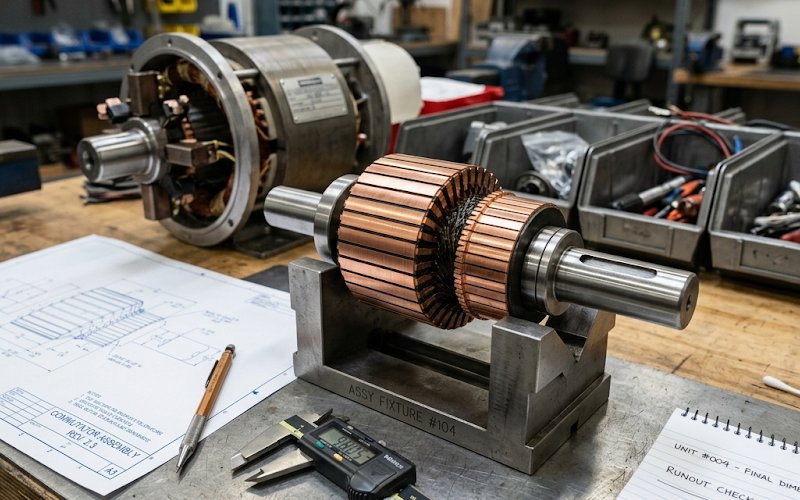
Sourcing Custom Industrial Commutators: What Buyers Should Check Before Approving a Drawing
Custom industrial commutators rarely fail because a drawing was missing one obvious number.
They fail because the drawing looked complete, and the application details stayed vague.
Copper can be correct. Dimensions can be correct. The part can still come back with brush chatter, selective wear, unstable film, hot risers, blackened bars, or sparking that only shows up after load and temperature move together.
That is the gap buyers need to close before approving a drawing.
Table of Contents
Key takeaways
- Review duty cycle before you review geometry.
- Specify the brush system, not only the commutator itself.
- Lock down mica undercut, chamfer, and burr control before shipment.
- Ask for finished runout and bar-to-bar consistency data, not a generic inspection statement.
- Treat the riser and connection design as a thermal and mechanical risk point.
- Do not approve a custom commutator quote until the supplier has reviewed the actual operating conditions.
Why DC Motor Duty Cycle Matters More Than Commutator Geometry
A drawing tells you what the part should look like.
It does not tell you what the part has to survive.
For custom industrial commutators, the real starting point is duty:
- continuous current
- peak current
- starts per hour
- reversing duty
- stall exposure
- overspeed margin
- vibration
- cooling limits
- contamination
- humidity swings
This is where many sourcing decisions go wrong. The buyer sends a print. The supplier prices the print. Nobody slows down long enough to ask how the motor is actually used.
That is how a commutator that looks fine at nominal load becomes unstable in service.
A machine with frequent starts and reversals does not load the commutator the same way as a steady-duty machine.
A machine that runs dirty air does not build the same surface condition as one in a clean enclosure.
A machine that sees low-speed heating and weak airflow will not behave like one operating near base speed.
So the first check is simple: if the RFQ only describes geometry, it is incomplete.
What Buyers Should Specify Beyond the Commutator Drawing
A custom commutator should not be sourced from dimensions alone.
The RFQ needs operating context.
At minimum, the supplier should receive:
- rated and peak current
- operating speed range
- start-stop frequency
- reversal frequency
- shaft and fit details
- brush grade or approved brush family
- brush pressure target
- holder arrangement
- environmental exposure
- cooling conditions
- expected overload events
- inspection and test requirements
Without that, the quote is only a machining quote.
Not an application review.
And that difference matters. A lot.
Why Copper Grade Alone Does Not Decide Commutator Performance
Buyers ask about copper first because copper is visible, familiar, easy to compare.
But in service, the commutator does not fail as “copper.”
It fails as an assembly.
The real questions are usually these:
- Does segment hardness match the duty?
- Does the bar stack remain stable under thermal cycling?
- Are the risers built for transient current and mechanical stress?
- Does the joining method hold under overload?
- Does the finished surface support stable brush contact?
- Is bar-to-bar variation controlled after machining?
This is where sourcing gets more serious. The material stack is part of the answer, not the whole answer.
A premium material claim is not enough if the riser runs hot.
Not enough if the bars shift.
Not enough if the finished track is inconsistent from segment to segment.
If the supplier talks at length about conductivity but says little about assembly stability, that is not a complete technical answer.
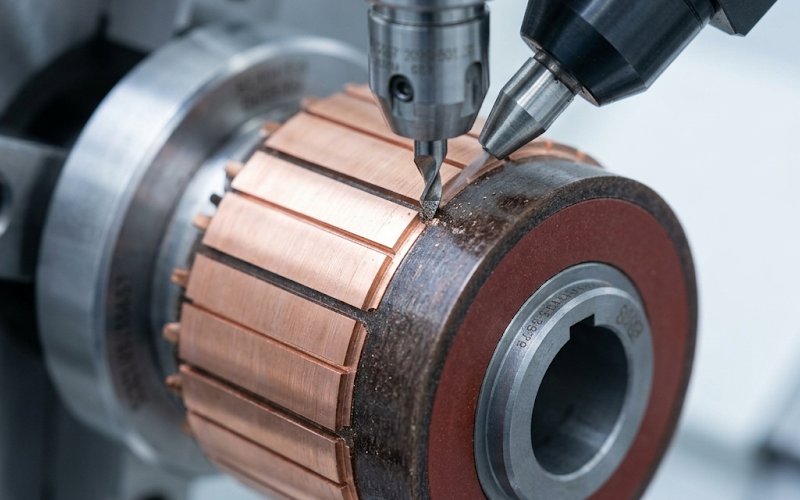
Mica Undercut, Chamfer, and Burr Control in Custom Commutator Manufacturing
This section gets ignored too often. Then it comes back as a brush problem.
Mica detail changes contact behavior. Small errors here can turn into larger problems later:
- brush noise
- chatter
- uneven wear
- unstable film
- edge picking
- local sparking
When reviewing a supplier, ask about the finishing sequence after the last turning operation:
- Is mica undercut after final machining?
- How is undercut depth controlled?
- How are burrs removed?
- What edge condition is required on each bar?
- How is bar-to-bar height checked?
- What is the acceptance limit for surface finish?
These are not shop-floor trivia points. They affect how the brush enters, rides, and leaves each segment.
A commutator can meet the print and still be rough in all the places that matter.
How Brush Pressure and Brush Holder Fit Affect Commutation Stability
A commutator is not a standalone purchase.
It runs as part of a contact system.
That system includes:
- brush grade
- spring pressure
- holder fit
- holder spacing
- neutral setting
- surface film behavior
This is one of the most common sourcing blind spots. The buyer evaluates the commutator as a component. The machine later punishes that decision as a system.
Brush pressure that is too low can promote unstable contact.
Pressure that is too high can push wear and heating in the wrong direction.
Poor holder fit can create uneven contact.
Mixed brush materials can distort current sharing and film behavior.
So yes, the supplier should be reviewing the brush path before quotation. Not after the first complaint.
At Sino, drawing review should include brush system compatibility, not only diameter, segment count, and shaft fit. That check catches problems earlier, when they are still cheap.
Runout, Bar Height Variation, and Finished Geometry Checks Before Shipment
This is where many buyers ask for “inspection,” but not for the numbers that matter.
For a custom industrial commutator, finished geometry should be discussed in terms of service behavior:
- total indicated runout
- bar-to-bar height variation
- roundness after final machining
- track finish
- concentricity relative to the actual mounting reference
Not all geometry problems show up immediately. Some wait until speed rises. Others wait until the unit gets hot. Some only appear when brush pressure, vibration, and load interact.
That is why the right question is not:
“Was it inspected?”
The right question is:
“What finished geometry data will be supplied with the order?”
If the answer is vague, the inspection plan is vague too.
Why Riser Design and Connection Quality Deserve More Attention
Risers do not always get much space in a quote review. They should.
In real service, riser and lead connection problems tend to show up as:
- localized heating
- burned joints
- current imbalance
- segment discoloration
- intermittent faults after thermal cycling
And once that damage starts, the commutator often gets blamed for symptoms that began at the connection.
When sourcing a custom commutator, buyers should check:
- riser geometry
- current path
- joint method
- overload expectation
- mechanical support
- evidence of continuity and connection quality
The weak point is not always where the part looks delicate.
Sometimes it is where the current changes direction and heat collects faster than expected.
Custom Industrial Commutator Supplier Checklist
Use this as a buying filter before approving a drawing or release order.
| Sourcing Factor | What Buyers Should Specify | What Can Go Wrong If Ignored | What the Supplier Should Confirm Before Quotation |
|---|---|---|---|
| Duty cycle | Continuous load, peak load, starts, reversals, stall events | Heat build-up, unstable commutation, accelerated wear | Application review tied to real operating duty |
| Speed and mechanical limits | Speed range, overspeed margin, vibration, shaft fit | Runout sensitivity, bounce, mechanical instability | Finished geometry targets and mounting reference |
| Segment stack | Bar count, pitch, bar width, height tolerance | Uneven current sharing, poor brush tracking | Bar-to-bar variation control after machining |
| Mica system | Insulation thickness, undercut requirement, edge condition | Chatter, edge wear, unstable contact film | Undercut, chamfer, and burr control process |
| Brush interface | Brush grade, pressure target, holder arrangement | Sparking, uneven wear, hot spots | Compatibility review of brush and holder system |
| Riser and joints | Current path, joint design, overload expectation | Local overheating, intermittent faults, burned bars | Joint integrity and continuity checks |
| Environment | Dust, oil mist, humidity, chemical exposure | Surface contamination, friction changes, film instability | Material and process suitability for site conditions |
| Inspection data | Runout, surface finish, bar height, continuity, insulation | Hidden variability, early field failure | Lot-level inspection records and traceability |
| Service strategy | Rework limits, turn-down limits, spare approach | Higher lifecycle cost, poor repair planning | Recommended service limits and replacement timing |
What Inspection Data to Request From a Custom Commutator Supplier
A useful inspection package does not need to be long.
It needs to be relevant.
Buyers should ask for data that connects directly to service risk:
- finished runout
- bar-to-bar height variation
- surface finish confirmation
- undercut and burr condition
- continuity or resistance checks where applicable
- insulation verification
- traceability by lot or serial reference
This matters for repeat orders too.
Not only for first articles.
If a part performs well in the field, you want the next batch built and inspected against the same real controls.
Not just the same nominal print.
At Sino, quotation review should convert these requirements into a build checklist before production release. That step is usually where hidden risk gets found.
Common Sourcing Mistakes Buyers Still Make
Some mistakes repeat because they look efficient on paper.
Approving from a legacy drawing without reviewing the duty
The old part may have survived under different current, temperature, or contamination conditions.
Treating the brush as a separate purchasing item
It is a separate item in the ERP system. It is not a separate item in service behavior.
Asking for material upgrades before checking geometry and interface stability
A harder or more conductive material does not fix poor contact conditions.
Accepting “tested before shipment” without defining the test scope
That phrase sounds good. It does not tell you much.
Reordering a failed design as a copy
If the previous part failed in service, duplicating the print may duplicate the problem.
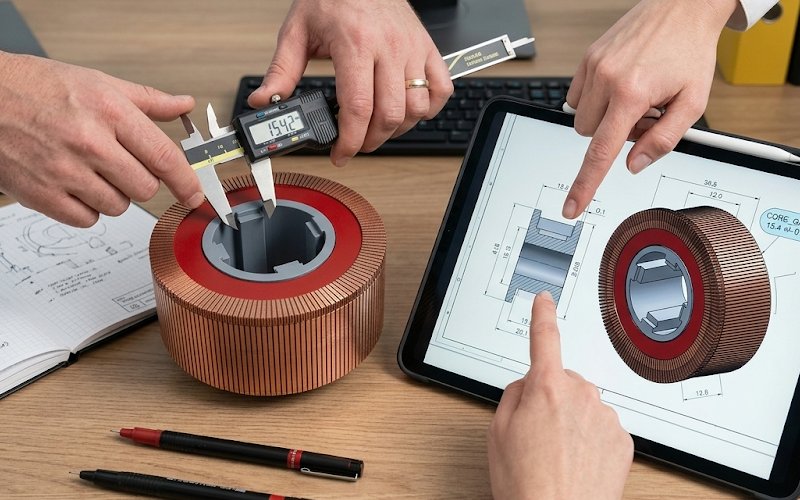
A Better Way to Approve a Custom Commutator Order
Before approving the next drawing, the review should answer five questions:
- What duty is this commutator actually expected to survive?
- What brush system will run against it?
- What finishing controls define the usable contact surface?
- What geometry and electrical data will be recorded before shipment?
- What failure mode is being prevented by this design choice?
That last question matters more than it seems.
A good sourcing decision is not just about what gets built.
It is about what gets prevented.
If your next order is being quoted from dimensions alone, the review is probably still too shallow.
Need a technical review before release?
Sino can review commutator drawings against duty cycle, brush system, runout target, mica detail, and inspection scope before quotation.
FAQ: Sourcing and Troubleshooting Custom Industrial Commutators
What should be included in an RFQ for a custom industrial commutator?
Include the drawing, yes. But also include duty cycle, current range, speed range, starts and reversals, environment, cooling conditions, brush grade, holder arrangement, and required inspection data. A dimensional RFQ is not enough for application review.
Why does an industrial commutator spark even when the copper grade is correct?
Because sparking is often caused by system mismatch, not just base material choice. Brush pressure, holder fit, film condition, mica height, runout, riser heating, and current imbalance can all create sparking even when the copper specification is acceptable.
How much runout is too much for a custom commutator?
There is no useful single number without context. Acceptable runout depends on speed, brush system, machine stiffness, and duty. What matters is the finished runout limit for that application, verified on the final reference condition.
What causes uneven brush wear on a new industrial commutator?
Common causes include bar height variation, unstable film, poor holder fit, incorrect brush pressure, high mica, burrs, misalignment, or vibration. New parts do not always wear evenly just because they are dimensionally new.
Should the brush grade be reviewed during commutator sourcing?
Yes. Always. The commutator and brush operate as a contact pair. Sourcing one without confirming the other creates avoidable risk.
When should mica undercut be checked before shipment?
Before final approval, and as part of the finished surface inspection. If undercut depth, edge condition, or burr removal are inconsistent, the problem often appears later as brush instability rather than as an obvious dimensional nonconformance.
Can I reorder an old commutator design if the machine now runs a different duty cycle?
Not safely by default. A change in starts, reversals, peak load, cooling, or operating environment can be enough to require a revised review, even if the old geometry seems close.
What is the most important question to ask a custom commutator supplier?
Ask how the supplier converts your application data into build controls. If the answer stops at dimensions and material, the review is incomplete.
Final Check Before You Approve the Drawing
If the discussion is only about copper, dimensions, and lead time, the sourcing process is still missing the real risk points.
For custom industrial commutators, buyers should be locking down:
- duty cycle
- brush system compatibility
- mica detail
- runout and bar variation
- riser robustness
- inspection scope
- traceability
That is usually the difference between a clean startup and a field problem that gets diagnosed too late.