Custom Commutators for Small Hobby Motors, Drones, and RC Models: Design Factors That Affect Life and Stability
In small brushed motors, the commutator is rarely the biggest part. It is often the part that decides whether the motor survives high start-stop frequency, unstable load, and long production runs without turning into a warranty problem.
That matters in hobby platforms. Micro drones, small RC vehicles, compact actuators, lightweight accessory drives. The motor is small, yes. The tolerance window usually is not.
From a manufacturing side, most field complaints in these motors do not begin as “motor problems.” They begin as contact problems. Uneven commutation. Excessive sparking. Fast brush wear. Output drift after a short service period. Noise that was not there at sample stage. Most of that traces back to a short list of commutator variables: material, segment geometry, runout, surface finish, insulation integrity, and batch consistency.
This is the point that gets missed. For small hobby motors, a commutator is not just a copper switching part. It is a wear interface. A geometry problem. A production stability problem.
Table of Contents
Where commutator quality shows up first
In this product range, engineers usually notice commutator quality in four places first:
- spark behavior at startup and throttle change
- brush seating and early wear rate
- temperature rise during repeated duty
- consistency between pilot samples and production lots
If those four move in the wrong direction, the motor may still pass a basic no-load test. It still becomes difficult to ship with confidence.
For drone and micro-air applications, the issue is usually speed and thermal margin. The motor is small, the cycle count is high, and any instability at the brush-commutator interface shows up quickly. In ground RC products, especially low-speed or intermittent-duty designs, the issue is often not peak RPM but repeatability: smooth startup, controlled current transfer, and stable wear over time.
Different platform. Same weak point.
What motor manufacturers usually need from the commutator
For OEM brushed motors in hobby and RC applications, the buying decision is rarely about the commutator alone. It is about whether the commutator can support the motor target without becoming the first unstable variable in the assembly.
In practical RFQ terms, the commutator usually has to match five things:
1. Speed range
High RPM changes everything. Contact stability becomes harder to hold. Surface defects become more destructive. Poor roundness that looks minor at low speed becomes visible as spark, noise, and wear.
2. Load profile
A motor that sees short pulse duty behaves differently from one that sees frequent direction change, repeated stall events, or long periods near peak current. The commutator design has to reflect that. Not just the winding.
3. Brush system
Brush material, spring pressure, seating behavior, and commutator surface condition work as one system. A good commutator with a poor contact match still fails like a poor commutator.
4. Size constraints
In small motors, there is less room to hide dimensional drift. OD, ID, overall height, segment spacing, hook geometry, and insulation structure all become tighter decisions.
5. Batch repeatability
A drawing can be correct and the supply still fails in production. This is common. Sample parts run clean. Batch parts introduce drift in runout, burr control, copper edge condition, or molded insulation stability. Then spark behavior changes lot to lot.
That is where sourcing becomes engineering.
The design factors that actually affect motor life
Material selection is not a background detail
For small commutators, material choice is tied to wear resistance, electrical erosion behavior, manufacturability, and cost. If the application speed is high, or the duty cycle is sharp, the material decision becomes less forgiving.
In small hobby motors, material mismatch often shows up as one of two things: early surface damage or unstable film development. The motor still runs. Then the wear pattern starts to shift. Output becomes less clean. Current transfer gets less even.
This is why material selection should be tied to actual duty, not only rated voltage.
Segment geometry affects more than commutation timing
Segment count, segment width, spacing, and edge condition affect current transfer, brush bridging behavior, and spark tendency. In small brushed motors, coarse decisions here can create problems that later get blamed on the brush, the winding, or the power supply.
Not always. Usually the geometry got there first.
For custom projects, we review segment geometry together with motor speed, number of coils, current density, and available brush footprint. That reduces rework later. It also avoids the common mistake of copying a legacy commutator layout into a new motor with a different operating envelope.
Runout is one of the fastest ways to create field failures
If runout is not controlled, brush contact becomes uneven. That leads to localized heating, unstable film, faster wear, and more visible sparking. In micro motors, the damage curve can be steep because the system has little mechanical forgiveness.
This is one reason a commutator that looks acceptable visually may still perform poorly in assembled motors. The issue is not only appearance. It is dynamic contact quality under speed.
For small hobby motors, runout control is not a premium feature. It is a basic requirement for batch stability.
Surface finish decides how the interface begins to age
If the surface is too smooth, brush seating becomes less stable. If it is too rough, brush wear rises early. In both cases, the motor can pass incoming inspection and still create life problems after short use.
We treat surface finish as part of the commutation system, not as a cosmetic machining result. The target is a controlled contact surface that supports clean seating, stable film formation, and low variability between lots.
A lot of returns start here. The first hours of running matter more than people admit.
Burrs, edge condition, and insulation details are small until they are not
Bar edge condition, chamfer consistency, insulation position, and molding cleanliness tend to be ignored in early supplier comparisons because they look like minor details. In production they are not minor.
Poor edge condition can disturb brush travel. Poor burr control can damage the contact path. Incomplete insulation control can create long-term reliability issues that are hard to diagnose from finished motors alone.
For small commutators, defect size may be tiny. Failure cost is not.
Common motor failure modes and how commutator sourcing affects them
| Failure mode in finished motor | Likely commutator-related cause | What we usually control first | Result for the motor manufacturer |
|---|---|---|---|
| Edge sparking during startup or speed change | Excessive runout, unstable segment geometry, poor edge condition | Roundness, segment consistency, chamfer control | Lower visible sparking, cleaner commutation |
| Rapid brush wear in early life test | Surface too rough, material mismatch, unstable contact path | Surface finish window, copper alloy match, burr control | Longer brush life, less early drift |
| Output instability between production lots | Dimensional variation or inconsistent molded body stability | Batch inspection, tooling control, in-process SPC | Better lot-to-lot repeatability |
| Temperature rise above sample level | Uneven current transfer or higher friction at the contact interface | Runout, surface finish, contact-area consistency | More predictable thermal behavior |
| Noise increase after short service period | Irregular wear path, poor seating, localized surface damage | Surface preparation, geometry review, cleanliness control | Lower complaint rate in field use |
| Short life in high-cycle micro motors | Material and geometry not matched to real duty cycle | Application-based commutator redesign | Higher usable life without changing the full motor platform |
Why small drone and RC motor projects need custom commutators more often than expected
Standard commutators are fine when the motor envelope is standard too. Many hobby projects are not.
A compact brushed motor for a micro drone may need aggressive weight control, fast acceleration, and limited thermal headroom. A brushed motor for a small RC mechanism may need stable startup torque, repeated reversing, and low-speed smoothness. Same market family. Different commutator priorities.
This is why custom commutator development is often necessary when the project has any of these conditions:
- non-standard OD or ID constraints
- unusual shaft and armature fit requirements
- high RPM relative to motor size
- repeated pulse duty or reversing duty
- brush footprint limitations
- lifetime targets that exceed the normal hobby replacement cycle
- tighter noise or spark limits for branded OEM products
In these cases, a standard catalog part can delay the project. It looks faster at the beginning. Then the motor team starts compensating elsewhere.
That approach gets expensive.
What we review before recommending a commutator design
For new projects, we usually ask for the motor and application data before discussing the final commutator structure. Not because the part is complicated by itself. Because the wrong input produces a clean-looking, wrong part.
The most useful data points are:
- motor OD and stack constraints
- shaft diameter and fit details
- operating voltage and current range
- target RPM range
- duty cycle and start-stop frequency
- brush type and spring arrangement
- expected life target
- available drawings, samples, or failed parts
- environmental notes if contamination, humidity, or storage conditions matter
With that information, the discussion gets practical very quickly. Material, segment count, overall dimensions, hook or riser style, insulation method, and tolerance priority can be reviewed in one flow instead of trial-and-error purchasing.
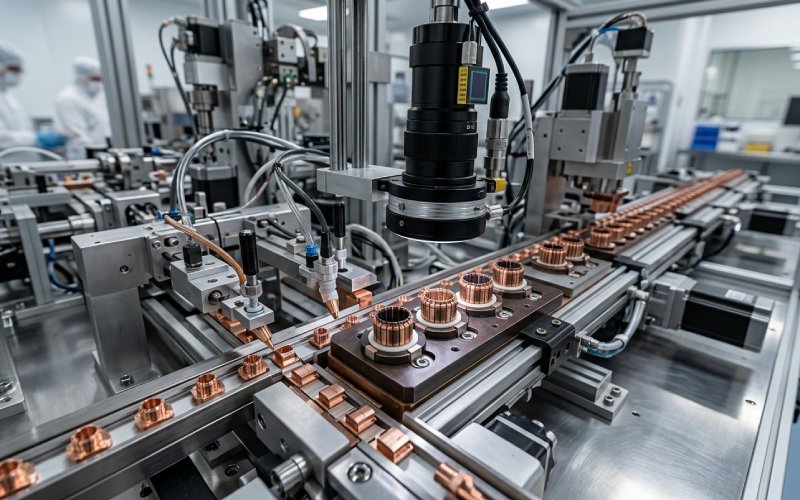
Our manufacturing focus for micro motor commutators
For small commutators used in hobby motors, RC motors, and compact brushed drive systems, we focus on the points that usually affect assembly yield and field stability most:
Tight dimensional consistency
Small motors do not tolerate casual dimensional drift. We control critical dimensions around OD, ID, height, hook structure, and segment layout so assembly remains stable from samples to volume production.
Controlled runout
Runout has a direct effect on brush contact and spark behavior. We treat it as a core process metric, not a final-stage afterthought.
Stable surface condition
Surface condition influences seating, wear, and early-life behavior. We keep the machining and finishing window controlled so the motor does not need to “correct” the commutator during the first hours of use.
Clean edge and insulation control
Segment edges, burr condition, and insulation integrity matter more in small motors because defect tolerance is low. This is why visual inspection alone is never enough.
Custom development support
For OEM and custom motor programs, we support design review based on target application, not only drawing replication. That matters when the original part is one reason the motor is underperforming.
When a standard commutator is enough, and when it is not
A standard design is usually enough when:
- the motor platform already has stable field history
- speed and current are moderate
- life target is modest
- there is enough dimensional margin in the armature design
- the project is price-led and replacement cycle is short
A custom design is usually the better route when:
- the motor is moving to higher RPM
- spark behavior must be reduced
- field life needs to improve without a full motor redesign
- the existing part varies too much by batch
- the assembly line is sensitive to fit tolerance
- the OEM needs repeatable supply over multiple production phases
That divide is simple. Use standard when the motor can tolerate standard. Use custom when it cannot.
FAQ
What information do you need for a custom micro motor commutator quotation?
The minimum useful set is motor drawing or sample, target dimensions, operating voltage, current range, RPM range, brush type, and expected life target. If you have failed samples or test data, that speeds up design review.
Can you customize OD, ID, height, segment count, and hook structure?
Yes. For small hobby motors and RC motors, these dimensions usually need to match the armature layout and assembly method closely. We can review custom geometry based on drawing, sample, or motor parameters.
Why does runout matter so much in small brushed motors?
Because uneven rotation at the commutator surface creates uneven brush contact. That usually shows up as spark, heat, unstable wear, and reduced life. In compact high-speed motors, the effect becomes visible quickly.
Do you help evaluate failed commutators from an existing motor?
Yes. For many OEM projects, reverse review of worn or failed parts is the fastest path. Surface damage pattern, edge condition, dimensional drift, and fit structure often show where the original design or production control is weak.
Can a commutator change improve brush life without changing the full motor design?
Often yes. Not in every case. But if the main issue is contact stability, surface condition, material match, or geometry, commutator optimization can improve brush wear and spark behavior without changing the full motor platform.
What is the usual development path for a new project?
Normally it goes in four steps: technical review, drawing or sample confirmation, prototype production, then batch validation. Once the commutator is stable in the motor test window, mass production becomes much easier to hold.
Final note
For small hobby motors, drones, and RC models, the commutator is still one of the easiest parts to underestimate. It looks simple. In production, it is not simple.
If you are developing a brushed motor and need better control of spark behavior, brush wear, or batch stability, send us your drawing, sample, or motor parameters. We can review the commutator structure around your actual speed, load, and life target instead of forcing the project into a standard part that was made for another motor.