What are compensating windings and how do they help commutation?
In this article, we’ll just talk about what compensating windings actually do for commutation, when they’re worth paying for, and what they mean for brush life, sparking, and specification work on large DC machines.
Table of Contents
1. Quick recap: what “compensating” really means
Very short version:
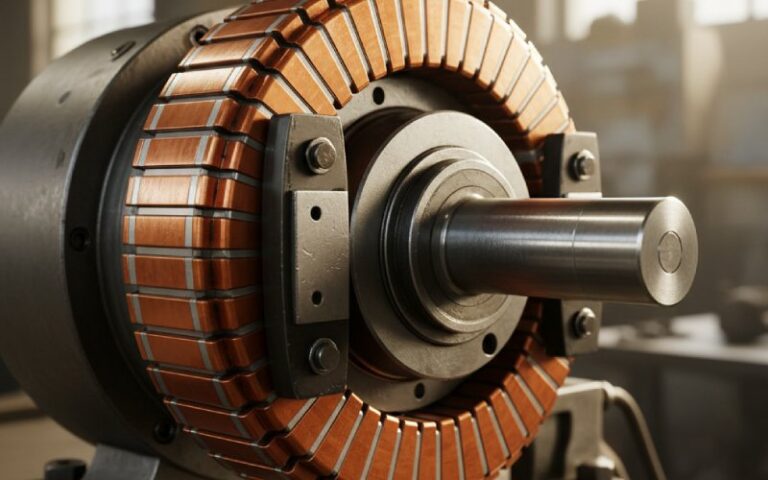
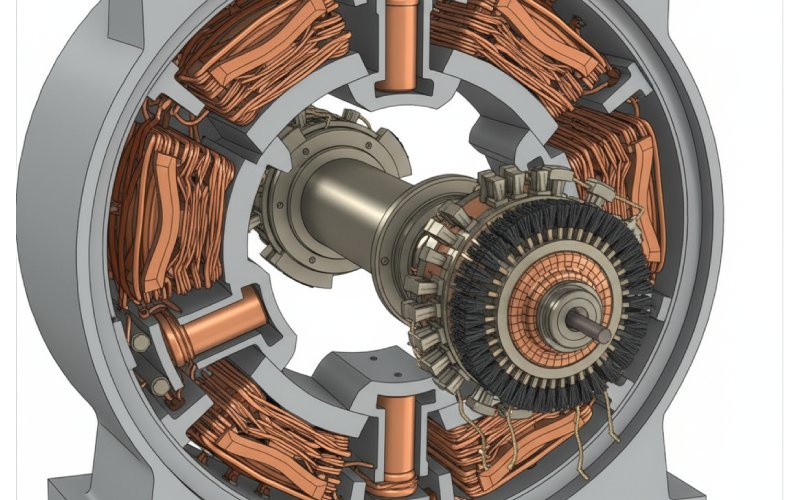
- Compensating windings are conductors buried in the pole shoes of a DC machine, aligned with the armature slots under that pole and connected in series with the armature.
- They carry armature current and create a local mmf that opposes the armature mmf under the pole face, flattening the flux waveform there.
- The result: the magnetic neutral plane stops wandering with load, flux under the poles stays close to the “no-load” shape, and brush position becomes much less sensitive to current swings.
You already know why that matters: the coil being commutated really hates surprise flux.
2. Where compensating windings sit relative to the commutator
Think in geometry, not slogans.
- Interpoles live in the interpolar gaps and act mostly on the coil in commutation as it short-circuits under the brush.
- Compensating windings sit directly under the main poles, right above the armature conductors that carry most of the current most of the time.
So:
- Armature current rises.
- Armature mmf bends the main field and drags the neutral plane.
- Compensating winding sees the same current (series connection) and instantly produces equal-and-opposite mmf under the pole shoe, cancelling most of that bend before the flux reaches the commutating zone.
The commutator then sees a field that looks almost like the design drawing, even when the load cycle is ugly.
3. How compensating windings actually help commutation
Let’s skip the long derivations and just walk through the main effects on the commutation process.
3.1 Neutral plane stays put
Without compensation, you see the classic pattern:
- As current increases, cross-magnetizing armature mmf pushes the neutral plane ahead or behind the geometric neutral, depending on machine mode.
- To keep commutation acceptable, someone has to shift the brushes (or accept sparking).
Compensating windings swamp that cross-magnetizing component right where it’s created, so the neutral plane is practically fixed across the normal load range.
Result in real life: you set the brushes once; you don’t keep chasing them every time the process engineer decides to push the line harder.
3.2 Lower reactance voltage in the commutating coil
The coil under commutation is short-circuited by the brush for a brief mechanical angle. The nasty part is the reactance voltage induced by:
- its own leakage inductance, and
- any flux cutting it while current tries to reverse.
Compensating windings shrink the armature flux that would otherwise cut that coil, so the induced reactance voltage during commutation goes down. Interpoles handle the remaining piece by injecting a properly phased commutating emf, but they no longer have to fight a wildly distorted main field.
3.3 Better flux symmetry under the pole face
Armature reaction doesn’t just shift the neutral plane; it distorts flux density under the pole shoes:
- One edge of the pole tends toward saturation.
- The other is weakened, sometimes enough to hurt torque per ampere.
Compensating windings level that out, which gives two side effects that commutator people care about:
- Torque pulsations are smaller, so current ripple at the brushes is less violent.
- Less local saturation means less sensitivity to small mechanical offsets in brush position.
3.4 Interpoles can be modest instead of heroic
Once the heavy armature reaction under the poles has been cancelled, you don’t need massive interpole ampere-turns just to pull the neutral plane into line. Several design notes point out that with compensation, interpole ampere-turns can drop by roughly half, which also reduces leakage, local saturation, and stray heating.
So compensating windings don’t just “improve” commutation; they make the rest of the commutation hardware work in a more reasonable range.
4. Compensating windings vs. interpoles
Most online explainers blur the two. For specification work it’s useful to keep them separate.
| Item | Compensating windings | Interpoles (commutating poles) |
|---|---|---|
| Location | Slots in the main pole shoes, aligned with armature conductors under the poles | Small poles placed between the main poles, facing the interpolar gaps |
| Connection | In series with armature | In series with armature |
| Main job | Cancel cross-magnetizing armature reaction under pole faces, keep flux distribution and neutral plane stable | Supply commutating mmf / emf to the short-circuited coil in the interpolar region |
| Zone of influence | Broad: entire pole face and most of the armature periphery under that pole | Local: narrow region around the coil being commutated |
| Effect on brush setting | Lets you keep brushes near geometric neutral over wide load range | Fine-tunes commutation around that fixed brush position |
| Cost / complexity | More copper, machining of slots in pole shoes; relatively expensive, used mainly on large or severe-duty machines | Cheaper to add; many large machines rely mainly on interpoles when cost pressure is high |
You need both on really demanding drives; for milder duty, interpoles alone often win on cost.
5. When compensating windings are actually worth the money
Compensating windings aren’t a feel-good feature; they’re a response to specific operating patterns. Common triggers:
- Large, fast current swings Rolling mills, mine hoists, big cranes, and similar drives live on step changes and cyclic overloads. Cross-magnetizing armature reaction swings hard there, so relying only on interpoles tends to give compromise brush settings and periodic sparking.
- Frequent reversals When direction reverses, armature flux reverses relative to the main field. The “best” brush position shifts unless the armature field is mostly cancelled under the poles. Compensating windings track that automatically because they carry the same current as the armature, in the right opposition.
- Weak-field operation / field weakening In deep field-weakening regions of a DC drive, the ratio of armature mmf to field mmf gets high, and the neutral plane becomes very load-sensitive. Compensation keeps that regime usable without absurd brush wear.
- Very large frame sizes On a 5 kW lab motor you just move the brushes a few degrees and accept it. On a few-hundred-kilowatt mill motor with a wide commutator, that’s not sustainable. Most classic large DC industrial motors either use heavy interpoles plus compensation, or at least provide the option.
If your duty cycle is steady and your overload factor is tame, interpoles alone might be enough and cheaper. That’s why many modern notes stress the relative expense of compensation.
6. Design details that quietly decide whether it works
You can check “with compensating winding” in a spec sheet and still end up with mediocre commutation if a few real-world details are off.
6.1 Ampere-turn balance
Compensating mmf has to roughly match the armature mmf under the pole. That implies:
- Proper turns per pole in the compensating winding.
- Series connection that truly carries full armature current, not a bypassed fragment.
Too weak: residual neutral-plane shift and persistent sparking at high load. Too strong: over-compensation, flux distortion in the opposite direction, and trouble in low-load commutation.
6.2 Pole shoe slot geometry
Slots cut into the pole face for the compensating winding change the local reluctance:
- Deep narrow slots with minimal iron between them risk localized saturation at the remaining teeth.
- Shallow slots limit how much conductor you can fit before copper temperature climbs.
Manufacturers play with slot pitch, tooth width, and conductor shape (rectangular vs. round) to get the mmf they need without upsetting the field iron.
6.3 Sharing work with interpoles
Because compensation cancels most of the cross-magnetizing field, the interpole is free to focus on the reactance-voltage problem of the commutating coil. That means:
- Interpole turns can be reduced.
- Leakage flux from the interpole is smaller, which keeps excitation and heating in a saner band.
You get a more “balanced” commutation system instead of one heroic commutating pole doing everything.
7. What happens when compensating windings are damaged?
From a service engineer’s perspective, failed compensation has a pretty recognizable footprint.
Typical signs:
- Localized brush sparking under one or two poles rather than uniformly around the commutator.
- Patterned discoloration or ridging on the commutator surface aligned with specific poles.
- Unexplained commutation trouble after a field-system repair where compensating connections may have been disturbed.
Open-circuit or incorrectly reconnected compensating turns destroy the mmf balance under that pole. The interpoles still act, but now they’re correcting against a badly distorted field, and their “best” polarity/strength is no longer uniform.
For a B2B buyer talking to a repair shop, it’s worth asking specifically whether compensating windings have been insulation-tested and verified per pole, not just as “field windings checked”.
8. Practical checklist when you’re specifying or refurbishing
When you talk to your motor or commutator supplier, or you’re reviewing a design, questions like these tend to separate shallow specs from robust ones:
- Is compensation included on every pole or only some frames in the series?
- What armature current range was used to size the compensating ampere-turns? Does it match your real overload or regeneration levels?
- How are compensating coils brought out and protected mechanically? Terminations at pole sides, brazed joints, vibration supports.
- What’s the expected brush position range over the full duty cycle? If the answer is “you might need to move them a lot”, compensation may be marginal.
- How does the design handle field weakening with modern power-electronic drives? Commutation with high ripple DC is less forgiving.
- If you’re upgrading an old frame: can compensating windings be added without changing the commutator, or is a new rotor stack inevitable?
These are the bits that rarely show up in short online articles but tend to decide whether your commutator runs quietly for years or eats brushes.
9. FAQ: compensating windings and commutation
1. Do all DC motors need compensating windings?
No. They’re mainly used on larger machines or on drives with heavy load variations, reversals, or deep field weakening. Many industrial DC motors rely only on interpoles plus careful brush setting to manage armature reaction, partly because compensation is an added cost.
2. How can I tell if a machine already has compensating windings?
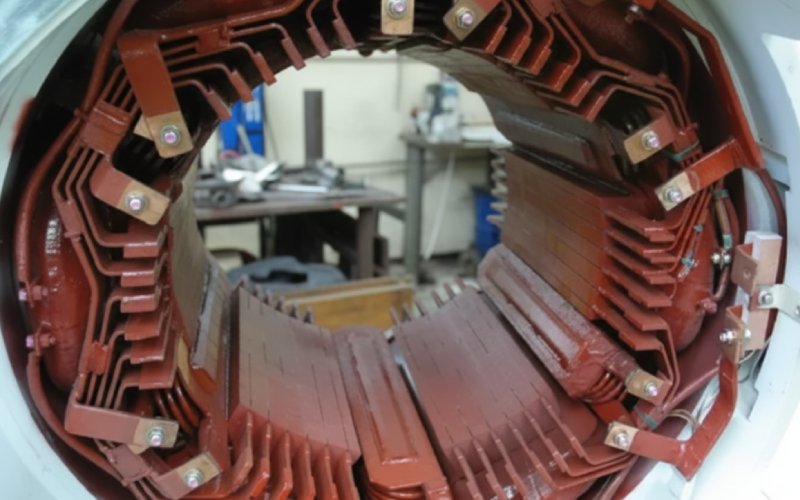
Look at the main pole faces: if you see slots cut across the pole shoes with copper bars or coils fitted inside and those conductors are connected in series with the armature circuit, you are looking at compensating windings. Manuals and nameplates sometimes note “with pole-face compensation” or similar wording.
3. Can compensating windings be retrofitted to an existing motor?
Sometimes, but it’s not trivial. You need pole shoes thick enough to accept slots, space for end connections, and a redesign of the series circuit to include the new coils. For many older machines, a replacement or major factory rebuild is the realistic path if compensation is required.
4. If I already have strong interpoles, do I still gain much from compensation?
Yes, in severe-duty applications. Interpoles handle the localized commutating emf, but they don’t fix distorted flux under the pole shoes themselves. Compensation removes most of that distortion so the interpoles work in a predictable field, which often means better commutation across a broader current range and less brush maintenance.
5. Are compensating windings still relevant now that many drives use AC motors?
For new greenfield plants, high-power AC drives have taken over much of the work. But there is still a vast installed base of large DC mills, hoists, and traction equipment where replacement is costly. On those machines, compensating windings remain a key part of keeping commutation stable, especially when old motor-generator sets are replaced by modern solid-state DC supplies with sharper current dynamics.
If your business depends on commutators running quietly at high current, compensating windings are not just a textbook topic. They’re one of the main reasons some DC machines shrug off brutal duty cycles while others spend their lives on the repair bench.