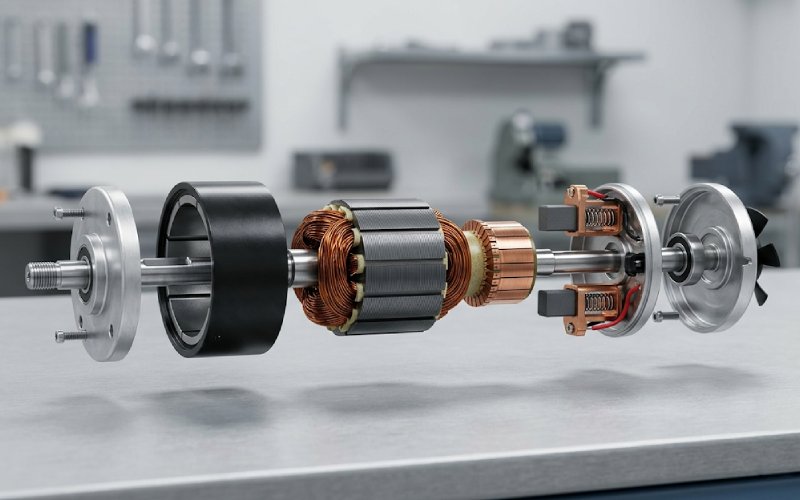
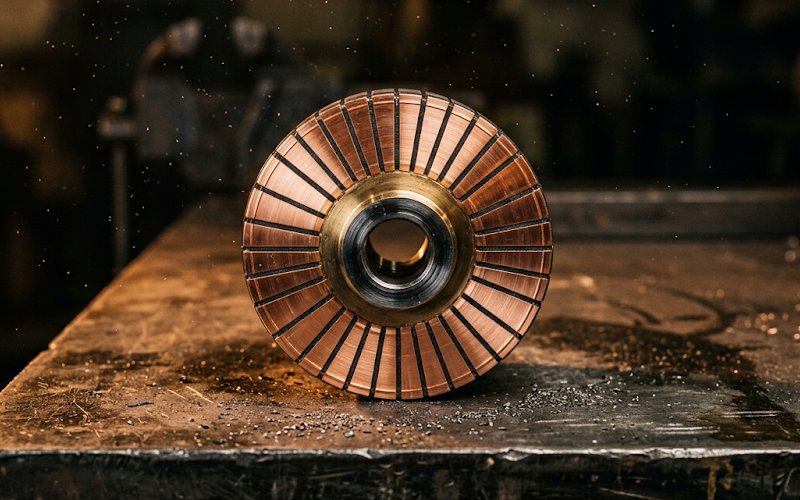
Understanding Commutator Specifications: Pitch, Diameter, and Bore
Commutator specifications look simple on paper. They are not. Pitch, diameter, and bore are tied together, and they usually fail together too. A drawing can show a correct outside diameter and still give unstable brush behavior if the bore is off. A commutator can be turned clean and still be wrong because pitch has been eaten away. That is the real problem here.
Table of Contents
Key Takeaways
- Pitch is not just spacing. It is copper width, insulation allowance, and the amount of brush-track margin left after manufacturing and rework.
- Diameter sets surface speed, commutation time, heat behavior, and how much service life remains after turning.
- Bore is the datum. If the bore-to-track relationship is wrong, a “good” diameter does not save the part.
What Commutator Pitch Means
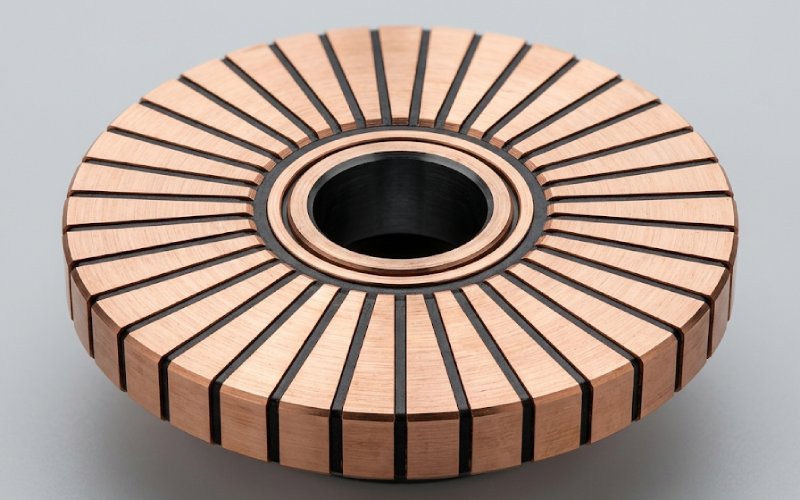
Commutator pitch is the circumferential pitch of one segment at the finished brush track:
tau_c = (pi x D_c) / S
Where:
- tau_c = commutator pitch
- D_c = finished commutator diameter
- S = number of segments
This is the number people treat as layout. It is more than layout.
Pitch decides how much copper each segment gets. It decides how much insulation can exist between bars without becoming fragile. It affects how comfortably the brush spans segments during commutation. It also shrinks whenever finished diameter shrinks. That part gets missed a lot.
A practical lower limit often used in design work is about 4 mm. Below that, mechanical strength and insulation allowance start getting tight. In many conventional designs, that minimum is thought of as roughly 3.2 mm copper plus 0.8 mm insulation. Typical outer segment widths often land in the 4 to 20 mm range. If your design goes below that lower end, the burden of proof is on the drawing and the process plan, not on the repair shop.
How to Calculate Commutator Pitch
The calculation is short.
If a finished commutator diameter is 140 mm and the commutator has 84 segments:
tau_c = (pi x 140) / 84 = 5.24 mm
Nothing unusual there.
Now turn that same commutator down to 136 mm during repair, with the same 84 segments:
tau_c = (pi x 136) / 84 = 5.09 mm
Still usable, maybe. But the point is not the exact number. The point is that every cut takes pitch away. Rework does not only reduce diameter. It reduces segment margin.
That is why pitch should be checked from the actual finished diameter, not from the nominal diameter printed on an old drawing or parts list.
How Commutator Diameter Affects Surface Speed and Heat
Commutator surface speed is:
v_c = (pi x D_c x N) / 60
Where:
- v_c = peripheral speed in m/s
- D_c = finished commutator diameter in m
- N = rotational speed in rpm
A common design starting range puts commutator diameter at roughly 60% to 80% of armature diameter. That is only a starting point. The more useful check is surface speed.
For many conventional DC machine designs, designers try to keep commutator peripheral speed around or below 15 m/s where possible. Higher values are used. Sometimes much higher. But the commutation margin gets tighter because the reversal interval becomes shorter, and the reactance voltage term rises with di/dt. So the brush track gets less forgiving. Small geometry errors matter more. Local bar height errors matter more. Brush contact instability stops being minor.
Diameter also changes service behavior.
When a commutator is turned during repair, three things happen at once:
- The brush track diameter drops.
- The pitch drops.
- The available future rework allowance drops.
This is why the drawing should never stop at nominal diameter. It should also state minimum service diameter or discard diameter. Without that number, people keep machining until the surface looks good and the geometry is already poor.
A second detail: after turning, the brush holder position may need resetting because the brush-to-track relationship has changed. Ignoring that detail creates a problem that looks electrical but started as geometry.
Why Commutator Bore Tolerance Matters
The bore is not just a hole for the shaft. It is the reference axis for the whole part.
Brushes do not care whether the outer diameter was measured correctly in isolation. They care whether the brush track runs true to the rotational axis. That means the bore, the brush surface, and the segment stack have to agree with each other.
Two errors matter here:
- Eccentricity: the bore axis and brush track axis are offset
- Skew: the bars are not properly parallel to the bore centerline
Either one can produce cyclic brush loading, nonuniform contact film, chatter marks, uneven wear, or recurring sparking at one angular position. Those symptoms get blamed on brushes all the time. Often the bore relationship is the first thing that should have been checked.
So a usable bore specification should include more than size. It should include:
- bore diameter
- bore tolerance
- fit intent
- geometric relation of the brush track to the bore
- face or shoulder datum if axial location matters
Without that, inspection is forced to guess what “true” actually means.
Clearance Fit, Transition Fit, or Interference Fit?
A commutator bore cannot be specified intelligently without stating the fit strategy.
There are three basic fit modes:
- Clearance fit: the shaft is always smaller than the bore
- Transition fit: the joint may assemble with slight clearance or slight interference
- Interference fit: the shaft is always slightly larger than the bore
For keyed joints, either clearance or interference can be valid. For keyless joints, interference is usually required.
The wrong fit causes very familiar field problems:
- Too loose: creep, fretting, wobble, polished witness bands, red-brown debris, keyway wear
- Too tight: assembly damage, residual stress, thermal trouble, cracked hubs, distorted geometry
“Creep” here means slow relative movement between hub and shaft under load. Not dramatic. Just enough to leave marks and shift the fit condition over time. “Fretting” is micro-motion damage at the interface. Fine oxide debris. Surface damage. Then fit loss.
So no, the bore callout cannot stop at Ø12.000. It needs intent.
How Pitch, Diameter, and Bore Interact
This is where many drawings go flat.
A commutator is not specified by three isolated dimensions. It behaves as a coupled system.
- Increase the segment count and keep the diameter fixed. Pitch falls.
- Turn the commutator during repair. Diameter falls, and pitch falls with it.
- Keep the diameter within tolerance but let the bore run eccentric. The brush still sees a bad part.
- Pick a fit that allows micro-motion. The bore may start acceptable and drift out of truth in service.
Then the mica enters the picture.
After turning, the insulation between bars usually has to be undercut so it stays below the running copper surface. If it is left high, brush contact gets disturbed. If the slot is poorly cleaned, or the bar edges are left sharp, the track does not settle properly. A common repair rule is to make undercut depth roughly 1 to 1.5 times the slot width, with edge beveling afterward. Some industrial repair standards also work in a narrow depth band near 1.25 mm, depending on design family. The exact number should belong to the product specification. The drawing should not leave it implied.
A Practical Comparison Table
| Specification | What it controls | What goes wrong when it is weak | What the drawing should state |
|---|---|---|---|
| Pitch | Segment strength, insulation land, brush overlap, margin after rework | Thin bars, weak insulation land, unstable contact, early loss of tolerance | Finished pitch, segment count, finished diameter used for the calculation |
| Diameter | Surface speed, commutation interval, thermal behavior, remaining rework life | Heat rise after repeated turning, reduced service margin, false acceptance based on nominal OD only | Nominal OD, minimum service OD, surface-speed check, brush-track runout requirement |
| Bore | Rotational datum, shaft fit, brush-track truth | Creep, fretting, eccentric running, skew-related wear, cyclic sparking | Bore size, tolerance, fit intent, datum relationship, concentricity/runout to brush track |
Common Drawing Mistakes in Commutator Specifications
These show up over and over.
1. Only stating nominal diameter
That is incomplete. A repairable commutator also needs a minimum service diameter.
2. Showing segment count but not checking pitch
Segment count alone tells almost nothing. Pitch has to be verified against the actual finished diameter.
3. Giving bore size without fit intent
A size without a fit is half a callout.
4. Controlling OD but not OD-to-bore relationship
The brush sees runout relative to the axis, not diameter in a vacuum.
5. Leaving undercut requirement out of the process note
That invites inconsistent service work.
6. Mixing unit systems without a declared primary unit
Keep one primary system. Add conversion only where the shop needs it.
Inspection Checks That Actually Matter
This is the short list.
Recalculate pitch after turning
Do not assume the original pitch still applies.
Measure runout from the real datum
On repair work, that usually means the bore or the bearing seats, not a convenient outer surface.
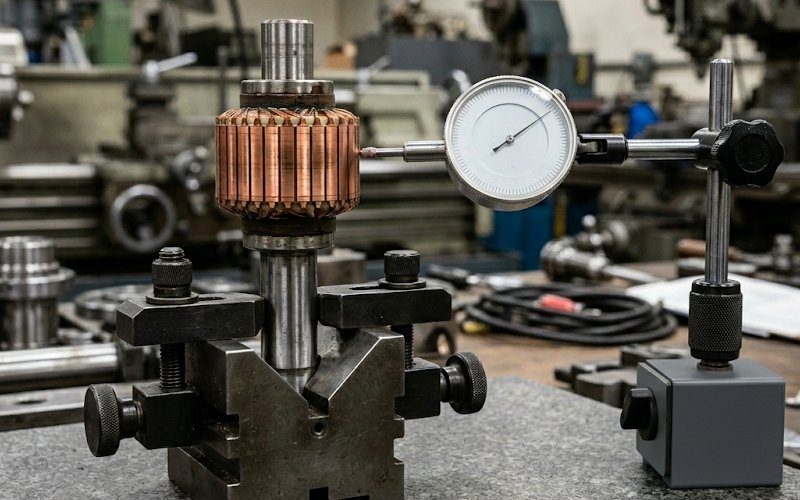
Check local bar-to-bar condition, not only total runout
A commutator can pass average runout and still have local step errors that disturb brushes.
Verify undercut and bar-edge condition
Flat is not enough. The slots must be clean. The insulation must sit below the running copper. The bar edges should not be left sharp.
Look for fit distress at the bore
Red powder, polished bands, offset witness lines, movement marks, or abnormal keyway wear are not cosmetic. They are fit evidence.
As a shop-level reference, repair standards often keep total indicated runout in the range of about 0.076 mm at lower peripheral speeds and about 0.038 mm at higher peripheral speeds, with local adjacent-bar variation kept much tighter. Those are not universal design values. They are useful inspection discipline.
FAQ
What is commutator pitch?
Commutator pitch is the circumferential distance occupied by one segment at the finished brush track, including the insulation gap between segments. In practice it is usually checked from finished diameter and segment count.
How do you calculate commutator pitch?
Use:
tau_c = (pi x D_c) / S
Where D_c is the finished commutator diameter and S is the number of segments.
What happens if commutator pitch is too small?
You lose copper width, insulation allowance, and mechanical margin. The segment stack becomes less forgiving, especially after rework. Brush stability also gets harder to maintain.
Why does commutator diameter matter if the machine speed is fixed?
Because surface speed still changes with diameter. Surface speed affects commutation interval, contact behavior, and heat. Diameter also defines how much material remains for future turning.
Is bore tolerance really that important if the outside diameter is in tolerance?
Yes. The bore defines the axis. If the brush track is not true to that axis, the machine can show chatter, uneven wear, or sparking even when the outer diameter itself measures correctly.
Should a commutator bore use clearance or interference fit?
That depends on torque, speed, assembly method, and whether the joint is keyed or keyless. Keyless joints normally need interference. Keyed joints may use clearance or interference depending on service conditions.
When should a commutator be turned, and when should it be replaced?
Turn it when the surface condition can be corrected without violating the minimum service diameter and without leaving pitch, runout, or undercut condition outside limits. Replace it when geometry, fit, or remaining material no longer supports stable service.
Final Note
A commutator drawing becomes much more useful when it states four things clearly:
- the finished geometry,
- the minimum service geometry,
- the bore fit strategy,
- the geometric relationship between the brush track and the bore.
Without those, a commutator is easy to machine and hard to control.