Commutator Replacement: A Deep, Practical Guide to Saving Your DC Motors
This article is about everything that goes wrong around commutator replacement – and how to stop bleeding money and uptime there.
We’ll focus on how real shops and plants handle it: when to replace, how to replace without creating a new problem, and what to document so you don’t repeat the same failure every 18 months.
Table of Contents
1. When does a commutator really need replacement?
Most plants replace commutators either too early (wasting rotor life) or too late (catastrophic failure, armature scrap). Let’s put some structure on the decision.
From common industrial guidance and long-running maintenance practices, the usual repair path is: clean → stone → skim/turn → undercut → only then replace if still out of spec.
So, ask three questions first:
- Can machining restore geometry and surface? If you still have copper thickness and the bar insulation isn’t failing, you usually machine and undercut, not replace.
- Is insulation between bars still trustworthy? Carbon tracking, lifted mica, bar-to-bar flashover marks – these point to deeper issues, often pushing you toward a new commutator.
- Is the root cause elsewhere? Wrong brush grade, vibration, shaft misalignment, bad environment can destroy a brand-new commutator again.
Here’s a compact decision view.
Typical commutator symptoms vs action
| Symptom on commutator surface | Likely underlying issue | Replace commutator? | Usual action path |
|---|---|---|---|
| Light, even brown film, minor marks | Normal commutation | No | Clean, check brush pressure, continue to monitor. |
| Threading / fine spiral lines | Contamination, wrong brush grade, poor film | Usually no | Clean, stone, correct brush grade, improve filtration and enclosure sealing. |
| Light grooving, mild ridges | Under-cut mica wrong, brush too hard, vibration | Sometimes | Turn in lathe or in-situ, correct mica undercut, review brush spec. |
| Deep grooves, step wear, bars “hooked” | Long-term misuse, hard contamination, wrong brush | Often | Skim/turn if thickness allows; otherwise prepare for commutator replacement and brush redesign. |
| High bars, loose bars, bar movement under pressure | Mechanical loosening, failed support, thermal cycling | Usually yes | Replace commutator, check armature support, check for overload and vibration history. |
| Heavy burning on groups of bars | Coil fault, unequal current sharing, brushgear misalignment | Often | Investigate windings, test bar-to-bar, repair windings and possibly replace commutator. |
| Severe out-of-round (ovality) beyond OEM or service standard | Poor prior machining, bearing issues, shaft issues | Depends on remaining copper | Turn to restore roundness if copper allows; if not, replace. |
| Insulation tracking, carbonized mica, flashover marks | Surface leakage, moisture, overload events | Often | Dry out, test insulation; heavy tracking usually pushes toward replacement. |
The rule of thumb that many shops quietly use: if you can no longer get a clean, round, stable surface with one more light skim and undercut, you stop trying to rescue it. You plan replacement.
2. Pre-replacement checklist: don’t pull the rotor too early
Before the motor is even stripped, set yourself up so the new commutator actually survives.
2.1 Capture operating context
You don’t need a novel, just facts:
- Duty cycle, load swings, start/stop frequency.
- Ambient contamination: carbon dust, conductive dust, moisture, oil mist.
- Cooling quality: blocked filters, undersized ducting, fan issues.
- Recent events: trips, overcurrents, brush fire, flashover.
This data tells you whether the old commutator died “of age” or because the application is punishing.
2.2 Baseline tests before tear-down
Quick checklist:
- Insulation resistance and PI (polarization index).
- Bar-to-bar resistance or voltage drop where practical.
- Shaft runout and bearing condition.
- Brushgear position, rocker setting, spring pressures.
You’ll repeat some of this after replacement. Useful to know whether the commutator was the main culprit or just collateral damage.
2.3 Check brush regime and intervals
Many OEM and carbon suppliers give simple rules: first brush inspection early (e.g., ~100 hours) then periodic checks every few hundred hours of operation.
If your CMMS shows you are running “inspect when sparking is visible,” then commutator replacement is just the symptom. Your maintenance regime is the real fault.
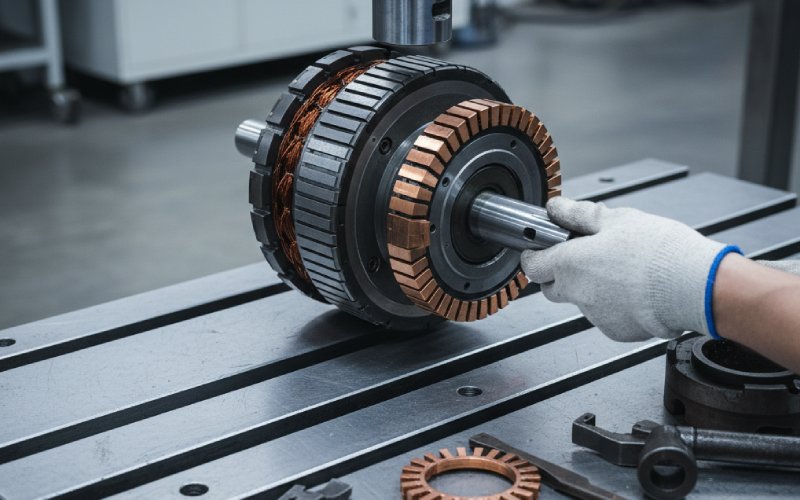
3. DC motor commutator replacement workflow (practical version)
There are dozens of official sequences. They all share the same skeleton. Below is a straight industrial, rotor-out approach. Adjust for your frame size and rules.
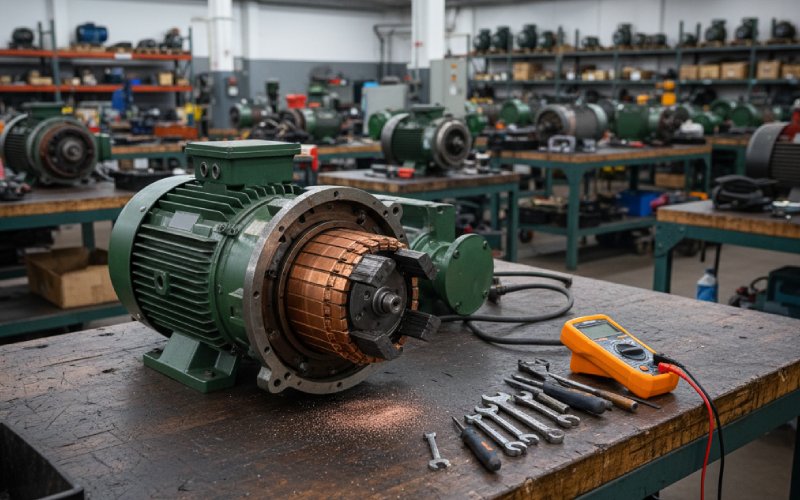
Step 1 – Strip-down and marking
You know this drill, but a few patterns matter:
- Mark everything: brush arms, rocker ring angle, axial positions of shields and bearings. Paint marks, punch marks, photos.
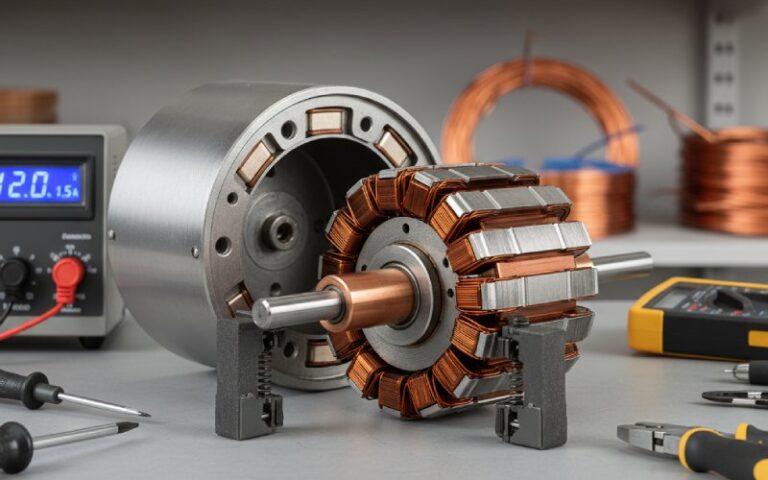
- Record commutator dimensions: overall diameter, active length, bar count, keyway details, hub length. That data saves you once the rotor is on a truck and the buyer calls.
- Tag all leads and equalizers before you lift anything from the risers.
Step 2 – Remove the old commutator
Most DC rotors use a shrink fit or keyed fit, plus brazed coil connections.
General practice:
- Support the armature by the core, not the commutator.
- Desolder or cut the coil risers with enough length left for re-termination.
- Use a hydraulic press or thermal expansion method suitable for the shaft and hub design.
- Measure shaft seat after removal. Look for rubbing, fretting, any ovality.
If the shaft journal is damaged and you ignore it, the new commutator will follow that bend and runout.
Step 3 – Preparation of the shaft seat
Short, boring, but critical:
- Clean the seat fully, remove burrs.
- Inspect keyways and shoulders.
- Confirm fit tolerances per drawing or service standard (interference, axial location, face squareness).
Any step or taper error here becomes commutator wobble later.
Step 4 – Mounting the new commutator
Typical shop practice is heating the commutator hub and pressing it on a cold shaft or inverse.
Key points:
- Control temperature; do not overheat insulation system around the bars.
- Press in one smooth controlled movement; no hammering.
- Seat firmly against shoulder or spacer, verify axial dimension.
- Once cool, immediately check runout and end float on V-blocks or lathe.
If runout is already large before machining, something in the fit is wrong. Don’t hope the lathe will “fix it.”
Step 5 – Reconnecting coils and equalizers
This is where traceability saves you:
- Follow your bar map precisely; one swapped connection will give mysterious bar heating later.
- Clean riser faces before brazing.
- Use the correct brazing alloy and flux, avoid wicking into flexible parts.
- After cooling, inspect joints visually and, if your shop allows, perform low-level thermal imaging under test current.
You want mechanically secure yet not brittle joints. Over-brazed, rigid bundles tend to crack with vibration and thermal cycling.
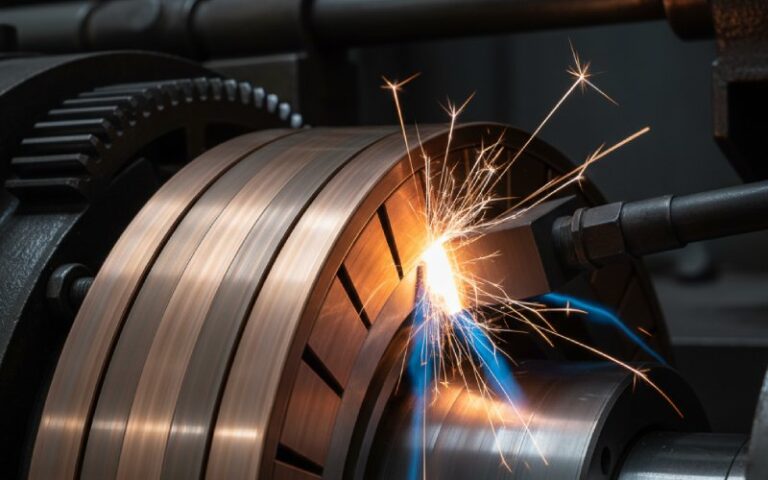
Step 6 – Turning and undercutting the commutator
After installation and connection, you machine and undercut. Typical good practice:
- Turn in a lathe or using an in-situ grinder so you get a cylindrical surface with the correct finish. Surface should not be mirror-polished; a fine, even finish promotes correct film formation.
- Undercut the mica between bars to a depth in the range usually recommended (often around 0.5–1 mm below copper surface, adjust to OEM guidance).
- Clean slots after undercutting. No burrs, no copper dust bridges.
If you skip proper undercutting and cleaning, brushes ride on mica or debris, wear poorly, and your “new” commutator starts to groove quickly.
Step 7 – Chamfering, stoning, and brush seating
Finishing work that often gets rushed:
- Lightly chamfer bar edges so brushes don’t chip.
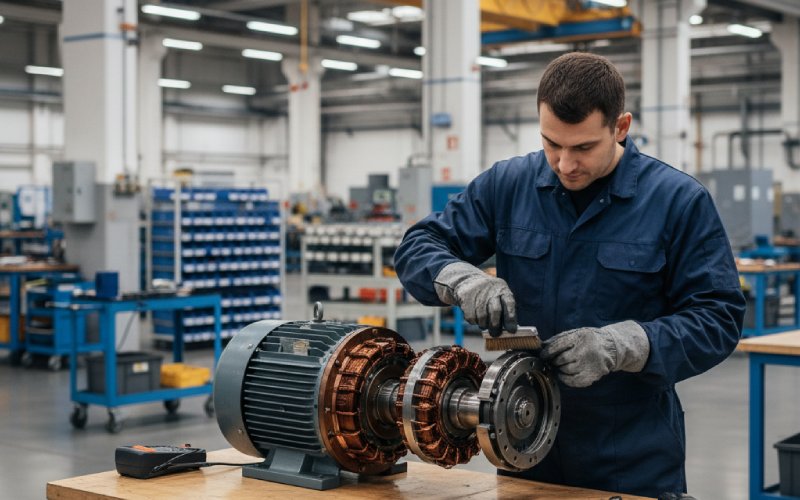
- Hand-stone lightly with a proper commutator stone, with the rotor turning, to remove micro ridges.
- Seat new brushes to the commutator radius using sandpaper or seating stone as per supplier instructions, never emery.
Then blow everything out with dry, clean air.
Step 8 – Electrical checks and trial run
Post-replacement baseline:
- Insulation resistance, PI again.
- Bar-to-bar checks, continuity.
- Slow-speed run to check mechanical vibration and commutator runout.
- Gradual loading, watching sparking level against a known chart (many suppliers use graded spark levels).
Log what you see. That first hour of running tells you a lot about whether the replacement and brush setup will live comfortably.
4. Tolerances and “good enough” for commutator replacement
Official manuals give hard numbers. Here we’ll keep it practical and non-brand-specific.
Think in four groups:
- Runout (Total Indicated Runout – TIR) You want TIR low enough that brushes share current without bouncing. Excessive out-of-round leads to sparking and rapid wear; most service standards place fairly tight limits for industrial machines, especially on high-speed units.
- Surface finish Too rough and you chew brushes. Too smooth and you struggle to form a stable film. Guides for commutator machining often recommend a fine turned or ground finish rather than mirror polishing.
- Mica undercut depth and profile Mica must sit clearly below copper so brushes ride on copper only. Insufficient undercut or sloping slot sides push you into threading, grooving, and higher spark levels, especially with harder brush grades.
- Brush pressure and position Too low: sparking, film instability. Too high: heat, wear, groove formation. Technical guides emphasize periodic verification of brush pressure and free movement in holders as a basic part of maintenance schedules.
If your replacement job hits reasonable values in all four, the commutator will usually behave. If one is badly wrong, you can expect trouble even with a brand-new part.
5. Failure patterns after commutator replacement (and how to debug them)
You put in a new commutator. Two weeks later, maintenance calls: “It’s sparking again.” Typical.
Here’s how to think it through.
Case A – Persistent sparking at light load
Look at:
- Brush seating: poor conformity, wrong bedding process.
- Brush grade: too hard, not matched to current density and undercut depth.
- Rocker position: small mis-set can increase sparking at certain loads.
If commutator surface is still smooth with a thin film, fix brush issues before touching the copper.
Case B – Threading reappears quickly
You see fine spiral lines even on a new surface:
- Check air quality and filtration. Contaminants embed into brushes and act as abrasives.
- Confirm mica undercut is clean and to spec.
- Revisit brush grade; some grades are more prone to threading in dusty or humid conditions.
Case C – Localized burning on bar groups
That usually points away from the commutator and toward:
- Coil imbalance or turn fault in associated armature coils.
- Poor or cracked brazed connections at risers.
- Unequal brush current sharing across the circumference.
If you just keep stoning and skimming without finding the electrical root cause, you’ll cycle through commutators.
Case D – Rapid grooving on specific brush tracks
Focus on mechanical points:
- Brush alignment and tilt relative to rotation.
- Excessive brush pressure on some holders.
- Vibration, misaligned bearings, flexible mounting base.
The commutator is telling you about conditions elsewhere in the system.
6. Make vs buy: when to send commutator replacement to a specialist
Some B2B buyers want to build full in-house capability; others prefer to ship rotors out. Both paths work if the decision is conscious, not accidental.
You probably keep the job in-house when:
- Frame sizes are small to medium, low criticality.
- You already have a suitable lathe/grinder, undercutter, and test bench.
- Your team does enough volume to stay practiced.
You look for an external motor repair shop when:
- Motors are large, traction-grade, or process-critical with high downtime cost.
- You need certified testing, balancing, or compliance with recognized repair practices (industry standards for rotating apparatus repair).
- You don’t want to invest in specialized commutator equipment and training.
When evaluating a shop, useful questions:
- How do they control runout and document it?
- What undercut process and tooling do they use?
- How do they qualify brazed connections?
- Do they provide before/after test data and photos of commutator condition?
If a vendor can’t show you their standard work for commutator replacement, you’re buying a black box.
7. Data to log after every commutator replacement
For a B2B site and maintenance team, the most valuable output of a replacement is not just a running motor. It’s the data set for the next decision.
You don’t need complex systems; consistent fields are enough:
- Motor ID, location, duty description.
- Date of replacement, service provider (internal or external).
- Reason for replacement (wear, flashover, mechanical damage, other).
- Measured commutator diameter, runout, undercut depth.
- Brush type and grade, spring pressure settings, brush position notes.
- Baseline sparking level, IR, bar-to-bar checks at recommissioning.
- Next planned inspection date.
After a few years, you’ll see cycles: which lines, which loads, which environments consistently shorten commutator life. That’s where design or application changes pay for themselves.
8. FAQ: practical questions on commutator replacement
1. Can I replace a commutator without removing the rotor from the motor?
For small DC motors with good access, some teams do in-situ machining and minor repairs. However, major commutator replacement usually means removing the rotor so you can control alignment, runout, brazing quality, and testing properly. Many industry guides state that full replacement commonly involves rotor removal and workshop processing.
2. How do I know if I should machine the commutator or replace it?
Check:
Remaining copper thickness versus minimum allowed by OEM or house standard.
Ability to restore roundness within allowed TIR.
Condition of bar insulation and mica (no severe tracking or looseness).
If you can meet all three with a reasonable skim and undercut, machining is usually more economical. If not, replacement is safer.
3. Do I always need new brushes after commutator replacement?
Strictly speaking, not always. Practically, it’s almost always wise:
New copper surface + old partially worn brushes = poor contact pattern.
Replacement is often used as a trigger to optimize brush grade and pressure based on what you learned from the failed unit.
So in most industrial settings, new commutator means new brushes and a fresh seating process.
4. How often should I inspect commutator condition after replacement?
Good practice: early and then regular.
First close inspection after a relatively short running time (around 100 hours is a common suggestion in several maintenance guides).
After that, periodic checks every few hundred hours or as your duty cycle demands.
If you’re only looking when there is visible sparking or a production complaint, you are probably late.
5. What tools are really necessary for serious commutator work?
For an industrial workshop, the usual list includes:
Lathe or in-situ grinding device suitable for the motor range.
Mica undercutter (manual or automatic) and cleaning tools.
Commutator stones, seating stones, suitable sandpapers.
Insulation tester, bar-to-bar test gear, basic vibration tools.
Without these, you can still perform minimal work, but you’re closer to “patching” than to controlled commutator replacement.
6. Can a bad environment destroy a brand-new commutator even if the replacement was perfect?
Yes. Conductive dust, moisture, persistent underload, or strong vibration can all damage commutators and brushes even when the replacement job was flawless. Technical references on brush and commutator behavior explicitly note vibration and pollution as major drivers of premature wear and damage.
If you repeatedly see early damage on new commutators in the same area of the plant, the environment and duty are the first suspects.