To Oil a Commutator or Not? A Quietly Honest Answer for B2B Teams
Table of Contents
1. Short Answer First
- Industrial DC motors (your main production machines)
- Do not oil the commutator bars.
- Lubricate bearings as per OEM, keep the commutator dry, let the brush film do the sliding.
- Slip ring machines
- Bearings: yes, of course.
- Rings: only use dedicated greases or oils if the slip ring OEM explicitly specifies them. Many guides treat oil on current-carrying rings as contamination, not maintenance.
- Universal motors in tools / small appliances
- Same core rule: no free oil on the copper surface. A trace of suitable contact treatment is sometimes allowed in niche cases, but that’s OEM territory, not guesswork.
- Model / RC / hobby motors
- People do sometimes oil or “drop” the commutator in that world. It works for them because duty cycles are short and failures are cheap. That logic does not scale to a 500 kW DC drive on a line that costs six figures per hour when stopped.
- If your manual says clearly: “Apply mineral oil to the commutator”
- Then follow the manual—but treat it as a controlled, microscopic film, not “a few nice drops”.
If nobody is willing to sign their name under a written procedure that says “oil the commutator bars”, you already have your real answer.
2. Why the Advice Online Looks So Confused
Search results are noisy:
- Some guides (for example from Sinotech) explicitly say “use mineral oil on commutators” as part of a broader maintenance checklist.
- Technical maintenance PDFs from Mersen tell you to protect commutators and slip rings against oil projections and treat oil as a contaminant.
- The carbon-brush specialists at Morgan Advanced Materials frame it differently: the brush itself is responsible for lubricating the sliding contact by forming the commutator film.
- Practical electricians on Q&A boards warn that oil on contact surfaces burns under arcing and leaves a nasty resistive layer; they remind you that graphite, not oil, is the intended “lube” at the interface.
So you get everything from “never touch it” to “oil it a little” to “the brush will lubricate it anyway”.
The trick is to separate surface lubrication at the brush path (graphitic film) from oil anywhere near that path (usually contamination in modern industrial practice).
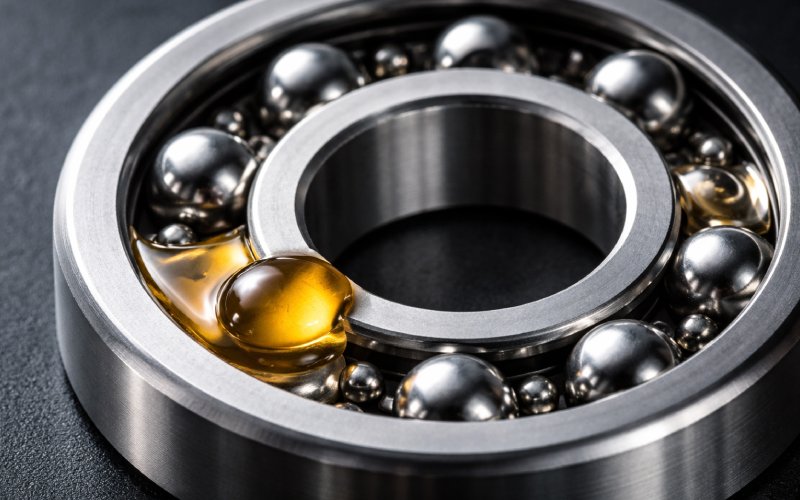
3. What Actually Lubricates a Commutator in Real Machines
In most production DC machines:
- Sliding contact between brush and commutator is handled by
- The carbon brush grade
- The film on the copper (oxide + carbon + moisture)
- That film is created by:
- Brush material and additives
- Operating environment (humidity in the air is surprisingly important)
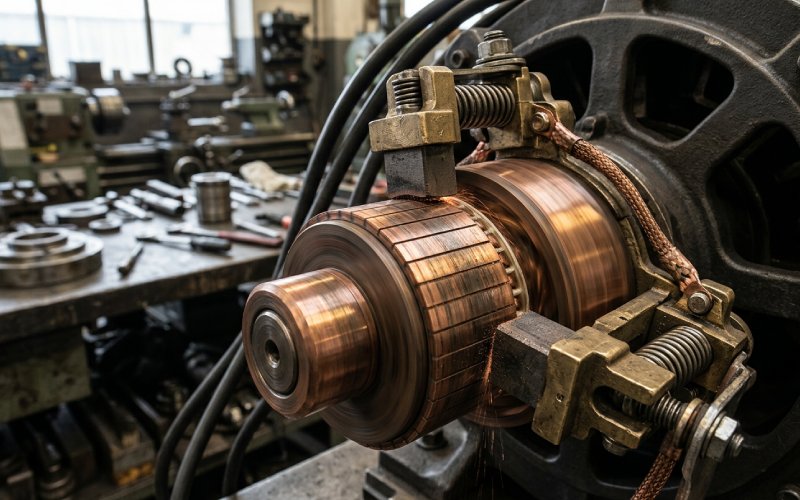
Once the film is stable, the surface looks slightly dark, uniform, not mirror-bright. You know this look—you see it on motors that “just run” for years.
Oil doesn’t build that film. At best it sits on top of it. More often it dilutes brush dust into a conductive paste and starts trouble.
4. What Actually Goes Wrong When You Add Oil
On paper, oil lowers friction. On a live commutator, you also have:
- Arcing at every bar transition
- Carbon dust everywhere
- Heat from load changes and startups
Now add a thin organic fluid to that mix.
Common failure patterns reported in field and technical guides:
- Burnt residue on the bars
- Arcing carbonizes the oil. You get a patchy, high-resistance film and erratic current sharing.
- Brushes wedged in their boxes
- Brush dust mixes with oil into a thick grease; boxes gum up, springs can’t move the brushes freely.
- Increased tracking risk
- Oil migration into the mica undercuts and insulation zones gives you easier paths for leakage currents. Some guides call out heavily oiled insulation as a reason to rework or replace it.
- Film destroyed, then rebuilt badly
- When contamination forces you to re-machine or stone the commutator, the original stable film is gone. You start again with higher friction and more wear until a new one forms.
Oil fixes a noise or sparking symptom “right now” only to pay you back as brush wear, downtime, and extra machining later.
That’s fine for a toy locomotive on a kitchen table. Not fine for a steel mill winder.
5. Table: Oil vs No Oil by Application
Use this as a reference during design reviews and PM planning:
| Machine / Contact Type | Typical Duty & Environment | OEM Stance You Often See | Oil Directly on Commutator Bars / Rings? | Preferred Approach in B2B Context |
|---|---|---|---|---|
| Medium / large DC motor with carbon brushes | Continuous / cyclic, industrial, dirty air | Keep commutator clean, correct brush grade and pressure | No. Oil treated as contamination. | Lubricate bearings, protect comm from oil, maintain film |
| Fractional-kW DC motor in OEM equipment | Intermittent, mixed environments | Very short or vague lubrication notes | Only if manual explicitly states a method. | Default to dry comm; clarify with OEM if unclear |
| Universal motor (hand tools, appliances) | High speed, intermittent, dusty | Replace rather than overhaul in many cases | No free oil on bars; at most, OEM-grade treatment. | Keep oil at bearings only; manage dust and cooling air |
| Industrial slip ring (power) | Low–medium speed, variable load | Dedicated greases sometimes specified. | Only with the exact product and procedure given. | Follow slip ring manufacturer spec; treat “homebrew” oils as off-limits |
| Precision / signal slip rings | Low current, sensitive to noise | Often tout low-maintenance or specific lubricants | Random oils are a hard no. | Respect OEM chemistry; think signal integrity first |
| Hobby / RC brushed motors | Short races, frequent swaps, cheap hardware | Community guides promote various comm drops. | Sometimes yes in that ecosystem. | Do not import those habits to industrial assets |
If your use case is missing from this table, assume “no oil on the bars” until the OEM tells you otherwise in writing.
6. So Why Do Some Pro Guides Mention “Mineral Oil on Commutators”?
Some older or niche maintenance checklists specify a very light wipe of mineral oil on a commutator.
Important details often get lost when that becomes a one-line tip on the internet:
- It usually refers to a minimal, controlled application, not dripping.
- The intent can be:
- Corrosion protection during storage
- Assisting with film stabilization in a specific machine design
- Modern guides from carbon-brush specialists lean instead on brush chemistry and operating environment to control film, not added oil.
So if your maintenance team is copying an oil step from an old PDF without the rest of the context (machine type, brush grade, climate, operating regime), you might be preserving tradition more than performance.
7. Practical Decision Framework: To Oil or Not in Your Plant
When you’re standing in front of a motor with a problem and someone proposes “a bit of oil on the commutator”, walk through this quickly:
- What is the actual failure mode?
- Excessive sparking?
- Uneven film / banding?
- Brushes chattering?
- Out-of-round commutator?
- Do we have recent inspection data?
- Film description, roughness, bar edge condition, spring pressure.
- Where do we already use oil or grease nearby?
- Bearings, gearboxes, couplings.
- Any known history of oil migration or mist?
- What does the motor or brush OEM actually say?
- If they say nothing about oil on the commutator surface, treat that as “no”.
- If they say “do not contaminate commutators with oil or hydrocarbons”, that is your policy.
- What is the cost of being wrong?
- If the motor is critical path with limited spares, avoid experiments.
- If it’s an accessible, redundant motor, controlled tests are possible—but still better without adding unapproved fluids to the collector.
Nine times out of ten, you’ll find that better brush selection, correct spring pressure, clean air, and proper machining solve the issue with less risk.
8. A Maintenance Pattern That Makes Oil on the Commutator Unnecessary
For B2B fleets, a stable routine beats clever tricks. A compact pattern that aligns with modern guides:
On a planned outage:
- Inspect
- Bar surface: uniform color, no heavy grooving, no raised mica
- Brush wear: even, correct seating, no signs of burning or flaking
- Brush pressure: verify with a gauge, not just “looks OK”
- Clean
- Vacuum carbon dust; avoid blasting it everywhere with compressed air
- Use approved solvents on bars only when necessary, removing brushes during the process to protect them
- Correct
- Lightly stone or skim the commutator if roughness is out of spec
- Deal with mechanical issues: shaft alignment, bearing play, vibration sources
- Rebuild the film the right way
- Install the recommended brush grade
- Run in at controlled load and speed to allow the film to form evenly
No oil on the bars needed in any of those steps. If oil enters the picture, it’s as bearing lubricant with sealed paths so it never reaches the collector.
9. How to Talk About This Inside Your Company
The debate usually isn’t technical. It’s cultural.
Some engineers grew up with motors where “one drop of oil sorted the commutator right out”. They weren’t wrong for that equipment and era. But your current machines, with today’s power densities and production pressures, live in a different context.
A productive way to align the team:
- Anchor on OEM text and modern brush/commutator guides rather than forum anecdotes.
- Write down a plant-level standard:
- “No free oil or grease on commutator bars or contact surfaces unless specified in [these] written procedures.”
- Add one small, non-negotiable rule:
- “If oil is found on the bars, treat it as a defect and record a root cause.”
That shifts the mindset from “maybe oil helps” to “if oil is here, something upstream failed”.
10. FAQ: Commutator Oil Questions Your Team Will Ask
1. Is “contact cleaner with lubricant” safe on commutators?
Not automatically. Many aerosol products marketed for electrical contacts contain light oils or additives that leave a film. On lightly loaded switchgear that can be acceptable; on a commutator with carbon brushes and arcing, that residue can burn, attract dust, and alter the film. Use only products that your motor or brush supplier explicitly endorses for sliding DC contacts—not just “electrical”.
2. What about very dry environments where the film struggles to form?
Extremely low humidity does hurt film formation and increases wear. But the standard mitigation is adjusting brush grade and operating conditions, not adding oil to the copper. Some suppliers offer brushes tailored for dry climates; that’s usually the first knob to turn.
3. Our legacy procedure says to wipe the commutator with oil before long-term storage. Keep it?
That can make sense only if:
The motor is cleaned and reconditioned before it goes back into service, and
Your storage and recommissioning procedure explicitly includes removal of that oil film, brush lift, and new film formation.
If those follow-up steps are missing in practice, you’re effectively putting an oiled collector straight into service. Better to switch to modern storage methods (sealed enclosures, desiccants, controlled environment) and avoid the oil.
4. Can a microscopic amount of oil ever improve commutation?
In very specific machines, with specific brush grades, under controlled conditions—yes, it can. That’s the scenario behind some of the mineral-oil recommendations.
But that’s design-level tuning guided by the OEM or brush supplier, not a field improvisation when a motor is misbehaving. If you’re not working from an official procedure, treat “oil to improve commutation” as off-limits.
5. What’s the safe way to phrase our policy for audits and suppliers?
Something like:
“Our standard practice is to maintain commutator sliding performance through appropriate brush selection, mechanical condition, and environment control. We do not apply free oil or grease to commutator bars or brush contact paths unless a written procedure from the OEM or brush manufacturer specifies the product, quantity, and method.”
Short, clear, and easy to defend in front of both inspectors and production managers.
6. If we already have a motor that’s been ‘oiled’ historically, what now?
Document the history.
Schedule a controlled outage.
Clean, inspect, and if required, re-machine and re-brush the commutator to remove old burnt oil and rebuild a proper film.
From that point on, treat any new oil traces on the bars as a defect, not a maintenance step.
11. Key Takeaways for Your B2B Commutator Strategy
- In modern industrial practice, oil on the commutator surface is almost always a contaminant, not a lubricant.
- The real “lubricant” at the sliding contact is the carbon brush film, built from brush material, environment, and correct operating conditions.
- When a motor misbehaves, you’ll get more reliable gains from:
- Correct brush grade and pressure
- Clean, dry commutator surfaces with good geometry
- Proper bearing lubrication that doesn’t migrate