Commutator Motor Types: The Guide That Starts Where the Textbook Stops
If you’re reading this, you already know what a commutator is and you’ve seen brushes spark at least once.
So we skip the “what is a motor” part.
This piece is about how different commutator motor types actually behave in real projects – cost, failure patterns, dust, overspeed, complaints from the maintenance crew – and what to ask suppliers so you don’t discover the problems after commissioning.
You’re not just picking a motor type.
You’re picking which way it will age and fail.
Table of Contents
1. What exactly falls under “commutator motor types”?
In practice, engineers usually put these under the commutator umbrella:
- DC commutator motors
- Shunt-wound
- Series-wound
- Compound (cumulative / differential)
- Permanent-magnet DC (PMDC)
- Separately excited DC
Common DC motor references group self-excited DC motors more or less like this: shunt, series and compound as the main families, plus PM and separately excited variants.
- AC commutator motors
- AC series / universal motors (same family, AC-only vs AC + DC)
- Repulsion and repulsion-induction motors for special single-phase cases
Electronically commutated / brushless motors sit outside this article. Here we stay with copper bars, brushes and the black dust that comes with them.
2. DC commutator motor types
We won’t redraw wiring diagrams. Focus is behavior, cost and traps.
2.1 Shunt-wound DC motor
Field in parallel with the armature.
How it behaves
- Speed changes little with load; inherent regulation is decent.
- Starting torque is reasonable but not aggressive.
- Easy to control with armature voltage and a bit of field tweaking.
Where it makes sense
- Fans, blowers, smaller conveyors, classic machine tools.
- Retrofits where the DC bus already exists and nobody wants to touch the power section.
Questions to ask suppliers
- “What’s your speed regulation from no-load to rated load? ±5%? ±15%?”
- “Do you include interpoles / compensating windings on my frame sizes?”
If the answer is:
“Small frames don’t need interpoles.”
…check your duty cycle. If your machine has frequent starts, reversals or steep load steps, that “don’t need” can easily turn into brush fire and noise.
2.2 Series DC motor
Field in series with the armature. Same current, same drama.
Behavior
- Very high starting torque.
- At light load, speed climbs fast; at no-load it will try to run away. Overspeed is not just a textbook example.
Good fit
- Cranes, hoists, presses, traction – places where stall torque matters more than tight speed.
Non-negotiables
- Some combination of mechanical limits and electrical protection against no-load overspeed.
- Honest discussion of stall / near-stall duty. That’s where armature and commutator take the biggest hit.
2.3 Compound DC motor (cumulative & differential)
Field has both shunt and series components. Standard DC motor guides list compound machines alongside shunt and series as the third main class.
Two versions:
- Cumulative compound – series field helps the shunt field.
- Differential compound – series field weakens the shunt field.
Cumulative compound
- Higher starting torque than shunt.
- Better speed stability than pure series.
- Useful in elevators, rolling mills, heavy duty conveyors.
Differential compound – why it’s almost never offered
Differential compound looks clever on paper, but under heavy load the weakened net field can cause unstable, rising speeds, up to a runaway condition. That instability and safety risk are why most modern industrial applications avoid it; it tends to show up only as a special-case or historical design.
If a datasheet casually mentions “differential compound” on a production machine, and people stand near moving parts, you probably keep scrolling.
2.4 Permanent-magnet DC (PMDC)
No field winding. Magnets do the job.
Pros
- Compact, with no field copper loss.
- Good efficiency at low power, linear torque vs current.
Cons
- Torque constant and base speed are mostly frozen at design time.
- Overcurrent plus high temperature brings a risk of partial demagnetisation.
Typical roles
- Fractional-horsepower drives, office equipment, light industrial actuators and pumps.
You go here when there is a low-voltage DC bus anyway and size beats tweakability.
2.5 Separately excited DC motor
Field fed from its own supply. Armature on another.
Why it still appears in real plants
- Wide speed range: armature voltage + field weakening.
- Reasonable dynamic behavior with a modern DC drive.
A lot of older high-power lines still run on these. Project question is often simple:
keep the DC machine and upgrade the drive, or redesign everything around AC / brushless.
3. AC commutator motor types
Here the commutator stays; the supply is AC.
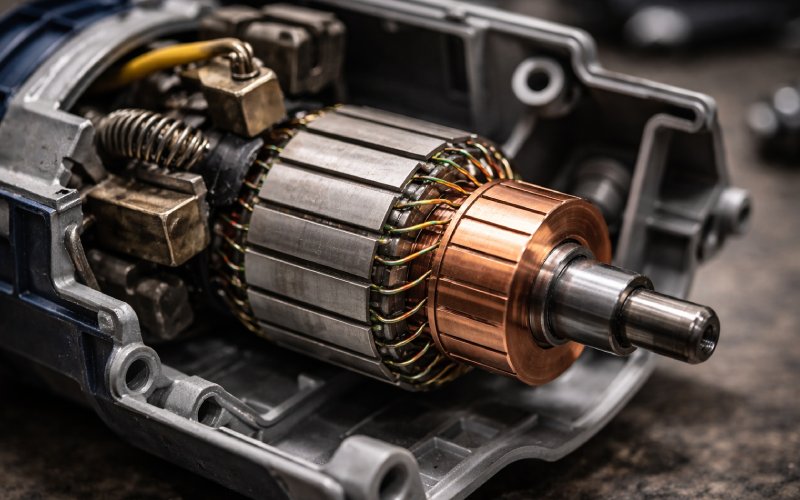
3.1 AC series vs universal motors – same family, slightly different passport
In practice:
- AC series motor – series-wound commutator motor meant for AC only.
- Universal motor – similar series-wound design that works on both AC and DC with construction tweaks.
Most modern small “AC series” designs in tools and appliances are effectively universal motors. The distinction matters for textbooks, less so for your sourcing spreadsheet.
Shared behavior
- High starting torque vs frame size.
- Very high possible speeds, well above mains frequency.
- Direct mains operation with simple controls (triacs, taps).
Where they fit
- Portable power tools, mixers, vacuum cleaners, small single-phase pumps.
- Any low-duty device that needs a lot of speed in a small housing.
Where they annoy
- Brushes and commutator wear → predictable maintenance.
- Acoustic noise and EMI naturally higher than induction or brushless.
If an application is 24/7, hot, dusty and hard to stop – this family usually loses against induction or brushless unless the installed base forces your hand.
3.2 Repulsion and repulsion-induction motors
Classic single-phase AC commutator motors:
- Repulsion motor – stator like a single-phase motor; rotor with commutator and shorted brushes. High starting torque, brush position sets behavior.
- Repulsion-induction – hybrid rotor with commutator + squirrel cage, mixing repulsion torque at start with more induction-like running.
Today’s reality
- Very niche in new equipment.
- Still appear in some legacy woodworking machines, compressors and older single-phase heavy loads.
If a vendor proposes repulsion-type motors for a new platform, you ask “why this and not a capacitor-start induction motor or a small VFD package?”. The explanation matters.
4. Comparison of key commutator motor types
To keep this table usable on mobile, only the essentials stay inside it.
| Motor type | Supply | Typical “sweet spot” power range | Main strengths | Typical uses |
|---|---|---|---|---|
| DC shunt | DC | ~0.5–100 kW where steady speed is needed | Good inherent speed regulation, simple control, mature technology | Fans, blowers, light–medium conveyors, older machine tools |
| DC series | DC | ~1–300 kW on high-torque starts | Very high starting torque, compact for the torque level | Cranes, hoists, presses, traction drives |
| DC cumulative compound | DC | ~5–500 kW where both torque and speed stability matter | Compromise between shunt stability and series torque | Elevators, heavy conveyors, rolling / processing lines |
| PM DC | DC (often low-voltage) | W-level up to low kW | Small, efficient at low power, easy drive electronics | Small pumps, actuators, office / light industrial gear |
| Separately excited DC | DC | ~10–1000 kW in legacy systems | Wide speed range via field weakening; good with modern DC drives | Older process lines, high-power retrofits |
| AC series / universal | AC or AC+DC | ~50 W–2 kW | Very high speed, high torque from a small frame, cheap electronics | Power tools, household and light industrial appliances |
| Repulsion / repulsion-induction | Single-phase AC | ~0.25–10 kW | High starting torque, some versions with more stable running | Older single-phase heavy loads, niche replacements |
Outside the table you still decide one thing first: is your plant okay with brushes and commutator servicing at all.
5. What the type label does not tell you
This is where real-world behavior hides.
- Duty profile
- Continuous vs intermittent duty matters more than the catalogue photo.
- Frequent starts and reversals kill some commutator designs much faster than steady running.
- Thermal headroom
- Insulation class and allowed temperature rise decide whether your line survives a hot summer or just a lab test.
- Field weakening on DC motors works until you push copper and insulation beyond what the fan can remove.
- Commutator design
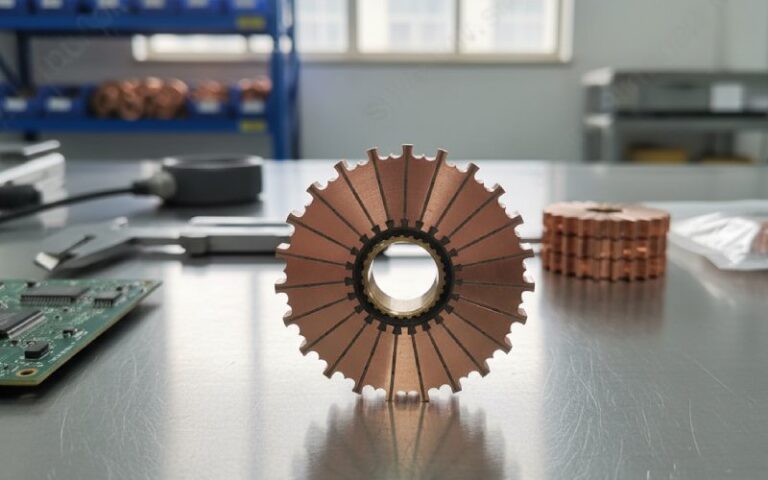
- Number of segments, bar material, undercut depth – all change how tolerant the motor is to load swings.
- Surface speed of the commutator sets real limits on overspeed and brush selection.
- Brush system
- Carbon / graphite / metal-graphite choices affect wear rate vs commutation quality.
- Spring pressure and brush holder alignment matter as much as the brush grade itself.
- Contamination control
- Not just ambient dust, but internal carbon dust from the brushes. More on that in the failure section.
- Enclosure and environment
- IP rating, bearing seals, coating; whether the motor sits in fertilizer dust or in a clean lab.
- In some atmospheres, commutator sparking simply isn’t allowed by code.
When you scan a datasheet, eyes go straight to duty, insulation, commutator, brush grade, IP and ambient. The type label doesn’t cover those.
6. Cost & TCO: always compare to induction and BLDC
“Medium” or “high” cost alone doesn’t help. You need a baseline.
For most industrial buyers:
- Baseline 1 = standard three-phase AC induction motor + basic starter / VFD.
- Baseline 2 = BLDC or permanent-magnet synchronous motor + matching drive.
Against those:
- DC shunt / separately excited
- Initial cost: Medium to high compared with standard AC induction motors of the same power.
- Drives: DC drives can be more expensive than simple VFDs in some ranges.
- Maintenance: Brushes + commutator service; cost depends a lot on access and in-house skill.
- TCO: Reasonable where you already have DC infrastructure and staff; weaker case for clean-sheet designs vs induction/BLDC.
- DC series / cumulative compound
- Initial cost: Similar to other DC motors at the same rating, again above a basic induction motor for many frame sizes.
- Hidden cost: If oversizing and protection are not done well, commutator damage from overloads becomes a major expense.
- TCO: In cranes/hoists and similar, downtime cost often dominates pure motor price; that should drive the decision, not catalogue cost alone.
- PM DC
- Initial cost: Low to medium and often cheaper than an equivalent BLDC + drive setup at small sizes.
- Drives: Simple DC or PWM drives; lower cost than many BLDC controllers.
- Maintenance: Brushes still there, but often easy to access.
- TCO: Good for small machines and short duty cycles. Once duty and ambient temperature increase, BLDC starts to look better.
- AC series / universal
- Initial cost: Usually lowest for small power when compared to both induction and BLDC options, and electronics are cheap.
- Maintenance: Brushes, noise, sometimes armature rewinds.
- TCO: Works when products are low-cost, duty cycles are short and replacement is acceptable. In 24/7 industrial service, induction or BLDC usually wins.
- Repulsion / repulsion-induction
- Initial cost: Can be higher than a comparable capacitor-start induction motor due to a more complex rotor.
- Maintenance: Fewer people can service them well; that alone raises lifecycle cost.
- TCO: Usually justified only when matching legacy equipment where rewiring the whole system would be worse.
For a new industrial platform, brushless or induction will often win the TCO contest. Commutator types stay competitive mainly when existing power and mechanical interfaces are locked in, or when product price and size dominate everything else.
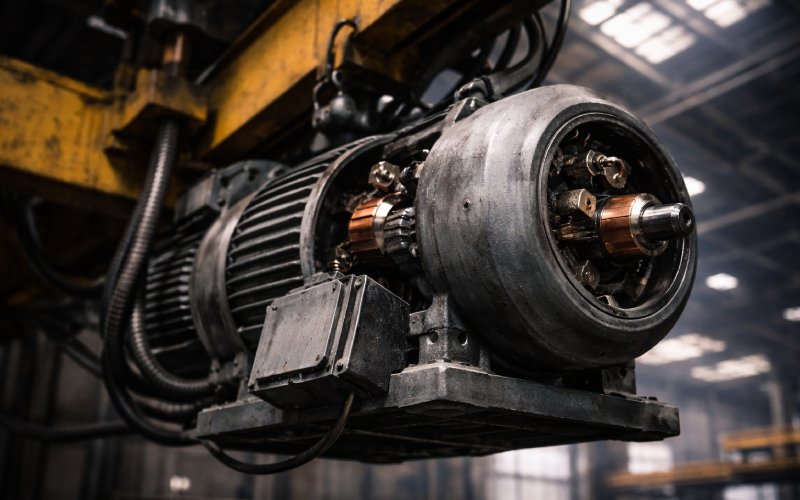
7. Failure patterns – including the carbon dust problem everyone meets
You don’t just choose torque and speed. You choose which failure symptoms you want to live with.
7.1 Shared issue: carbon dust contamination
All brushed commutator motors keep grinding brushes against copper. That creates conductive dust:
- Dust accumulates inside the housing and around brush holders.
- It lowers insulation resistance, promotes tracking and makes flashover more likely.
- It can wear commutator bars and cause uneven surfaces if not removed.
In many plants, contamination and carbon dust are at the top of the list when DC motor failures are analysed. It’s also one of the reasons some facilities switch to brushless or induction whenever they upgrade equipment.
If your maintenance culture doesn’t include regular internal cleaning and insulation testing, brushed commutator motors will eventually remind you of that through ground faults and nuisance trips.
7.2 DC shunt / separately excited
Typical patterns:
- Gradual brush wear leading to more dust, more noise and visible sparking.
- Commutator grooving from wrong brush pressure or contamination; if ignored, this starts to damage brushes even faster.
- Field insulation aging in hot ambient, especially on older machines with marginal cooling.
These usually give warning signs. Insulation testing and visual inspection can catch them if someone actually removes the covers on schedule.
7.3 DC series / cumulative compound
On top of the shunt issues:
- Runaway events when load is lost or mechanical coupling fails. Overspeed can damage rotor, bearings and anything attached to the shaft.
- Short, brutal overloads leave distinct heat patterns on commutator bars, which over time lead to raised mica, edge burning and eventually flashover.
- Strongly compounded machines can suffer extra mechanical stress when they repeatedly swing between high-torque starts and light running.
If your process allows running these motors at no-load for “quick tests”, add protection in hardware, not just in instructions.
7.4 PM DC
Add a couple of specific risks:
- Demagnetisation when you push too much armature current at too high a temperature. Once magnets partially weaken, the motor’s torque constant drops and current rises for the same load.
- Torque ripple and vibration if the application drives the motor far outside the designed operating zone.
Symptoms often look like “the same load now takes more current and feels weaker”. Many users blame the drive first.
7.5 AC series / universal
Common in tools and appliances:
- Fast brush wear and sparking under dirty mains, worn commutators or poor cooling.
- Heat build-up if ventilation holes clog with dust or if the motor runs at low speed for long periods with a simple phase-angle controller.
- Over time, carbon dust, collector wear and insulation aging combine; in many cases replacement is cheaper than full rewind.
For industrial OEMs, every loud, sparking motor in the field still points back to your brand, even if the device is technically “consumer grade”.
7.6 Repulsion / repulsion-induction
Less common now, but when they fail:
- Brushgear misalignment and poor contact cause heavy sparking and rapid brush wear.
- Wrong brush position after service leads to strange starting torque or unexpected speed behavior.
- Because fewer workshops are used to these designs, misadjustment after repair is a real risk.
If you keep such motors in production machines, it helps to have a clearly documented setup procedure, not just “set the brushes by feel”.
8. A practical selection path (with an environmental veto at the front)
You can formalize this, but a simple decision path works well.
Step 0 – Environment check
- Explosive gas or dust?
- Very high dust load inside the machine?
- Strict limits on sparking or EMI?
If any of these are “yes”, classic brushed commutator motors are often out immediately for compliance and safety reasons. You’re in induction / brushless territory.
Step 1 – Supply reality
- Existing DC bus with capable DC drives → DC commutator options stay on the table.
- Only single-phase AC and strict cost → AC series / universal may be considered for small, portable, low-duty devices.
Step 2 – Torque and speed profile
- Very high starting torque, short duty, okay with brushes → DC series / cumulative compound / universal.
- Fairly constant speed and moderate torque → DC shunt or separately excited.
Step 3 – Control philosophy
- Simple on/off, maybe two speeds → universal or PMDC with basic control often wins.
- Precise closed-loop control over a wide range → DC shunt / separately excited can work, but must be justified against modern AC/BLDC packages.
Step 4 – Maintenance culture and skills
- Strong in-house electrical maintenance, comfortable with commutators and brushes → DC commutator options stay viable.
- Outsourced maintenance and remote sites → every extra brush is a future truck roll.
Step 5 – TCO sanity check vs induction/BLDC
For the shortlisted type(s):
- Estimate brush change intervals and labor.
- Attach a number to one hour of downtime on that machine.
- Compare a 5–10 year lifecycle cost against an induction or BLDC alternative, even if motor list price is higher.
Only after this, “cheapest motor on BOM” becomes an informed decision.
9. Frequently Asked Questions on Commutator Motors
1. How often should brushes be replaced in an industrial DC motor?
There isn’t a universal hour figure. It depends on:
1. Current density at the brushes
2. Duty cycle (how often you start/stop)1.
3. Commutator surface speed and condition
4. Contamination and ambient temperature
What most plants do:
1. Track brush wear during early operation and derive a site-specific interval with a safety margin.
2. Combine brush replacement with scheduled shutdowns and internal cleaning to remove carbon dust.
If your first inspection already shows heavy grooving, chipped bars or uneven wear, something is wrong in grade, pressure or commutator geometry.
2. Why does my universal motor spark so much?
Common reasons:
1. Brushes worn down or wrong grade for the duty.
2. Commutator dirty, out-of-round or with raised mica.
3. Supply quality issues increasing stress on commutation.
4. Motor being run at conditions it was never sized for (long near-stall operation, blocked fan, tight enclosure).
If a new design shows heavy visible sparking at normal load, it is usually cheaper to fix that at the vendor selection stage than to teach your customers to live with it.
3. Is a universal motor just a DC series motor with a new label?
Not exactly, but close.
1. Both are series-wound commutator motors.
2. A universal motor includes design tweaks – laminated magnetic paths, compensating windings, different winding details – so that it works on AC as well as DC.
So as a buyer, you treat it as “a series commutator motor that tolerates AC mains”, not as a completely different species.
4. Why are differential compound DC motors almost never in catalogues?
Because the series and shunt fields fight each other, heavy loads can dangerously accelerate the motor instead of slowing it down. This unpredictable torque-speed curve makes them a safety hazard for modern equipment.
5. When does it make sense to replace commutator motors with induction or brushless?
Typical triggers:
1. Explosive or very dusty environment where brush sparking and carbon dust are unacceptable.
2. 24/7 operation with high downtime cost.
3. Tight efficiency and noise requirements from regulations or internal policy.
Once you factor in maintenance and lost production, induction or brushless packages often win even with a higher motor and drive price.