Can a Brushed DC Motor Stay in a Hazardous Location? A Practical Retrofit Guide for Commutators in Explosive and Flammable Areas
When can a commutator remain in service in a hazardous location, and when should it be relocated, enclosed, or replaced? This practical guide explains the key retrofit questions around ignition sources, dust, temperature class, enclosure, and maintenance.
Table of Contents
Short answer
Sometimes, yes. Often, no.
A commutator-equipped brushed DC motor can remain part of a system connected to a hazardous process, but an exposed brushed machine installed directly inside a hazardous location is often the weakest option. The reason is simple: a commutator is a spark-producing, wear-prone interface. In an area where flammable gas, vapor, mist, or combustible dust may be present, that is not a minor detail. It is the core of the risk assessment.
For retrofit projects, the real question is not “Are commutators good or bad?” It is this:
Can the ignition risk be controlled by location, enclosure, temperature management, inspection discipline, and repair quality?
If the answer is no, the commutator should not remain in the hazardous space.
Why this question matters in retrofit projects
This is not usually a greenfield design question. In new installations, engineers often have the freedom to choose a non-commutated motor and remove one common ignition source from the design. The commutator question comes up most often in legacy DC systems, where replacing the motor, controls, coupling, and driven equipment would trigger a larger shutdown or a more expensive rebuild.
That is why maintenance teams, plant engineers, and buyers ask a more practical version of the problem:
- Can the existing brushed DC motor stay?
- Should the motor be moved outside the classified area?
- Is an enclosure or protection method enough?
- Or is replacement the safer long-term decision?
A useful article must answer those questions in a way that supports engineering judgment, not just general awareness.
Why a commutator is a higher-risk component in hazardous locations
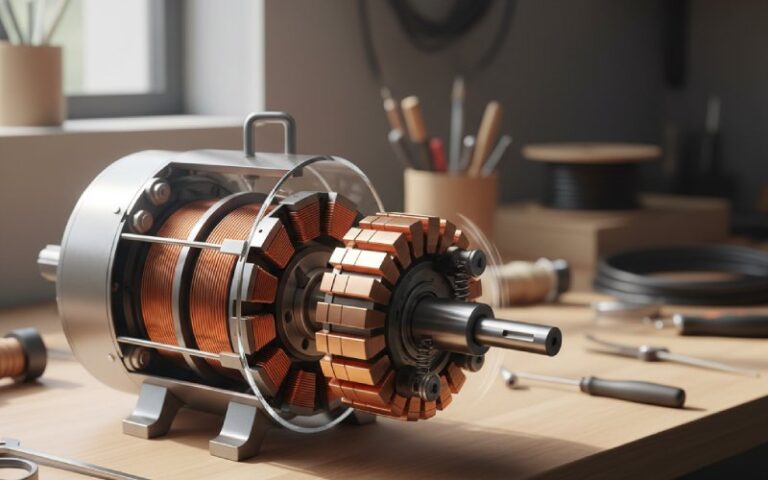
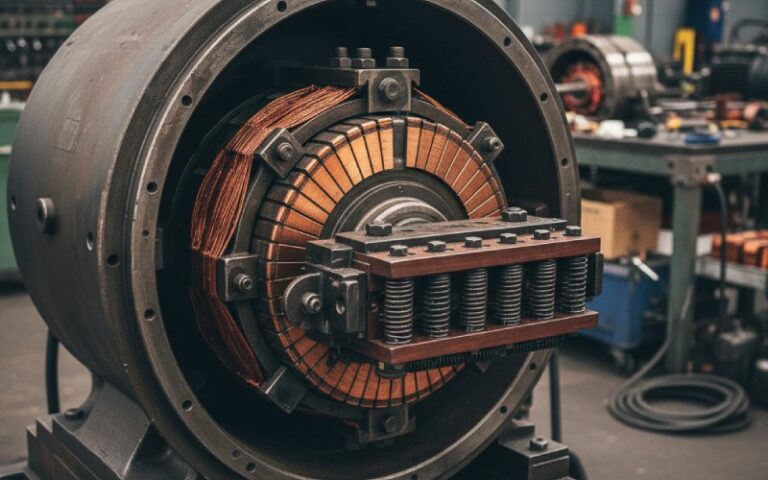
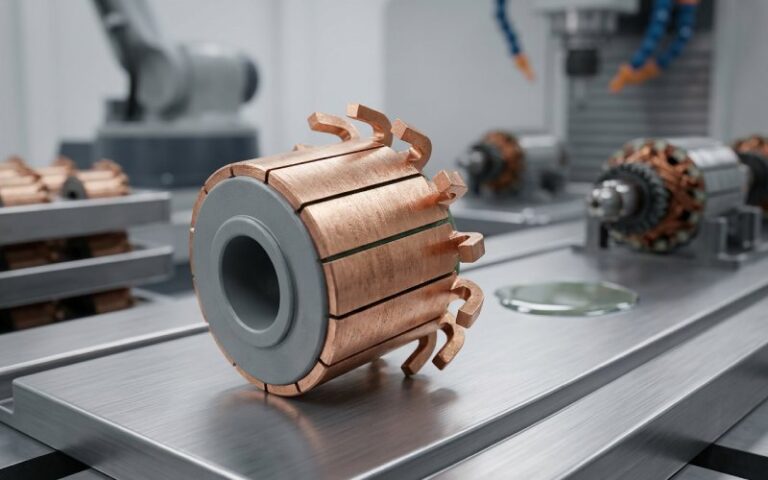
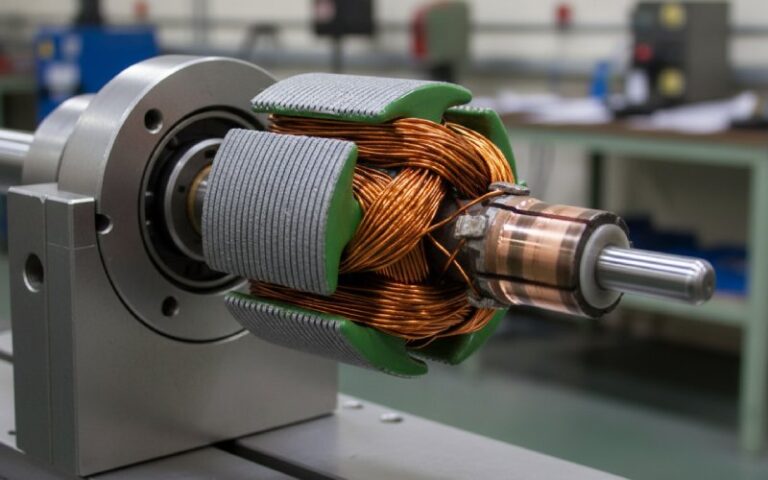
A commutator is the mechanical switching interface in a brushed DC machine. Brushes ride on segmented conductive bars to reverse current in the rotor. That is one reason brushed DC motors still appear in legacy applications: simple control, strong starting torque, and familiar maintenance practices.
But the same design has a built-in weakness for hazardous service:
- Brush-to-commutator contact is not sealed
- Wear is normal, not exceptional
- Contact quality changes over time
- Arcing and sparking can increase as conditions deteriorate
- Debris, contamination, vibration, and poor alignment can make behavior less stable
- Surface temperature can rise if contact quality, loading, or cooling gets worse
In a standard industrial room, those are maintenance issues. In a hazardous location, they can become ignition source issues.
That is why engineers tend to treat a commutator as a higher-risk component in explosive or flammable atmospheres, especially when compared with non-commutated motor technologies.
The first compliance question: what hazardous location are you actually dealing with?
Before anyone decides whether a commutator can stay, they need to define the environment correctly.
The motor is not judged only by whether it runs. It is judged by whether the complete installation is suitable for the actual hazard. That usually means understanding:
- Area classification For example, Zone-based or Class/Division-based systems, depending on the jurisdiction and site standard
- Hazard type Gas, vapor, mist, or combustible dust
- Frequency of presence Whether the hazardous atmosphere is present continuously, occasionally, or only abnormally
- Temperature requirements Surface temperature limits and applicable temperature class or T-code
- Protection concept and enclosure Whether the motor and associated equipment use a suitable protection method for the area
- Installation details Cable entries, sealing, ventilation, dust ingress, maintenance access, and repair history
This matters because the commutator alone is not “approved” or “not approved” in the abstract. Suitability depends on the whole arrangement.
That is also why vague statements such as “the sparking is small” or “this motor has been there for years” are not engineering arguments. A hazardous-location decision is based on ignition control, not familiarity.
When a brushed DC motor may remain in service
There are cases where keeping a commutator-equipped machine is still reasonable.
1. The motor is outside the hazardous area
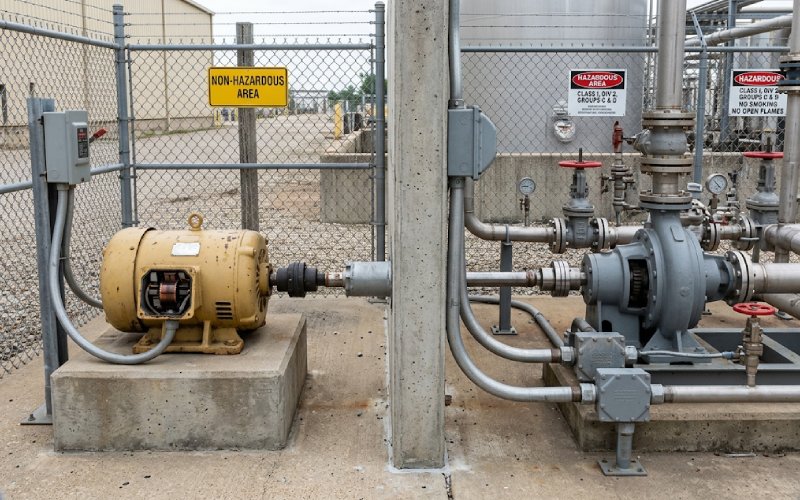
This is often the cleanest way to retain legacy DC performance while reducing direct exposure to gas or dust. The driven motion enters the process mechanically, while the spark-producing commutator stays outside the classified space.
If layout allows it, this is often one of the strongest retrofit options.
2. The complete equipment arrangement is suitable for the site
In some applications, the motor is part of a protected assembly specifically engineered for the duty. In that case, the decision is no longer about the commutator in isolation, but about whether the complete machine, enclosure, temperature behavior, and, temperature behavior, and maintenance controls are appropriate for the actual site classification.
3. The duty is intermittent and maintenance access is good
A machine that runs intermittently, is easy to inspect, and is maintained by a disciplined team is easier to manage than a continuously operating unit in a dirty or inaccessible area. This does not eliminate the risk, but it can change the practicality of keeping the machine.
4. The cost of total replacement is disproportionate
Some retrofit projects cannot justify replacing the entire drive train immediately. In those cases, the right question is not “Is a commutator modern?” It is “Can this legacy machine be kept safe, supportable, and economically reasonable until a larger upgrade is justified?”
That is a valid engineering and business question.
When replacement is usually the better decision
There are also situations where the answer becomes much shorter.
A commutator-equipped motor is often the wrong long-term choice when:
1. The motor must operate inside the hazardous area for long periods
Continuous-duty service in a hazardous location is already demanding. Add brush wear, commutation behavior, vibration, contamination, and thermal drift, and the safety margin can narrow quickly.
2. The environment includes combustible dust
Dust is not a secondary concern. Dust can accumulate, hold heat, reduce cooling, enter housings, and make temperature problems harder to detect early. In dust-heavy environments, the maintenance burden and ignition risk can rise together.
3. Inspection access is poor
If the motor is difficult to reach, brush condition, spring pressure, commutator surface condition, and cleanliness are more likely to drift between inspections.
4. Repair practices are inconsistent
Hazardous-duty equipment should not be treated like a generic motor repair job. If parts are casually substituted, surfaces are poorly reworked, clearances are altered, or enclosure integrity is compromised, the original protection basis may no longer hold.
5. A non-commutated alternative can do the same job
In a new project, or in a retrofit where redesign is feasible, removing mechanical commutation often removes one recurring source of trouble. That does not solve every hazardous-location requirement, but it does simplify the ignition-source picture.
Retrofit decision matrix: keep, relocate, enclose, or replace
| Situation | Main concern | Usually reasonable path |
|---|---|---|
| Existing brushed DC motor, but layout allows relocation | Direct exposure of commutator to hazardous atmosphere | Relocate the motor outside the classified area and transmit motion mechanically |
| Existing motor must remain near process, but enclosure/protection can be upgraded as part of a complete engineering review | Ignition-source control depends on full assembly, not the commutator alone | Evaluate the complete protected arrangement, not just the motor nameplate |
| Continuous-duty motor in hazardous area with vibration, contamination, or variable load | Wear, sparking, heating, and contact instability over time | Replacement is often the safer long-term decision |
| Dust-heavy area with limited cleaning and poor access | Dust buildup, cooling impairment, surface temperature risk | Avoid keeping an exposed commutator in the area unless controls are exceptionally strong |
| New installation with design freedom | No legacy constraint | Start with a non-commutated option if it can meet process needs |
| Legacy machine is critical and cannot yet be replaced | Economic and operational pressure to retain existing drive | Keep only with a documented inspection and repair discipline and a clear hazard-control strategy |
The five engineering questions to answer before keeping a commutator
A useful decision is rarely made from the nameplate alone. These five questions are better than a hundred generic warnings.
1. Is the hazardous atmosphere present where the commutator actually is?
This sounds obvious, but many poor decisions start with a vague understanding of where the classified space really begins and ends.
2. Is the main risk arcing, surface temperature, or both?
Some teams focus only on visible sparking. Others focus only on enclosure rating. In practice, both electrical ignition sources and thermal behavior matter.
3. How stable will brush contact remain between inspections?
This is one of the most practical questions in the whole decision. If the machine is exposed to vibration, dust, moisture, alignment issues, or load swings, contact stability may degrade faster than the maintenance schedule assumes.
4. Can the plant maintain this machine as hazardous-duty equipment?
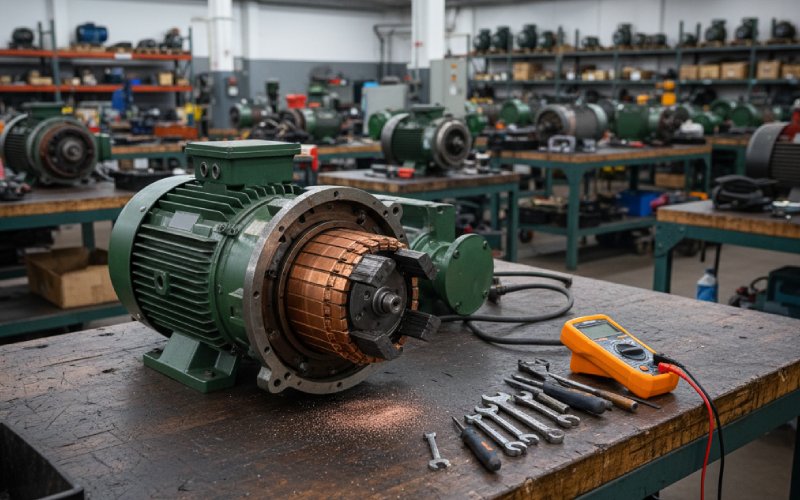
A hazardous-duty asset requires more than routine motor maintenance. It requires records, correct repair methods, suitable replacement parts, inspection intervals, and people who understand what cannot be casually modified.
5. Is there a real reason to keep mechanical commutation at all?
Sometimes the answer is yes. Legacy control architecture, torque behavior, or shutdown cost may justify it. But if the honest answer is no, that usually points toward replacement.
What maintenance teams should inspect on commutator-equipped motors in hazardous service
If a brushed DC motor remains part of the system, maintenance quality becomes a major part of risk control.
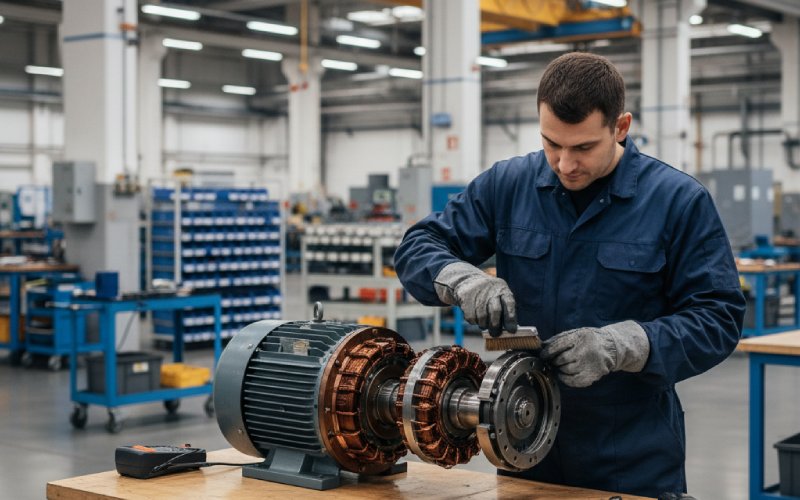
Inspection should typically focus on:
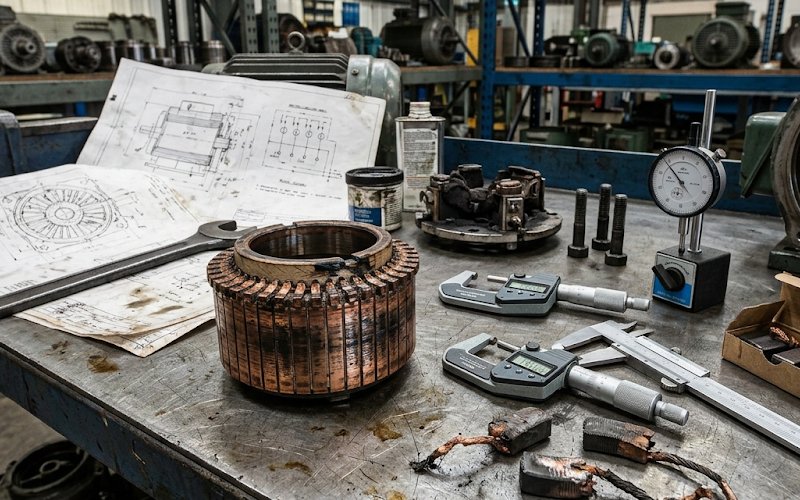
- Brush wear and brush grade suitability
- Spring pressure and brush seating
- Commutator surface condition
- Signs of abnormal sparking or uneven commutation
- Debris between segments
- Contamination, moisture, or conductive dust
- Temperature behavior under load
- Ventilation and cooling condition
- Vibration, alignment, and bearing condition
- Integrity of enclosures, seals, and cable entries where applicable
- Quality and traceability of replacement parts
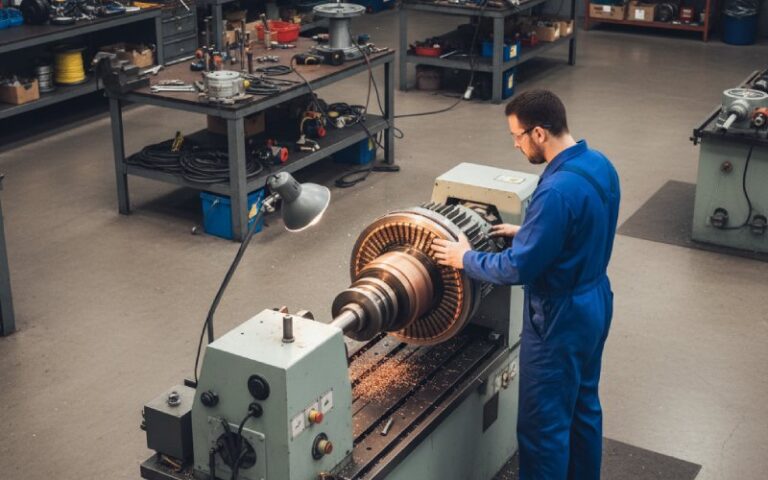
This is where a commutator manufacturer or repair partner can genuinely add value. In many legacy systems, the decision is not simply “replace the motor” or “do nothing.” The real need is often a reliable replacement commutator, correct brush interface, dimensional consistency, and repeatable repair quality.
That does not make the installation automatically suitable for a hazardous location. But poor replacement quality can certainly make it worse.
Why non-commutated alternatives often win in new projects
A non-commutated motor does not remove every hazardous-location requirement. Engineers still need to manage the enclosure concept, area classification, cable entries, surface temperature, installation quality, and certification path.
But it does remove one stubborn interface:
- no brush wear
- no commutator bar condition to monitor
- no brush dust
- no routine commutation sparking as part of normal operation
That is why, in a new installation, many engineers start by asking whether mechanical commutation can be removed from the design entirely.
For a commutator manufacturer, this is not bad news. It simply means the strongest commercial opportunities are often in legacy support, retrofit maintenance, engineered replacements, and difficult repair cases, not in pretending every application should remain brushed forever.
Plain-language conclusion
A commutator can stay in a system associated with a hazardous process, but it should stay there only when there is a clear engineering reason to keep it and an even clearer basis for controlling the ignition risk.
In practice, that usually means one of four decisions:
- Keep it only if the complete arrangement is suitable and maintainable
- Relocate it outside the hazardous area if possible
- Enclose/protect it only as part of a credible full-system solution
- Replace it when duty, dust, access, temperature risk, or maintenance reality make the old design a poor fit
That is the real decision framework. Not “Do we like commutators?” but “Can this commutator-equipped system be kept safe, supportable, and worth the trouble?”
FAQ
Can a brushed DC motor be used directly in a hazardous location?
Sometimes, but not by default. The decision depends on the complete installation, the area classification, the nature of the hazard, the protection concept, temperature behavior, and maintenance discipline. A commutator should never be judged as harmless simply because the visible sparking appears minor.
Why is a commutator considered risky in explosive or flammable areas?
Because the brush-and-commutator interface can create arcs, sparks, hot spots, and conductive debris, especially as wear, contamination, vibration, or poor alignment affect contact quality.
Is gas risk more serious than dust risk?
They are different, but both matter. Gas and vapor hazards make ignition from arcs and hot surfaces an obvious concern. Dust adds its own challenge because it can accumulate, impair cooling, trap heat, and contribute to fire or explosion risk.
If a commutator motor is already installed, does it always need to be replaced?
No. Legacy equipment is not automatically wrong. The real question is whether the ignition risk can be controlled cleanly, whether the machine can be maintained properly, and whether keeping it still makes technical and economic sense.
What usually makes brush sparking worse over time?
Common causes include worn brushes, poor spring pressure, rough commutator surfaces, vibration, contamination, misalignment, and debris between segments.
What is the simplest screening rule in a new project?
If the project is new and a non-commutated motor can do the job, start there. If the project is a retrofit, keep a commutator only after location, enclosure, thermal behavior, inspection regime, and repair controls have all been reviewed seriously.