Can a DC Motor Run With Only Two Commutator Segments?
Yes, a DC motor can run with only two commutator segments. But only in very specific, forgiving conditions. And almost never in production hardware you’d want to ship.
Table of Contents
1. Short answer for busy engineers
If you’re skimming:
- A two-segment commutator is basically the classic one-coil demo motor. It spins. Often badly.
- Practical motors standardize on three or more segments to avoid dead spots and short circuits during commutation.
- With only two segments you get:
- Zero torque at some rotor angles
- A stall position that can short the supply
- Very high torque ripple and electrical noise
- For any serious OEM design, two segments are usually a “lab toy only” decision.
If you’re a purchasing manager: if a drawing or RFQ ever shows “2 segments” for a working motor, that’s a big red flag. At least worth a phone call.
2. What “two commutator segments” actually means in hardware
When people say two segments, they usually mean:
- One armature coil
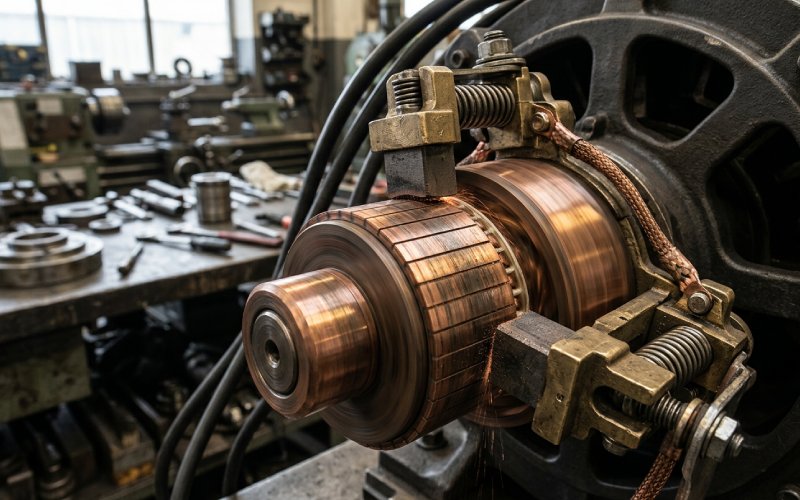
- Two copper bars (split ring) on the shaft
- Two brushes, roughly opposite each other
As the rotor turns 180°, each segment moves under the opposite brush, so the current in that one coil reverses. That’s textbook stuff.
The problem shows up when the brushes sit exactly across the insulating gap:
- The coil is effectively shorted by the two brushes bridging both bars.
- At that point torque drops to zero, and the supply sees almost a direct short.
That’s why simple one-coil kit motors are sold as demonstration models only. They can stop in that “dead spot” and never restart without a nudge.
So yes. Two segments work. Until the rotor stops in the wrong place.
3. Why most real motors insist on at least three segments
Textbooks and reference sites make two points that matter here:
- Practical commutators are built with three or more segments to avoid the dead-spot/short-circuit problem when a brush spans adjacent bars.
- Voltage between adjacent segments is limited, typically around 30–40 V, so higher-voltage machines must have more segments, often dozens or hundreds.
Real brushes are not razor-thin; they commonly span about 2–2.5 segments in width.
With only two segments and a brush that wide, several bad things line up:
- One brush inevitably covers both segments over a wide angle.
- The active coil is shorted more often and for longer intervals.
- There is no “other coil” to keep producing torque while that coil is undergoing commutation.
Add it up and you get:
- Unsafe current spikes
- Harsh torque pulsation
- Very unreliable starting
Three segments is the bare minimum to keep some part of the armature producing torque while one region is being commutated. Design references push the idea even further: more coils and segments → armature current distribution closer to a smooth “current sheet” → much smoother torque.
4. Two-segment behavior, from an engineer’s point of view
Let’s treat a two-segment commutator as a design option, not a physics curiosity.
4.1 Torque profile
- One coil, two segments, two poles.
- Torque is almost sinusoidal and drops to zero twice per mechanical revolution. Some analyses note that this arrangement has a minimum torque of zero; it simply cannot avoid going slack over part of the cycle.
- Inertia can carry the rotor through the dead zones at speed, but at startup or low rpm, it’s a gamble.
For applications that hate torque ripple (machine tools, gear drives, anything with feedback control), this is a non-starter.
4.2 Commutation and sparking
In a multi-segment motor, only one coil at a time is being reversed and the others keep producing torque. In the two-segment case:
- During the shorted interval, the entire armature energy dumps through the brush contact.
- Self-inductance of that coil fights the reversal, so the current doesn’t flip cleanly.
- When the brush finally breaks the short, L·di/dt has nowhere to go except an arc between bars and brush.
Result: hot, noisy commutation and accelerated wear.
4.3 EMI and acoustic noise
The same current spikes that eat brushes also radiate:
- Wideband conducted noise on the DC bus
- Radiated emissions from wiring and housing
- Audible “buzz” if the motor is lightly loaded
Adding filters later can cost more than just using a sensible commutator geometry from the start.
4.4 Control and sensing
Some low-cost systems infer speed or position from commutator ripple in the armature current instead of adding Hall sensors or encoders.
With only two segments:
- The waveform is dominated by brutal commutation artifacts.
- It becomes harder to extract clean speed information without aggressive filtering.
- Any brush fault or contamination can corrupt the only “signal” you have.
So you end up designing signal processing tricks to compensate for a mechanical choice that was questionable to begin with.
5. Two vs three vs “many” segments — quick comparison
For people writing specs or comparing suppliers, this is usually the part that matters.
| Design aspect | 2 segments | 3 segments | Typical multi-segment (≥12) |
|---|---|---|---|
| Minimum torque over one revolution | Drops to zero twice | Non-zero if loaded; noticeable ripple | Very small ripple, near-constant torque |
| Start from any rotor position | Not guaranteed; dead spot may stall | Generally OK | Guaranteed in normal designs |
| Commutation stress | Whole armature in one coil → high arcing | Lower, but still harsh compared with many segments | Much smoother; each coil carries smaller share |
| Voltage rating scalability | Poor; only one segment pair to share the voltage | Slightly better | Excellent; segment count chosen from V/segment limit |
| EMI / noise | High | Medium | Lower (with proper brush/interpole design) |
| Typical use | Classroom demos, hobby kits | Tiny low-end motors in toys (rare) | Industrial DC motors, automotive, quality consumer products |
| What your commutator supplier thinks | “Interesting experiment” | “Borderline, depends on spec” | “Normal production” |
If your application description includes words like continuous duty, gearbox, feedback, low noise, or warranty, you are almost never in the left column.
6. What this means for purchasing and sourcing
If you’re on the purchasing side, you probably don’t care about torque equations. You care about risk, lifetime, and whether two similar quotes are actually comparable.
A few practical checks:
- Look for segment count on drawings and datasheets
- Sometimes hidden under “No. of commutator bars” or “segments”.
- If it’s missing, ask. Segment count strongly influences life and performance in DC motors.
- Cross-check against voltage rating
- Any serious design text limits the average voltage between adjacent bars to a few tens of volts (often 30–40 V) to avoid flashover.
- If you see a 220 V armature with surprisingly few segments, something is off.
- Ask how brush width relates to segment pitch
- Good practice: brush width slightly larger than the insulation gap but not so large that it bridges too many segments for too long.
- On a two-segment design, the brush has essentially no room to “breathe”; it is either on one bar or shorting everything.
- Clarify test conditions
- Does the lifetime or noise spec assume a particular load profile, duty cycle, or ambient?
- Two-segment concepts might pass light-duty lab tests but age quickly in a real product.
- Standard vs custom commutator
- Multi-segment commutators are highly standardized in geometry, materials, and QA procedures.
- A two-segment custom part may not ride on those mature processes. That adds cost and schedule risk.
7. Are there any sensible uses for two segments?
A few edge cases exist:
- Educational motors and science kits Cheap, transparent housings, single loop of wire, often sold with warnings about needing a manual spin to start. Their job is teaching, not driving loads.
- Proof-of-concept lab rigs Quick and dirty setups where you care more about field pattern visualization than about torque quality.
- Very low-power gadgets where failure is acceptable Maybe a disposable toy or novelty where nobody will complain if a rotor occasionally sticks.
Even in these scenarios, many suppliers quietly move to three or more segments as soon as volumes and expectations increase. The cost difference in small copper and mica parts is tiny compared with the cost of field returns.
8. Design notes if you’re still tempted by two segments
If, after all that, your constraints still push you toward a two-segment commutator, some practical guardrails:
- Build in a starting bias
- Mechanical: offset the center of mass slightly so gravity nudges the rotor off the dead spot.
- Magnetic: tailor the magnet or pole geometry to create a “rest” position away from the shorting region.
- Limit supply voltage and current
- Keep armature resistance high enough that a shorted coil doesn’t instantly cook brushes.
- This usually means very low torque capability.
- Accept brutal torque ripple
- Don’t connect this motor to stiff mechanical systems or precision drives.
- Geartrains will rattle; feedback controllers will chase their tails.
- Expect aggressive maintenance
- Arcing will erode both bars and brushes faster than in a multi-segment design.
At that point, many teams realize a conventional multi-segment commutator was cheaper overall.
9. FAQ
Q1. So, can a DC motor run with only two commutator segments?
Yes. The simplest possible DC motor has one coil and two commutator segments and will rotate when conditions are right. Many educational texts and Q&A forums use exactly that setup as the basic example.
But it has dead spots, unstable starting, and poor commutation. That’s why practical designs move beyond it.
Q2. Why do most references insist on at least three segments?
Because with three or more segments:
A brush can span more than one bar without shorting the entire supply.
At least one coil can keep producing torque while another is being commutated.
This dramatically improves starting reliability and smoothness.
Q3. How many segments do typical small brushed DC motors use?
Common small permanent-magnet DC motors in tools, fans, pumps, and automotive actuators often use something like 5–25 segments, depending on voltage, size, and required smoothness. Larger industrial machines can have dozens to hundreds of bars.
Two-segment designs are essentially absent from mainstream production catalogues because they don’t meet normal requirements for life, torque, and noise.
Q4. What sets the minimum number of commutator segments?
Two main constraints:
Voltage per segment Design guidelines limit the voltage between adjacent bars (commonly to around 30–40 V) to prevent flashover and insulation breakdown. For a given armature voltage, that forces a minimum bar count.
Torque ripple and EMI More coils and segments share the load, so each commutation event is smaller and shorter. That reduces torque pulsation and current spikes.
So even if you could “get away” with a lower count electrically, you might add bars purely for smoother performance.
Q5. What happens if a segment is damaged or open-circuit?
On a multi-segment commutator:
One open coil usually causes a localized torque dip and some extra vibration, but the motor can often still run.
Maintenance teams can sometimes re-turn or even re-segment the commutator on large machines.
On a two-segment design:
Losing one segment means the entire armature circuit is broken.
The motor is simply dead.
Redundancy is one more quiet benefit of higher segment counts.
10. Key takeaways for your commutator sourcing
- Two segments are physically workable but operationally fragile.
- Three segments is the real “entry level” for a practical DC motor.
- Above that, segment count becomes a design variable tied to voltage, torque ripple, and noise targets.
- When you compare suppliers, always treat commutator segment count as a meaningful technical parameter, not a footnote.
If you’re drafting an RFQ or revising an existing motor spec, a simple line like:
“Commutator: molded copper, ≥ X segments, max V/segment Y V”
often saves long email threads later.