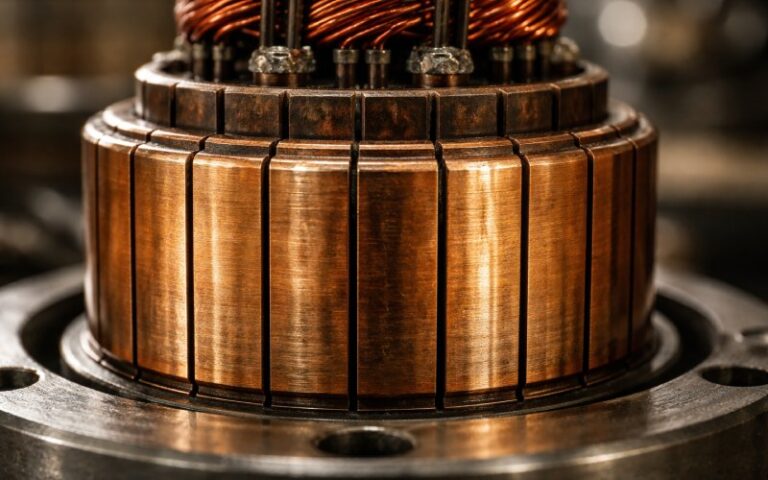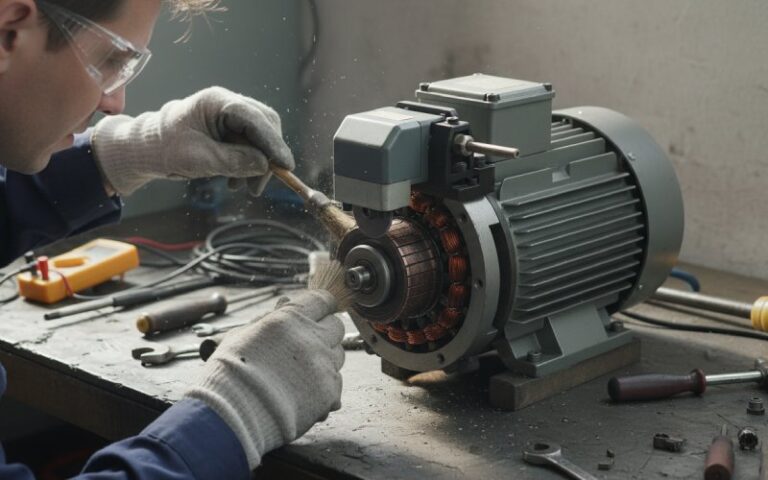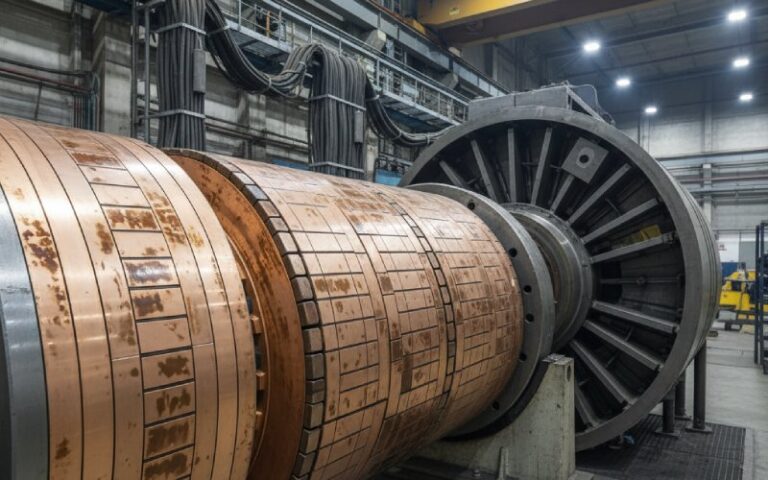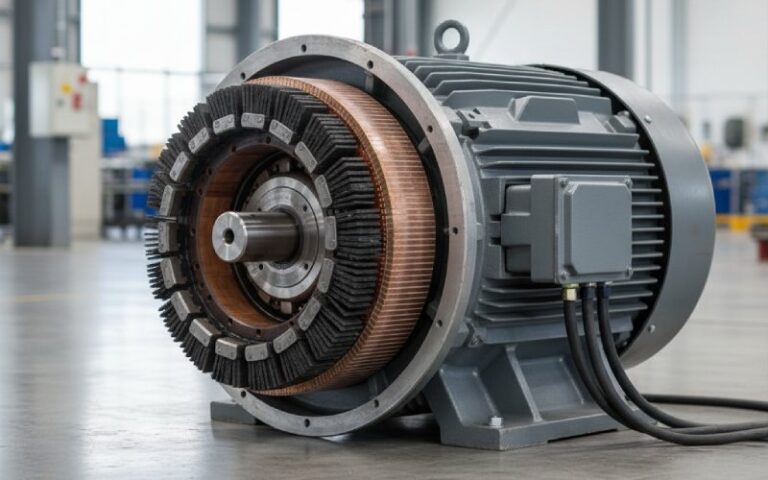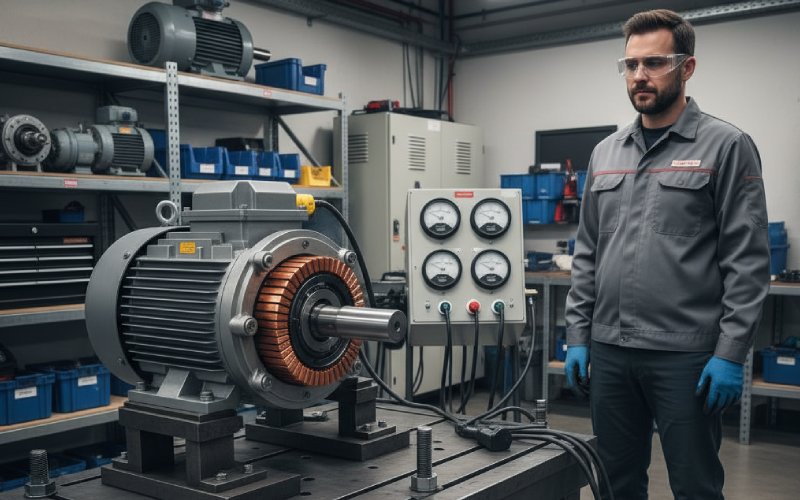
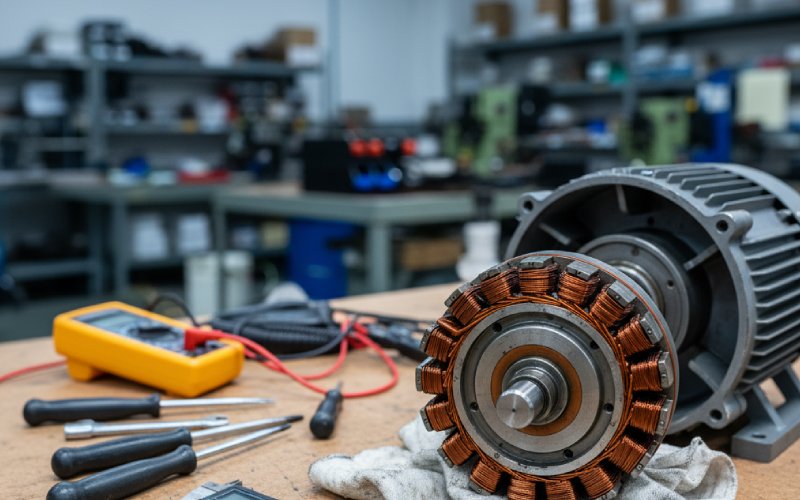
Can a DC motor commutator handle reverse rotation?
Short answer: yes, usually. But not always for long, and not always at the current you want.
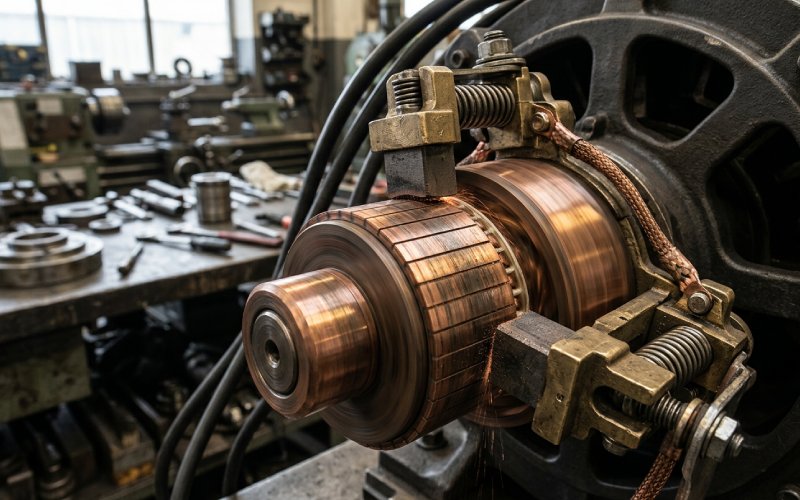
Most of the risk sits at the brush–commutator interface, not in the copper cylinder itself. Articles from motor vendors and brush suppliers agree that reverse running changes arcing behaviour, film formation, brush wear rate and heat.
Table of Contents
1. What actually changes when you flip direction?
Leaving theory aside, think about what physically swaps over when a brushed DC motor runs backwards:
- Leading edge becomes trailing edge Brush geometry and chamfer are usually chosen so one edge enters the commutator bar first. Reverse direction swaps that edge. If the design assumed “dragging” the brush, now you’re “pushing” it. That shifts vibration, contact pressure distribution and arc origin.
- Brush lead angle is now wrong way round Many motors set the brushes slightly ahead of the magnetic neutral plane to cut arcing in the rated direction. Turn the shaft the other way and the same offset becomes a lag. Current commutates later than ideal, so sparking goes up and bar edges heat.
- Carbon film direction reverses The transfer film on the commutator develops with a preferred sliding direction. Reverse it and, for a while, the brush scrapes that film off instead of stabilising it. During this “re-learning” period, friction and noise change and contact voltage is less predictable.
- Cooling and fans If the rotor fan is directional, reverse rotation may push hot air into the wrong parts of the frame or stall airflow over the commutator altogether. That doesn’t show up in the motor equation; it shows up months later as blackened bars.
- Brush gear mechanics Springs, flexible leads and brush boxes are often slightly asymmetric. In reverse, the brush can “walk” differently on the commutator, changing contact area and local pressure.
So when we ask “can the commutator handle reverse rotation?” we’re really asking: Did the motor designer consider all of these for both directions, or just one?
Application notes from Microchip Technology and others treat the commutator as part of a self-commutating structure and assume the rated direction unless bidirectional duty is explicitly called out.
2. When reverse rotation is usually acceptable
If you have a small PMDC motor with straight brushes, no arrow on the housing, and the datasheet literally says “bidirectional”, then continuous reverse rotation is normally expected. Many reference designs for H-bridge DC drives assume that.
Cases where reverse is typically fine, electrically and mechanically:
- Permanent magnet DC motors with radial (not skewed) brushes Symmetric brush holders and zero or tiny lead angle, same carbon grade both poles. Often used in small gearmotors, actuators, office equipment.
- Series or shunt motors explicitly rated “CW/CCW” Some industrial frames have adjustable brush rigs. Commissioning sets the rig to the real running direction. If you lock it in the neutral position and currents are moderate, either direction works… at some cost in efficiency.
- Occasional reversing Conveyor jog, tensioning, short homing moves. Motor spends 95% of its life in one direction, so commutator film and wear pattern still favour that.
Even then, reverse-duty life is rarely identical to forward-duty life. Vendors like Precision Microdrives note that the “preferred” direction usually gives better brush life because the brush is dragged rather than ploughed into the commutator.
If your project assumes “same life either way” and no one asked the motor maker, that’s a hidden risk.
3. When reverse rotation hurts a DC motor commutator
Now the less comfortable part. Reverse rotation can shorten commutator and brush life sharply:
- Significant fixed brush lead angle Optimised for low arcing in only one direction. Reverse the motor and you’re commutating late, so the short-circuited coil is still carrying substantial current while the bars pass under the brush. That lifts arc energy and bar-edge burning.
- Bevelled brushes and bar chamfers tuned one way These are designed so the leading edge lifts the film gently and avoids grooving. Reverse direction and you can get bar “hooking”, ridging and mechanical chatter.
- Heavy ripple current or rectified DC If supply form factor is already high, reverse rotation plus poor commutation raises RMS heating in the commutator and brush. Nidec US Motors warn that non-smooth DC raises heating and cuts brush life, without any directional bonus. Reverse rotation just removes the small margin you had.
- High-inertia loads with frequent reversing Think cranes, indexing tables, fast reciprocating drives. Now the motor spends a lot of time in high current, low speed conditions in both directions. Brush wear is set by the worst of both.
- Fans and blowers with directional blades The motor might survive reverse running, but the air mover won’t move air, and the motor then runs hotter. That indirectly drives commutator temperature above what the brush grade likes.
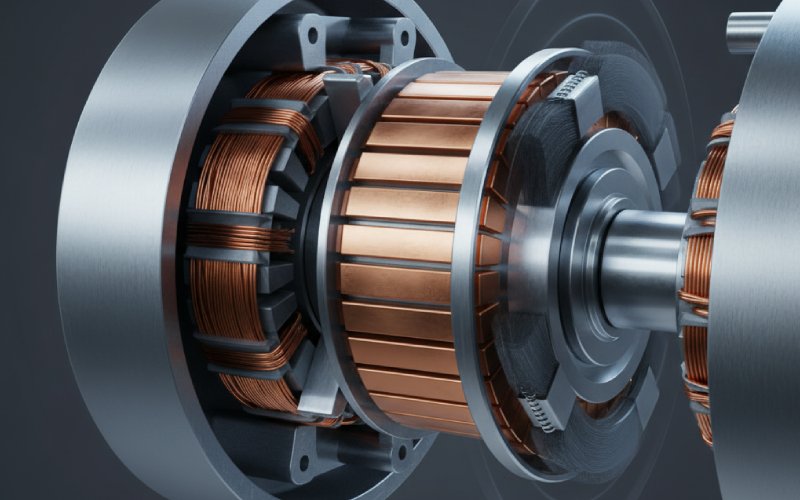
4. Quick comparison: forward-optimised vs bidirectional commutator motors
This isn’t about marketing labels, it’s about design clues you can actually verify.
| Feature / clue | Forward-optimised motor | Bidirectional-rated motor | What a buyer or engineer should check |
|---|---|---|---|
| Brush lead angle | Several degrees advanced in one direction | Zero or very small; or adjustable brush rig | Ask for brush rig drawing or photo with direction indicated |
| Brush shape & chamfer | Clearly asymmetric, obvious “leading” edge | Symmetric block or dual chamfer | Request brush drawing; check wear pattern on samples |
| Brush grade | One grade picked for single direction duty | Grade tested for reversing (catalog may say “reversing duty”) | Ask supplier for recommended grades for reversing applications |
| Commutator bar edge treatment | Chamfer on one side matches preferred direction | Uniform chamfer or very small edge break | Inspect a worn rotor: grooves or steps on one side suggest bias |
| Cooling fan | Directional impeller integrated with rotor | Either reversible fan or independent blower | Check air flow direction vs both motor directions |
| Marking on housing | Arrow for “normal rotation” only | Arrow plus note “bidirectional”; or no arrow but clear rating in datasheet | Never assume; look for a line in the spec, not just silence |
| Datasheet life data | Life stated for single direction | Life stated for reversing or “CW/CCW” duty | If life data is missing for reverse, treat it as unknown |
Very few catalogs spell all of this out, so asking specific questions during RFQ is usually the only way to know.
Documents from brush specialists such as Helwig Carbon Products describe how brush face design, contact pressure and film management change with direction, and how that ends up as commutator bar wear or grooving.
5. Field checklist: can my existing DC motor run backwards all day?
You already have a motor on the machine. Drawings are missing. Sales engineer is not answering. You still have to decide.
Practical steps, lowest effort first.
5.1 Read everything printed on the frame
- Any arrow with “normal rotation”? Take that seriously.
- Markings like “CW facing DE” or “CCW only” are hard limits, usually set by brush rig and cooling.
If there’s no direction information at all, that’s not proof of bidirectional rating, just an invitation to ask more questions.
5.2 Visual inspection of the commutator and brushes
Open one motor that has seen real service in its “normal” direction.
Look for:
- Uneven bar wear – ridges, dark bands, copper dragged in one direction.
- Brush pattern – shiny region offset toward one edge, indicating strong lead angle.
- Film colour – smooth chocolate-brown is healthy; patchy, streaked or heavily banded film usually means marginal commutation already.
If the wear pattern is clearly directional and you now ask for 50/50 reverse duty at the same load, expect shorter life unless you change something (brush grade, spring pressure, cooling).
5.3 Electrical check during reverse operation
On a test bench:
- Run at rated voltage forward and backward with no load, then with representative load.
- Observe brush sparking in a darkened room.
- Monitor current and temperature over, say, 30–60 minutes each direction.
If reverse rotation shows noticeably heavier sparking, higher noise and a clear rise in current at equal torque, the commutator is unhappy. Guidance from maintenance forums and manufacturer notes is blunt on this: prolonged heavy sparking usually means accelerated bar and brush damage.
6. Specifying a DC motor commutator for bidirectional duty
For new designs, you have leverage. Use it in the RFQ.
Key items to write explicitly:
- Direction and duty ratio
- Example: “Motor shaft to operate CW and CCW at 50/50 duty within each hour, with up to 10 direction reversals per minute.”
- Current and speed profile around reversals
- Max current during braking and re-accel.
- Expected stall or near-stall time.
- Required commutator and brush life
- Hours at rated load, for the defined reversing duty.
- Max number of reversal cycles over life.
- Acceptable maintenance actions
- Are you allowed to skim the commutator in situ?
- Is brush replacement planned at mid-life?
- Environmental conditions
- Altitude, ambient temp, dust or conductive particles. All of these affect brush film and commutator cooling.
And questions to ask each shortlisted vendor:
- What brush grade and lead angle do you use for this frame in reversing duty?
- Is there a different “reversing duty” variant of the same motor?
- What commutator diameter & run-out limits do you specify at end of life?
- Can you share any lab data for continuous reversing tests?
International standards and motor textbooks describe commutator design variables in detail, but they rarely connect them directly to bidirectional life. The only way to be sure is to pin the supplier down with these specifics and, if the application is critical, witness a test. (IJERT)
7. Failure modes when a commutator is abused in reverse
If you inherit a problem line, the commutator tells a story. It’s not always tidy, but patterns repeat.
| Symptom at the commutator or brush | What it often means under reverse duty | Typical next step |
|---|---|---|
| Heavy sparking across several bars | Brush lead angle too large for reverse; current commutates too late | Try neutral brush position, different brush grade, or lower current |
| Bar edges chipped on one side | Brush pushed into bar edge in reverse; mechanical chattering | Check brush geometry, spring force, commutator run-out |
| Deep grooving in direction of travel | Film unstable, debris trapped, brush vibrating | Improve filtration, adjust brush pressure, review brush grade |
| Green/black smearing, metal transfer | Overheating, copper melting, brush material degraded | Inspect for overload; may require turning the commutator |
| Radio noise / EMI spikes only in reverse | Poor commutation timing at that shaft polarity | Scope armature voltage, adjust drive and brush position |
Field reports and maintenance notes repeatedly link such patterns to poor commutation, overheating, or overload, often after operating conditions changed without revisiting the motor selection.
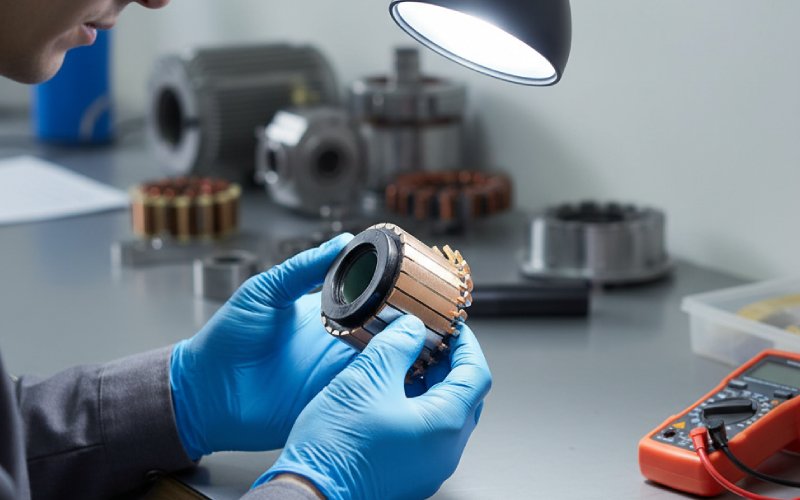
8. So… can your DC motor commutator handle reverse rotation?
Summing it up in plain terms:
- The copper commutator itself usually doesn’t care about direction. Geometry, brush rig and cooling do.
- Occasional reversing at modest current is rarely an issue for modern small PMDC motors. Especially when the datasheet states “bidirectional” or “CW/CCW”.
- Continuous or frequent reversing at high torque is a design topic, not an afterthought. It touches brush grade, lead angle, commutator bar profile and ventilation.
- If no one can show you life data for reverse duty, treat the motor as unproven in that mode. Assume higher maintenance or plan a qualification test.
For a B2B buyer, that usually leads to two options:
- Specify a brushed DC motor explicitly tested for reversing duty, with commutator and brushes chosen for symmetrical operation.
- Move to brushless or electronically commutated designs where direction is handled in power electronics and there is no mechanical commutator to wear.
Either way, asking about the commutator early in the sourcing process is cheaper than rewriting maintenance procedures later.
FAQ: DC motor commutators and reverse rotation
1. Is a DC motor commutator itself directional?
No. The commutator cylinder and bars are geometrically symmetric. Directionality comes from brush position, brush design, and cooling, not the copper rings. Standard references describe commutators as rotary switches that reverse current each half turn, independent of direction.
2. Can I just reverse the supply polarity and ignore everything else?
Electrically, yes. That’s how every H-bridge works. Mechanically, maybe. If the motor was only ever tested in one direction at rated load, reversing might mean higher arcing and faster wear. Articles on reversing brushed motors specifically warn that reverse operation can reduce life even though the motor runs.
3. Does motor type (series, shunt, permanent magnet) change the commutator risk?
The commutator physics are similar. What changes is typical current and duty:
Series motors often see high starting current; reversing under load can be harsh.
Permanent magnet motors usually have better defined current limits, so commutator stress is easier to control.
In all cases, brush rig geometry and cooling remain the key mechanical issues.
4. How many reversals per minute is “safe” for a commutator?
There is no universal number. Some actuator motors are designed for several reversals per second, others for a handful per hour. What matters is:
Armature current and inertia during each reversal
Cooling and duty cycle over time
How well the commutator and brush system have been matched to that pattern
If the specification or test data doesn’t mention reversing, assume you need separate validation.
5. Can I fix reverse-duty issues just by changing brush grade?
Sometimes, yes. A softer or more resin-rich carbon grade can improve film stability in both directions, at the cost of faster brush wear. But if lead angle or cooling are wrong, brush grade alone will not save the commutator. Brush manufacturers repeatedly stress that grade, geometry and operating conditions have to be considered together.
6. When should I avoid brushed commutators altogether for reversing duty?
Typical triggers:
Very high reversal frequency with high inertia
Strict uptime requirements and limited access for maintenance
Environments where brush dust and commutator debris are a contamination risk
In those cases, a brushless DC or electronically commutated solution usually gives more predictable life, even if the upfront cost is higher.