Commutator Sparking and Wear: Why Brushes Must Align With the Motor Neutral Plane
The motor neutral plane is the running position where the coil under the brush can reverse current with the least commutation stress. When brushes run away from that position, the result usually shows up first on the commutator. Sparking. Edge burning. Unstable film. Faster brush wear. Then the repair work starts getting expensive.
We see this often in returned units. The brush problem is discussed first. The commutator damage is discussed later. In service, it is usually the same event.
Table of Contents
Why neutral plane alignment matters to the commutator
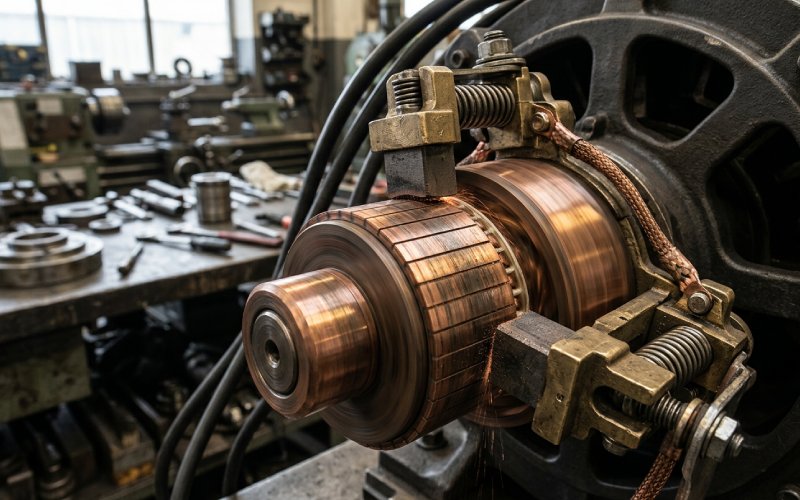
A brush does not just sit on copper. It bridges segments while the short-circuited coil is trying to finish current reversal. If the brush is not aligned with the running neutral plane, that reversal finishes too early or too late. The electrical error is brief. The surface damage is not.
What follows is familiar:
- commutator sparking increases
- the trailing edge starts carrying more stress
- bar edges discolor or burn
- film formation becomes uneven
- brush wear stops looking normal
- the commutator face loses stability, slowly at first
That is why brush alignment is not a small adjustment. It decides whether commutation stays inside control or moves out onto the segment edges.
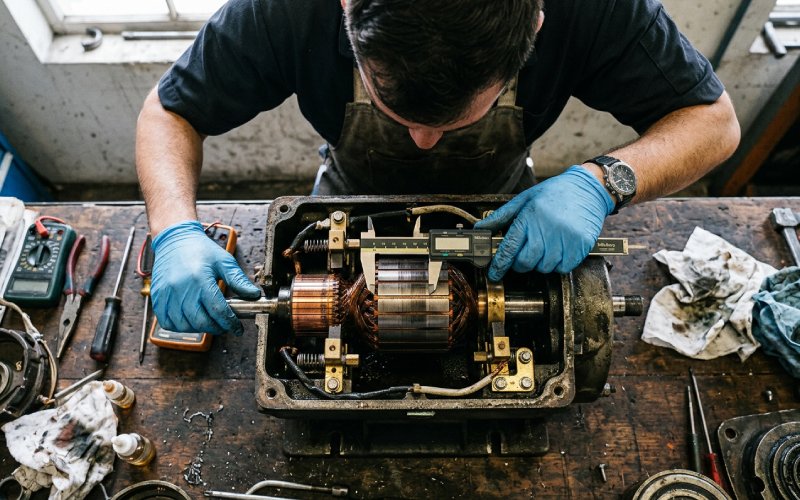
Symptoms of off-neutral brush alignment on commutators
In factory failure reviews, off-neutral running usually leaves a pattern rather than one isolated mark.
1. Bar edge burning
This is one of the clearest signs. The commutation event is no longer centered where it should be, so the segment edge starts seeing concentrated electrical stress. Once that repeats across load cycles, the edge condition worsens. Surface life drops.
2. Trailing-edge brush distress
When the current reversal is finishing late, the trailing edge often carries the penalty. The brush face starts telling the story before the machine operator does.
3. Uneven or weak commutator film
A stable film needs stable commutation. Off-neutral running disrupts that balance. Then the surface alternates between over-marking and under-protection. Neither state is useful.
4. Repeating spark marks around the commutator
Not random marks. Not dirt. A repeating pattern usually means the machine is running with a commutation error that keeps returning to the same area of contact.
5. Brush wear that gets blamed on material too early
This happens a lot. The brush grade is questioned first. Sometimes fairly. But when the neutral position is wrong, even a suitable brush grade starts looking bad.
How motor load shifts the neutral plane
This is where many field adjustments go wrong.
The neutral plane is not fixed in the way a mechanical mark is fixed. Under load, armature reaction changes the magnetic conditions inside the machine. So the running neutral plane can shift. At light load, the machine may look acceptable. Under working load, not really.
That matters because many commutator failures are not born during bench checks. They are born in actual duty:
- higher current
- longer operating cycles
- repeated starts
- changing torque demand
- imperfect compensation in the motor design
So a brush position that appears quiet at no-load can still damage the commutator in service. Slowly. Then suddenly not slowly.
Brush position vs. brush grade: what fails first
Brush grade matters. Pressure matters. Holder condition matters. Surface speed matters. So does contamination.
Still, in practical commutator work, brush position is one of the first things we want ruled out.
Why? Because wrong brush material may shorten life. Wrong neutral alignment can damage the commutation event itself. That is a different level of fault. The machine may continue to run, but the copper surface starts paying for it immediately.
We usually read the order of suspicion like this:
- Check brush position and neutral setting
- Check visible commutator pattern
- Check holder condition and pressure
- Then judge the brush grade
- Then judge whether the commutator has crossed into replacement territory
Not every unit follows this order. Enough do.
What off-neutral running means for commutator design
A good commutator cannot cancel a bad brush setting. It can, however, survive longer before the damage becomes permanent.
From the manufacturing side, several details matter once the machine is already operating near the edge:
- segment geometry consistency
- concentricity
- copper quality and hardness control
- mica depth and finish
- insulation stability under heat
- machining accuracy after assembly
These do not remove the need for correct brush alignment. They decide how much abuse the commutator can absorb before wear becomes edge burning, and edge burning becomes replacement.
That is one reason replacement commutators should not be treated as generic copper parts. If a motor has already shown repeated sparking or unstable brush wear, the replacement unit must match the application, not just the drawing dimensions.
Field signs we use when checking brush alignment issues
| Observed condition | What it usually suggests | What we check first |
|---|---|---|
| Bar edge burning | Commutation is displaced from the proper running zone | Brush position relative to the running neutral plane |
| Heavy sparking at the brush track | Current reversal is not finishing cleanly | Neutral setting under actual load |
| Trailing-edge brush damage | Late commutation or excessive stress at brush exit | Brush lead and holder position |
| Uneven commutator film | Unstable current transfer, often mixed with load or contamination effects | Surface pattern, load condition, alignment stability |
| Fast brush wear with no clear material defect | Electrical setting problem before material problem | Neutral plane alignment, pressure, holder fit |
| Repeating marks around specific bars | Recurring commutation stress at segment transitions | Segment condition, runout, and brush position together |
This table is how we keep the conversation grounded. Not every spark problem means immediate commutator replacement. But once segment edges are burned, the repair window gets narrow.
When brush misalignment becomes a replacement problem
There is a point where adjustment is no longer enough.
If the commutator already shows one or more of the conditions below, the issue is no longer just brush setting:
- segment edge burning that keeps returning after correction
- unstable surface film after re-seating brushes
- copper drag or roughened track
- measurable out-of-round development from repeated thermal stress
- insulation damage between segments
- repeated re-machining with declining service life
At that stage, the machine may still need alignment correction, but the commutator itself has already lost margin. A new unit with the same dimensions but weak segment control will not solve much. The replacement needs to be built for the actual load, speed, brush system, and duty cycle.
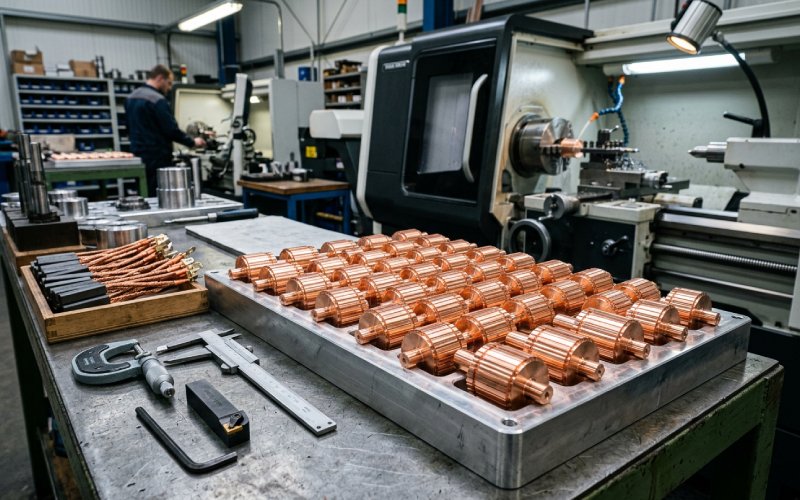
Our factory view on this problem
When customers send us worn samples, the first question is often, “Can you make the same commutator?”
Sometimes yes. Sometimes that is the wrong question.
The better question is: why did the previous commutator fail in this pattern?
If the root issue includes off-neutral brush running, then a proper replacement discussion usually involves more than dimensions:
- actual operating current
- duty cycle
- direction of rotation
- brush grade in use
- visible spark behavior
- observed wear pattern on bars and brushes
- whether the unit failed at startup, full load, or after long service hours
That is how we reduce repeat failure. Not by shipping copper that merely fits the shaft.
FAQ
What happens if motor brushes are not on the neutral plane?
Commutation becomes unstable. The short-circuited coil does not reverse current in the intended zone, which increases sparking, brush distress, bar edge burning, and commutator wear.
Can wrong brush position damage the commutator?
Yes. Very directly. Incorrect brush alignment increases electrical stress at the segment edges and can turn a brush-setting problem into a commutator surface problem.
Does the neutral plane stay fixed at all loads?
No. In running machines, the effective neutral plane can shift with load because the magnetic conditions change. That is why a setting that looks acceptable at light load may still produce commutator damage in service.
Is commutator sparking always caused by brush alignment?
No. Brush grade, pressure, holder fit, contamination, surface condition, and machine design also matter. But neutral plane misalignment is one of the first items worth checking because it can trigger the whole fault chain.
Should the brush grade be changed before checking neutral position?
Usually not. If the brush position is wrong, a suitable brush grade can still wear badly or spark heavily. Position and commutation conditions should be checked before blaming the material.
Can a higher-quality commutator tolerate some alignment error?
To a degree, yes. Better segment control, better machining, and more stable materials can improve service margin. But they do not remove the need for correct brush alignment. A good commutator lasts longer under stress; it does not rewrite the motor’s commutation physics.
When should a commutator be replaced instead of reconditioned?
Replacement is usually the better route when edge burning is recurring, insulation is damaged, the surface has become unstable after correction work, or repeated machining no longer restores useful service life.
Need a replacement commutator for a brush-related failure?
If your motor already shows bar edge burning, repeated sparking, unstable brush wear, or commutator surface breakdown, send us the drawing, sample, or core dimensions. We can review the wear pattern, check the application conditions, and recommend a replacement commutator built for the actual duty, not just the nominal size.
Contact us for:
- custom commutator manufacturing
- replacement commutators based on worn samples
- drawing-based production
- small-batch and volume orders
- application review for repeated commutation failures